
[Paper Review] Quantum algorithm for imaginary-time Green's functions
This paper presents a hybrid quantum-classical algorithm to compute imaginary-time Green's functions for quantum many-body systems using variational quantum eigensolver (VQE) and quantum subspace expansion (QSE). The method computes the Matsubara Green's function in Lehmann's representation via VQE-estimated ground states and QSE-extracted excited states, demonstrating accurate results on quantum simulators and IBM's noisy hardware for H₂ and H₄, with error mitigation enabling reliable extraction despite noise.
Green's function methods lead to ab initio, systematically improvable simulations of molecules and materials while providing access to multiple experimentally observable properties such as the density of states and the spectral function. The calculation of the exact one-particle Green's function remains a significant challenge for classical computers and was attempted only on very small systems. Here, we present a hybrid quantum-classical algorithm to calculate the imaginary-time one-particle Green's function. The proposed algorithm combines variational quantum eigensolver and quantum subspace expansion to calculate Green's function in Lehmann's representation. We demonstrate the validity of this algorithm by simulating H$_2$ and H$_4$ on quantum simulators and on IBM's quantum devices.
Motivation & Objective
- Address the challenge of computing exact one-particle Green's functions for strongly correlated systems, which remains intractable for classical computers beyond small systems.
- Develop a near-term quantum algorithm to compute imaginary-time Green's functions, enabling access to thermodynamic and spectral properties critical for materials and molecular simulations.
- Overcome limitations of existing variational time-evolution approaches by using a Lehmann representation and subspace expansion to improve accuracy and noise resilience.
- Demonstrate the feasibility and robustness of the algorithm on noisy intermediate-scale quantum (NISQ) devices using error mitigation and statistical resampling techniques.
Proposed method
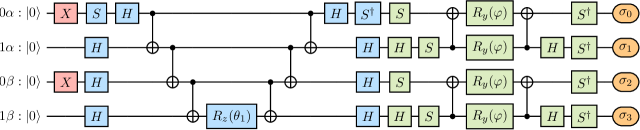
- Use the variational quantum eigensolver (VQE) to approximate the ground state of the system Hamiltonian, obtaining the N-electron ground state wavefunction.
- Apply quantum subspace expansion (QSE) to the VQE ground state to generate a subspace of excited states for N+1 and N−1 electron configurations.
- Compute transition matrix elements between the ground state and the expanded excited states using quantum circuits and measurement protocols.
- Classically reconstruct the Matsubara Green's function in Lehmann's representation using the computed energy levels and transition matrix elements.
- Implement readout error mitigation and jackknife resampling to reduce statistical and hardware noise in quantum hardware results.
- Validate the algorithm on quantum simulators (statevector and QASM) and IBM's real quantum hardware (ibm_hanoi), comparing results to full configuration interaction (FCI) benchmarks.
Experimental results
Research questions
- RQ1Can a hybrid quantum-classical algorithm based on VQE and QSE accurately compute the imaginary-time Green's function for small molecules on near-term quantum devices?
- RQ2How do quantum hardware noise and measurement errors affect the fidelity of the computed Green's function, and can error mitigation techniques restore accuracy?
- RQ3To what extent does the deviation in electron number expectation value correlate with errors in the real part of the Green's function?
- RQ4Can the algorithm be scaled to larger systems, and what are the computational bottlenecks in extending it to more complex molecular or materials systems?
- RQ5How does the choice of subspace size in QSE impact the accuracy of the Green's function when compared to FCI reference data?
Key findings
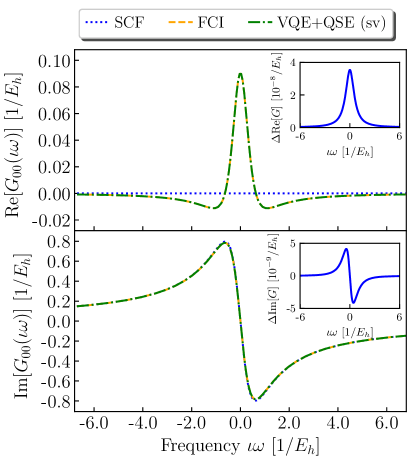
- The algorithm successfully computes the Matsubara Green's function for H₂ and H₄ using VQE and QSE, with results in good agreement with FCI benchmarks in the noise-free limit.
- On the IBM quantum device ibm_hanoi, the real part of the Green's function is more sensitive to noise, and its error correlates directly with deviations in the expected electron number.
- Readout error mitigation and jackknife resampling significantly improve the reliability of hardware results, yielding consistent error bars and accurate spectral features.
- The algorithm demonstrates robustness to noise through statistical post-processing, showing that meaningful physical observables can be extracted from NISQ-era devices.
- The QSE subspace expansion around the VQE ground state enables accurate extraction of excited-state matrix elements necessary for the Lehmann representation.
- The method is extendable to larger systems, with matrix element computations amenable to parallelization across classical processors.
Read this paper
Open the full text in the Nubint reader and ask about any passage as you read.
Read this paper on NubintThis review was generated by AI from the original paper. Please check the paper before citing it.