
[Paper Review] Quantum Circuit Synthesis and Compilation Optimization: Overview and Prospects
A comprehensive survey of quantum circuit synthesis, optimization, and compiling, highlighting representations, methods, and AI-driven integrated design approaches for NISQ and fault-tolerant regimes.
Quantum computing is a promising paradigm that may overcome the current computational power bottlenecks. The increasing maturity of quantum processors provides more possibilities for the development and implementation of quantum algorithms. As the crucial stages for quantum algorithm implementation, the logic circuit design and quantum compiling have also received significant attention, which covers key technologies, e.g., quantum logic circuit synthesis (also widely known as quantum architecture search) and optimization, as well as qubit mapping and routing. Recent studies suggest that the scale and precision of related algorithms are steadily increasing, especially with the integration of artificial intelligence methods. In this survey, we systematically review and summarize a vast body of literature, exploring the feasibility of an integrated design and optimization scheme that spans from the algorithmic level to quantum hardware, combining the steps of logic circuit design and compilation optimization. Leveraging the exceptional cognitive and learning capabilities of AI algorithms, it becomes more possible to reduce manual design costs, enhance the precision and efficiency of execution, and facilitate the implementation and validation of the superiority of quantum algorithms on hardware.
Motivation & Objective
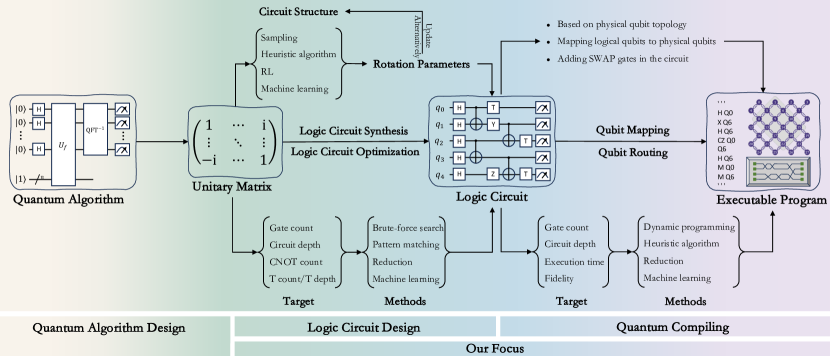
- Review the end-to-end workflow from quantum algorithm design to executable programs on quantum hardware.
- Systematically categorize circuit representations, synthesis, optimization, and qubit mapping techniques.
- Analyze real-world constraints in NISQ and fault-tolerant eras and propose integrated AI-assisted design and compilation strategies.
- Highlight challenges, opportunities, and prospects for automatic quantum circuit design and compilation on hardware clouds.
Proposed method
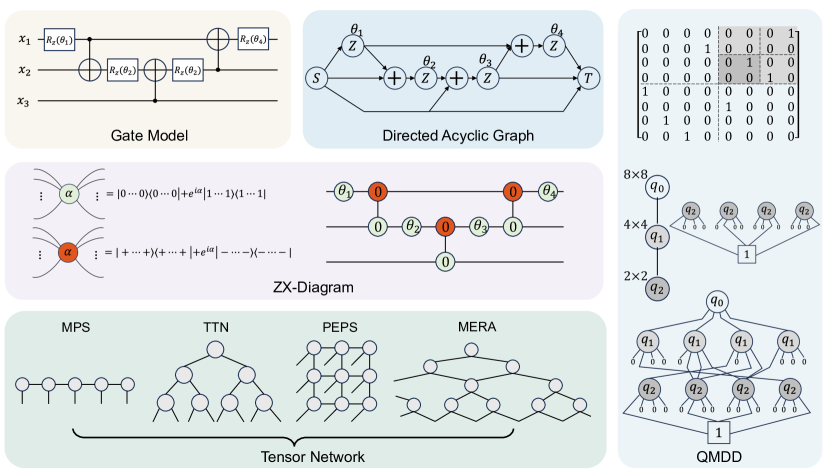
- Survey and taxonomy of quantum circuit representations (gate model, DAG, phase polynomials, ZX diagrams, tensor networks).
- Classification of synthesis approaches into unitary-targeted and non-unitary-targeted problems (e.g., oracle construction, VQE, QNN, error correction).
- Discussion of optimization objectives and methods including pattern matching, peephole optimization, database-based subcircuits, reinforcement learning, and ML-based search.
- Analysis of qubit mapping and routing under hardware connectivity constraints and SWAP gate costs.
- Proposal of an integrated quantum circuit design and compiling paradigm leveraging AI for automated hardware-aware optimization.
Experimental results
Research questions
- RQ1What are the dominant representations and their roles in quantum circuit synthesis and optimization?
- RQ2How can AI/ML techniques be integrated to automate quantum circuit design and compilation across hardware platforms?
- RQ3What constitutes an integrated pipeline that bridges circuit design, optimization, and qubit mapping to maximize hardware performance under NISQ and fault-tolerant constraints?
Key findings
- Quantum circuit representations (gate model, DAG, phase polynomials, ZX diagrams, tensor networks) enable tailoring synthesis and optimization methods to circuit structure.
- Synthesis problems split into unitary-targeted (e.g., oracle implementations) and non-unitary-targeted (e.g., VQE, QNN, error correction) with distinct objective formulations.
- AI and machine learning approaches (reinforcement learning, neural architecture search analogs) show promise in discovering efficient circuits and subcircuits beyond traditional heuristics.
- Qubit mapping and routing remain critical due to connectivity and SWAP gate costs, motivating integrated optimization that balances accuracy and noise.
- The survey argues for an integrated quantum circuit design and compiling framework that uses AI to automate and optimize across hardware-aware constraints.
Read this paper
Open the full text in the Nubint reader and ask about any passage as you read.
Read this paper on NubintThis review was generated by AI from the original paper. Please check the paper before citing it.