
[Paper Review] Quantum complexity phase transitions in monitored random circuits
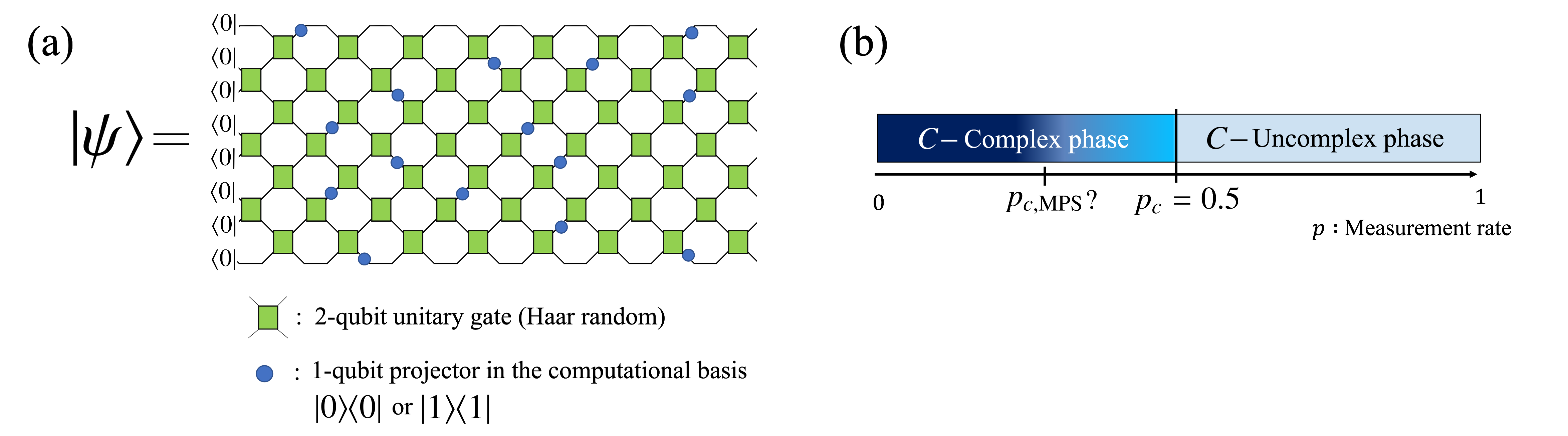
This paper investigates quantum complexity in monitored random circuits, where qubits undergo random unitary evolution and stochastic measurements. It identifies a phase transition at a critical measurement rate $ p_c = 0.5 $: below this, complexity grows exponentially in time ($ e^{ ext{poly}(n)} $), while above it remains polynomial ($ \text{poly}(n) $), established via percolation theory and algebraic geometry techniques.
Recently, the dynamics of quantum systems that involve both unitary evolution and quantum measurements have attracted attention due to the exotic phenomenon of measurement-induced phase transitions. The latter refers to a sudden change in a property of a state of $n$ qubits, such as its entanglement entropy, depending on the rate at which individual qubits are measured. At the same time, quantum complexity emerged as a key quantity for the identification of complex behaviour in quantum many-body dynamics. In this work, we investigate the dynamics of the quantum state complexity in monitored random circuits, where $n$ qubits evolve according to a random unitary circuit and are individually measured with a fixed probability at each time step. We find that the evolution of the exact quantum state complexity undergoes a phase transition when changing the measurement rate. Below a critical measurement rate, the complexity grows at least linearly in time until saturating to a value $e^{Ω(n)}$. Above, the complexity does not exceed $\operatorname{poly}(n)$. In our proof, we make use of percolation theory to find paths along which an exponentially long quantum computation can be run below the critical rate, and to identify events where the state complexity is reset to zero above the critical rate. We lower bound the exact state complexity in the former regime using recently developed techniques from algebraic geometry. Our results combine quantum complexity growth, phase transitions, and computation with measurements to help understand the behavior of monitored random circuits and to make progress towards determining the computational power of measurements in many-body systems.
Motivation & Objective
- To understand how quantum complexity evolves in monitored random circuits with stochastic measurements.
- To identify whether and where a phase transition in quantum complexity occurs as a function of measurement rate.
- To establish rigorous lower bounds on exact quantum state complexity using algebraic geometry and percolation theory.
- To clarify the computational power of measurement-induced dynamics in many-body quantum systems.
Proposed method
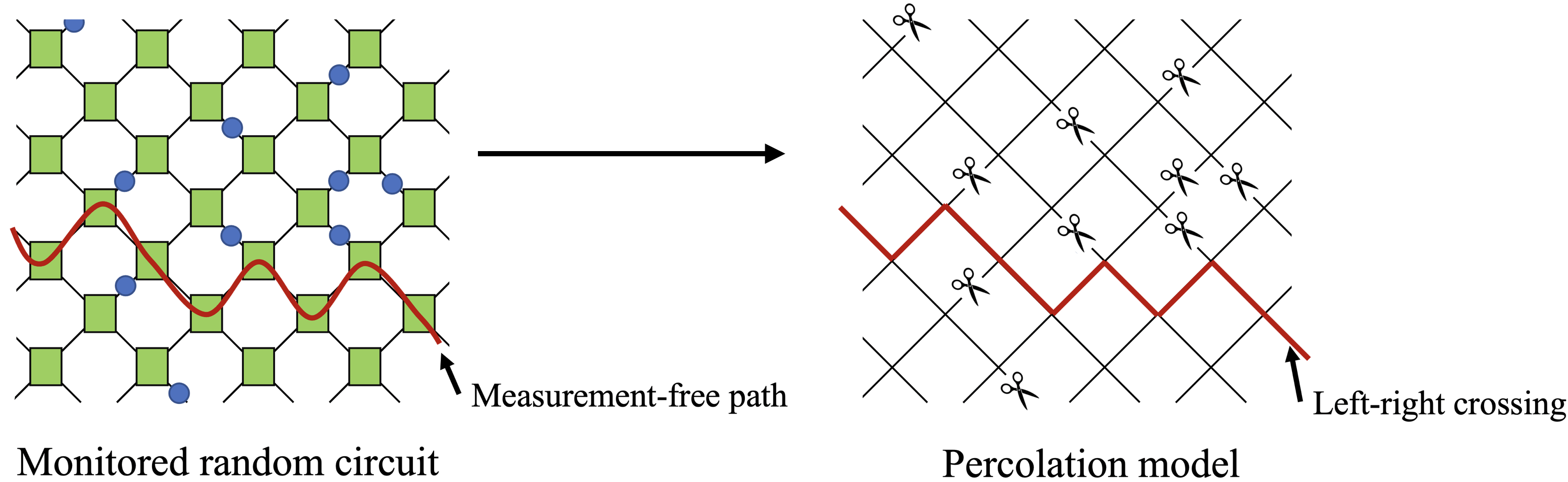
- Mapping the monitored circuit dynamics to a bond percolation problem on a square lattice to analyze measurement-free paths.
- Using percolation theory to prove the existence of linear-length measurement-free paths below the critical measurement rate $ p_c = 0.5 $.
- Applying algebraic geometry tools to lower-bound the accessible dimension of quantum circuits, yielding a lower bound on exact quantum complexity.
- Employing the FKG inequality to relate percolation on tilted and untilted lattices, ensuring equivalence of critical points.
- Deriving exponential lower bounds on complexity using the probability of left-right crossings in random lattices.
- Proving that complexity remains bounded by $ \text{poly}(n) $ above the critical rate by showing all clusters are small with high probability.
Experimental results
Research questions
- RQ1Does quantum complexity in monitored random circuits exhibit a phase transition as a function of measurement rate?
- RQ2What is the scaling behavior of exact quantum complexity below and above the critical measurement rate?
- RQ3Can percolation theory be used to identify long measurement-free paths that support exponential complexity growth?
- RQ4How does algebraic geometry contribute to lower-bounding the exact quantum complexity of random circuits?
- RQ5What is the role of measurement-induced state resets in limiting complexity above the critical rate?
Key findings
- A phase transition in quantum complexity occurs at a critical measurement rate $ p_c = 0.5 $, separating two distinct dynamical regimes.
- Below $ p_c $, the exact quantum complexity grows at least linearly in time and saturates at $ e^{ ext{poly}(n)} $, indicating exponential complexity.
- Above $ p_c $, the complexity remains bounded by $ \text{poly}(n) $, implying efficient classical simulatability.
- The existence of $ \Omega(n) $ measurement-free paths below $ p_c $ enables exponentially long quantum computations.
- Percolation theory ensures that with high probability, there are $ \Omega(n) $ left-right crossings in the circuit lattice below $ p_c $, supporting exponential complexity.
- Above $ p_c $, all open clusters are small with high probability, leading to a reset of complexity and preventing exponential growth.
Read this paper
Open the full text in the Nubint reader and ask about any passage as you read.
Read this paper on NubintThis review was generated by AI from the original paper. Please check the paper before citing it.