
[Paper Review] Quantum Computing for Climate Resilience and Sustainability Challenges
This paper proposes leveraging quantum computing (QC), particularly quantum machine learning (QML) and optimization algorithms like quantum annealing and VQE, to address climate resilience and sustainability challenges. It demonstrates QC's potential to enhance climate modeling, optimize waste-to-energy systems, improve flood prediction, and accelerate carbon capture material discovery—showcasing near-term feasibility through hybrid quantum-classical algorithms on current hardware.
The escalating impacts of climate change and the increasing demand for sustainable development and natural resource management necessitate innovative technological solutions. Quantum computing (QC) has emerged as a promising tool with the potential to revolutionize these critical areas. This review explores the application of quantum machine learning and optimization techniques for climate change prediction and enhancing sustainable development. Traditional computational methods often fall short in handling the scale and complexity of climate models and natural resource management. Quantum advancements, however, offer significant improvements in computational efficiency and problem-solving capabilities. By synthesizing the latest research and developments, this paper highlights how QC and quantum machine learning can optimize multi-infrastructure systems towards climate neutrality. The paper also evaluates the performance of current quantum algorithms and hardware in practical applications and presents realistic cases, i.e., waste-to-energy in anaerobic digestion, disaster prevention in flooding prediction, and new material development for carbon capture. The integration of these quantum technologies promises to drive significant advancements in achieving climate resilience and sustainable development.
Motivation & Objective
- Address the limitations of classical climate models in handling complex, high-dimensional environmental systems with insufficient resolution and biased physical representations.
- Overcome computational bottlenecks in traditional machine learning and optimization for large-scale climate and natural resource management problems.
- Evaluate the practical applicability of near-term quantum algorithms—such as VQE and QAOA—for real-world climate resilience challenges.
- Identify and demonstrate use cases in sustainable water treatment, flood prediction, and carbon capture material design using quantum-enhanced methods.
- Bridge the gap between theoretical quantum advantages and tangible climate applications by assessing current hardware and algorithmic performance.
Proposed method
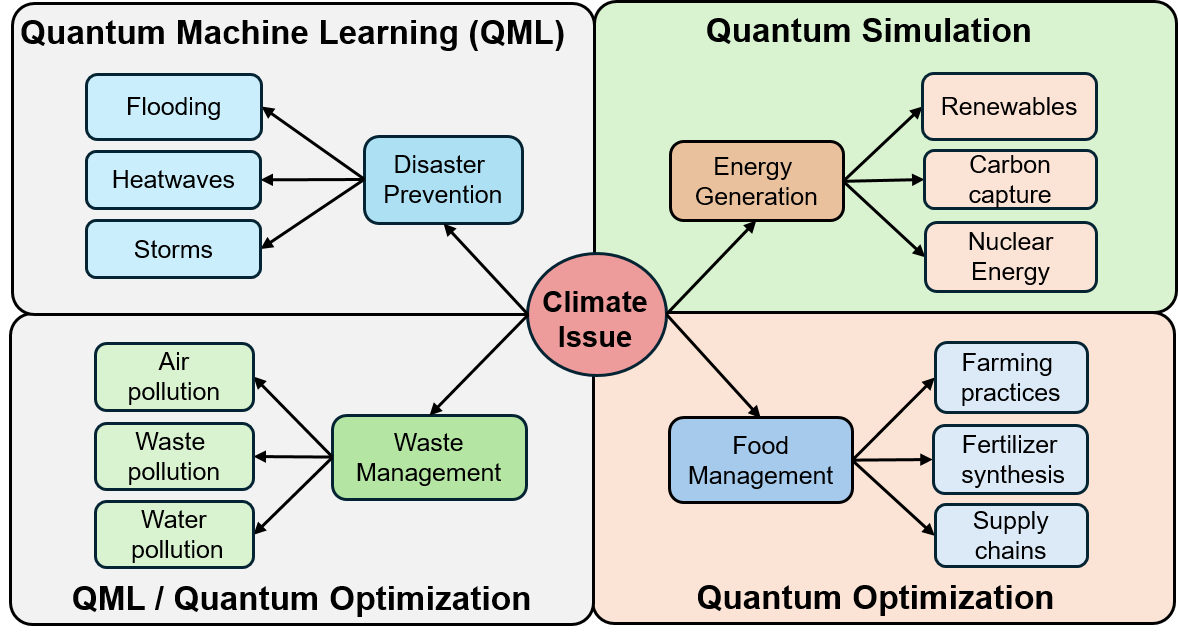
- Employ quantum annealing and gate-based quantum algorithms (e.g., QAOA) for solving large-scale optimization problems in infrastructure and resource management.
- Apply variational quantum eigensolver (VQE) to simulate electron correlation and binding energies in CO2-aluminum complexes for carbon capture materials.
- Use quantum machine learning (QML) models to analyze high-dimensional climate data for early warning systems in flooding, heatwaves, and storms.
- Integrate classical and quantum computing via hybrid algorithms to reduce computational cost and improve accuracy in climate and materials simulations.
- Construct quantum circuits with 4, 8, and 12 qubits to model varying active spaces in electron orbitals during CO2 adsorption, enabling scalable material screening.
- Benchmark quantum results against high-level classical simulations to validate accuracy and assess convergence under noise.
Experimental results
Research questions
- RQ1Can quantum optimization techniques like quantum annealing and QAOA outperform classical methods in optimizing multi-infrastructure systems for climate neutrality?
- RQ2To what extent can quantum machine learning models improve the prediction of extreme weather events such as floods and heatwaves compared to classical ML?
- RQ3How accurately can the variational quantum eigensolver (VQE) reproduce binding energies and electronic structures of CO2 in aluminum-based materials for carbon capture?
- RQ4What are the performance limitations of current quantum hardware and algorithms when applied to real-world climate and sustainability problems?
- RQ5Can hybrid quantum-classical algorithms like VQE enable scalable and accurate simulations of complex chemical processes relevant to climate mitigation?
Key findings
- VQE simulations achieved bond dissociation energy predictions within 1 milliHartree of high-level classical calculations, demonstrating strong agreement and feasibility for near-term quantum simulations.
- Quantum annealing successfully optimized biomethane production in anaerobic digestion, showing measurable advantages over classical optimization in real-world biogas production systems.
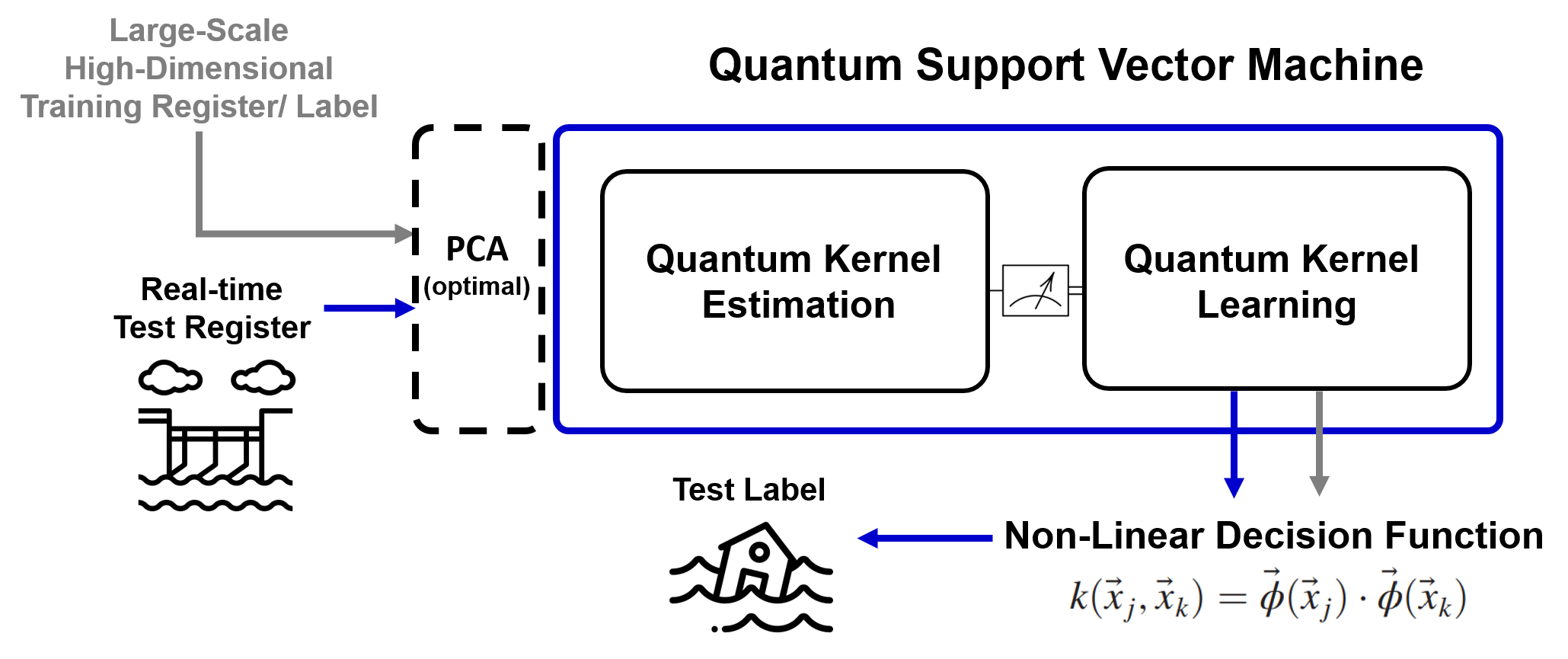
- Quantum machine learning models showed potential to handle high-dimensional, complex climate data for disaster prediction, overcoming limitations of classical ML in capturing pre-catastrophic system behaviors.
- The performance of VQE was highly dependent on prior knowledge of the system, particularly the choice of ansatz, indicating that algorithm success requires domain-specific initialization.
- Quantum simulation of CO2 adsorption on aluminum complexes revealed non-trivial interactions at non-active sites, highlighting the method’s ability to explore complex physical scenarios beyond classical reach.
- Current quantum hardware remains limited in qubit count and coherence, but hybrid algorithms like VQE and QAOA offer promising near-term pathways for climate-relevant applications.
Better researchstarts right now
From reading papers to final review, dramatically reduce your research time.
No credit card · Free plan available
This review was created by AI and reviewed by human editors.