
[Paper Review] Quantum computing with Qiskit
The paper presents Qiskit, IBM's open-source quantum software toolkit, detailing its design philosophy, architecture, and end-to-end workflow from problem encoding to quantum-classical execution, including dynamic circuits and hardware retargetability, with an example in condensed matter physics.
We describe Qiskit, a software development kit for quantum information science. We discuss the key design decisions that have shaped its development, and examine the software architecture and its core components. We demonstrate an end-to-end workflow for solving a problem in condensed matter physics on a quantum computer that serves to highlight some of Qiskit's capabilities, for example the representation and optimization of circuits at various abstraction levels, its scalability and retargetability to new gates, and the use of quantum-classical computations via dynamic circuits. Lastly, we discuss some of the ecosystem of tools and plugins that extend Qiskit for various tasks, and the future ahead.
Motivation & Objective
- Explain the design philosophy and scope of Qiskit within the quantum software stack.
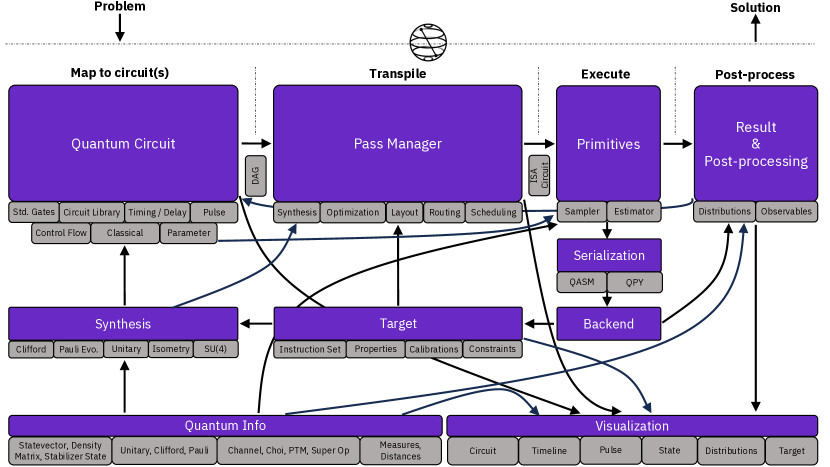
- Describe the core architecture including circuits, transpilation, targets, and primitives.
- Demonstrate an end-to-end workflow solving a condensed matter problem on a quantum computer.
- Highlight the Qiskit ecosystem and concepts like dynamic circuits and hardware retargetability.
Proposed method
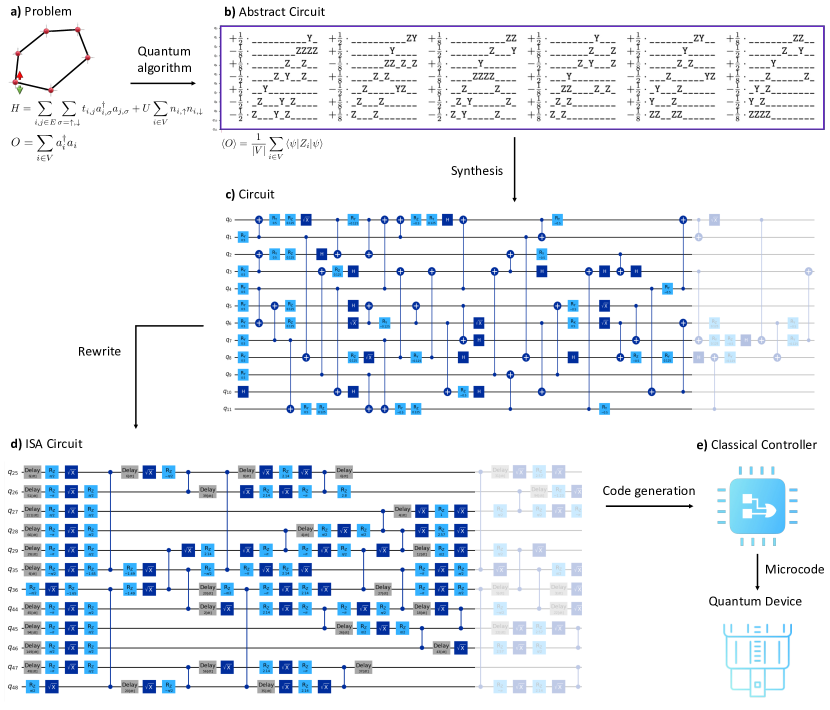
- Describe the four-step workflow: problem encoding, transpilation, execution via primitives, and post-processing.
- Explain modularity and extensibility through plug-in interfaces and external extensions.
- Detail the Pass Manager and transpiler architecture as circuit optimization and translation infrastructure.
- Introduce primitives (sampler and estimator) and the runtime integration for quantum-classical workloads.
- Showcase an end-to-end Ising-model Hamiltonian simulation to illustrate circuit representations at multiple abstraction levels and retargetability to hardware.
- Discuss visualization tools and tensor ordering conventions used within Qiskit.
Experimental results
Research questions
- RQ1How does Qiskit encode classical problems into quantum circuits across abstraction levels?
- RQ2How does the transpiler’s pass manager optimize and retarget circuits for different hardware instruction sets?
- RQ3What roles do quantum-classical integration and dynamic circuits play in practical quantum computations?
- RQ4How does Qiskit support end-to-end workflows from circuit creation to measurement and post-processing on real hardware?
- RQ5What evidence does the paper provide for the practicality and ecosystem around Qiskit (e.g., performance, retargetability, dynamic circuits)?
Key findings
- Qiskit enables end-to-end workflows from problem mapping to hardware execution, including dynamic circuits and hardware-aware retargeting.
- The four-step workflow (problem→transpile→execute→post-process) is a core pattern supported by a flexible API.
- Retargetable transpilation allows introducing new hardware gates (e.g., partial ZX) and shortening circuit duration.
- Dynamic circuits and tailored scheduling (e.g., dynamical decoupling) can reduce circuit depth and improve reliability.
- The paper demonstrates Ising-model Hamiltonian simulation on IBM hardware, illustrating multi-level circuit representations and optimization techniques.
- Qiskit supports an ecosystem of tools and plugins extending its capabilities beyond the core toolkit.
Better researchstarts right now
From reading papers to final review, dramatically reduce your research time.
No credit card · Free plan available
This review was created by AI and reviewed by human editors.