
[Paper Review] Quantum quenches in driven-dissipative quadratic fermionic systems with parity-time symmetry
This paper investigates quantum quench dynamics in driven-dissipative quadratic fermionic systems with parity-time (PT) symmetry, introducing the PT-symmetric generalized Gibbs ensemble (PTGGE) as the steady-state description. It demonstrates light-cone spreading of correlations, linear growth and volume-law saturation of subsystem entropy, and identifies directional pumping phases governed by non-Hermitian topology, revealing a new type of dynamical criticality in pumping rates via soft modes of the PTGGE.
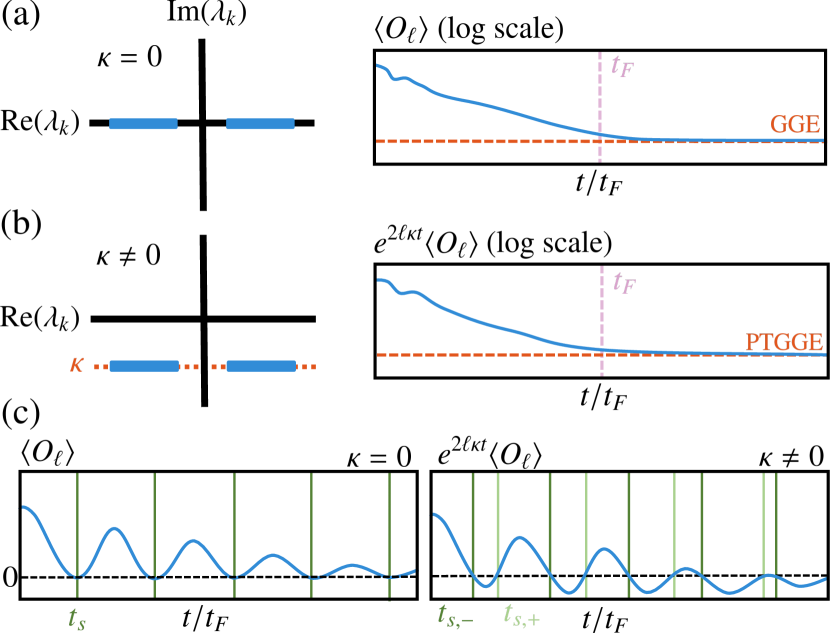
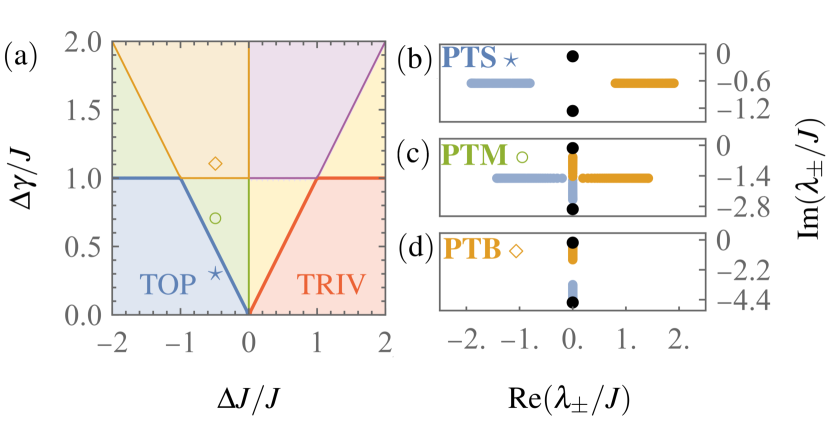
We study the quench dynamics of noninteracting fermionic quantum many-body systems that are subjected to Markovian drive and dissipation and are described by a quadratic Liouvillian which has parity-time (PT) symmetry. In recent work, we have shown that such systems relax locally to a maximum entropy ensemble that we have dubbed the PT-symmetric generalized Gibbs ensemble (PTGGE), in analogy to the generalized Gibbs ensemble that describes the steady state of isolated integrable quantum many-body systems after a quench. Here, using driven-dissipative versions of the Su-Schrieffer-Heeger (SSH) model and the Kitaev chain as paradigmatic model systems, we corroborate and substantially expand upon our previous results. In particular, we confirm the validity of a dissipative quasiparticle picture at finite dissipation by demonstrating light cone spreading of correlations and the linear growth and saturation to the PTGGE prediction of the quasiparticle-pair contribution to the subsystem entropy in the PT-symmetric phase. Further, we introduce the concept of directional pumping phases, which is related to the non-Hermitian topology of the Liouvillian and based upon qualitatively different dynamics of the dual string order parameter and the subsystem fermion parity in the SSH model and the Kitaev chain, respectively: Depending on the postquench parameters, there can be pumping of string order and fermion parity through both ends of a subsystem corresponding to a finite segment of the one-dimensional lattice, through only one end, or there can be no pumping at all. We show that transitions between dynamical pumping phases give rise to a new and independent type of dynamical critical behavior of the rates of directional pumping, which are determined by the soft modes of the PTGGE.
Motivation & Objective
- To understand the non-equilibrium dynamics of open quantum many-body systems with Markovian drive and dissipation.
- To establish the validity of a generalized thermalization framework in the presence of finite system-bath coupling.
- To identify and characterize novel dynamical phases—directional pumping phases—arising from non-Hermitian topology in the Liouvillian spectrum.
- To investigate the emergence of universal features such as light-cone spreading and entropy growth in driven-dissipative systems.
- To demonstrate that the PT-symmetric generalized Gibbs ensemble (PTGGE) governs the steady state even at finite dissipation, extending the scope of generalized thermalization.
Proposed method
- The study employs driven-dissipative versions of the Su-Schrieffer-Heeger (SSH) model and Kitaev chain as paradigmatic models with quadratic Liouvillians exhibiting PT symmetry.
- The dynamics are analyzed via the Liouville-von Neumann equation for the density matrix, with the Liouvillian structured to preserve PT symmetry.
- The steady state is identified as the PT-symmetric generalized Gibbs ensemble (PTGGE), derived from the principle of maximum entropy under PT-symmetric constraints.
- Correlation functions and subsystem entropy are computed using a quasiparticle picture, with time evolution solved in momentum space via Fourier transforms of block matrices.
- The time evolution of observables such as the string order parameter and fermion parity is tracked to identify directional pumping behavior.
- The asymptotic behavior of correlation functions is analyzed using stationary phase approximation in the thermodynamic limit.
Experimental results
Research questions
- RQ1Does the PT-symmetric generalized Gibbs ensemble (PTGGE) accurately describe the steady state of driven-dissipative quadratic fermionic systems with finite dissipation?
- RQ2Do universal features like light-cone spreading of correlations and linear growth of subsystem entropy persist in the presence of finite dissipation?
- RQ3Can directional pumping phases emerge in non-Hermitian systems, and how are they related to the topology of the Liouvillian spectrum?
- RQ4What dynamical critical behavior arises at transitions between distinct pumping phases, and what governs the rates of directional pumping?
- RQ5How do soft modes of the PTGGE influence the dynamics of pumping rates in the system?
Key findings
- The system relaxes locally to the PT-symmetric generalized Gibbs ensemble (PTGGE), even at finite dissipation, confirming the robustness of generalized thermalization in open quantum systems.
- Light-cone spreading of correlations is observed, indicating a quasiparticle picture remains valid in the driven-dissipative regime.
- The subsystem entropy exhibits linear growth and volume-law saturation, consistent with PTGGE predictions, confirming the persistence of universal entanglement dynamics.
- Directional pumping phases emerge, characterized by distinct dynamics of the string order parameter and fermion parity, with pumping occurring through one end, both ends, or not at all depending on post-quench parameters.
- Transitions between pumping phases give rise to a new type of dynamical criticality, where the rates of directional pumping are governed by soft modes of the PTGGE.
- The density autocorrelation function is analytically derived in the thermodynamic limit using stationary phase approximation, revealing asymptotic power-law decay modulated by exponential damping and oscillatory terms.
Better researchstarts right now
From reading papers to final review, dramatically reduce your research time.
No credit card · Free plan available
This review was created by AI and reviewed by human editors.