
[Paper Review] Quantum signal processing with continuous variables
This paper extends quantum signal processing (QSP) from the compact Lie group SU(2) to the non-compact SU(1,1), demonstrating that a QSP-like ansatz can be constructed for continuous-variable systems. Despite the non-compactness of SU(1,1), the authors show that arbitrary polynomial transformations can be approximated, with analytical protocols for Chebyshev polynomials, monomials, and tunable threshold functions, enabling new applications in quantum amplification and interferometry.
Quantum singular value transformation (QSVT) enables the application of polynomial functions to the singular values of near arbitrary linear operators embedded in unitary transforms, and has been used to unify, simplify, and improve most quantum algorithms. QSVT depends on precise results in representation theory, with the desired polynomial functions acting simultaneously within invariant two-dimensional subspaces of a larger Hilbert space. These two-dimensional transformations are largely determined by the related theory of quantum signal processing (QSP). While QSP appears to rely on properties specific to the compact Lie group SU(2), many other Lie groups appear naturally in physical systems relevant to quantum information. This work considers settings in which SU(1,1) describes system dynamics and finds that, surprisingly, despite the non-compactness of SU(1,1), one can recover a QSP-type ansatz, and show its ability to approximate near arbitrary polynomial transformations. We discuss various experimental uses of this construction, as well as prospects for expanded relevance of QSP-like ansätze to other Lie groups.
Motivation & Objective
- To extend the framework of quantum signal processing (QSP) from SU(2) to the non-compact Lie group SU(1,1), relevant to continuous-variable quantum systems.
- To investigate whether the core principles of QSP—such as polynomial function approximation via alternating unitary operations—can be preserved in non-compact settings.
- To develop analytical phase prescriptions that enable efficient and precise control of polynomial transformations in SU(1,1) systems.
- To demonstrate practical applications in quantum measurement and amplification, particularly in parametrically driven systems like traveling-wave parametric amplifiers.
- To establish a theoretical foundation for QSP-like algorithms beyond SU(2), opening pathways to new quantum algorithms in continuous-variable quantum computing.
Proposed method
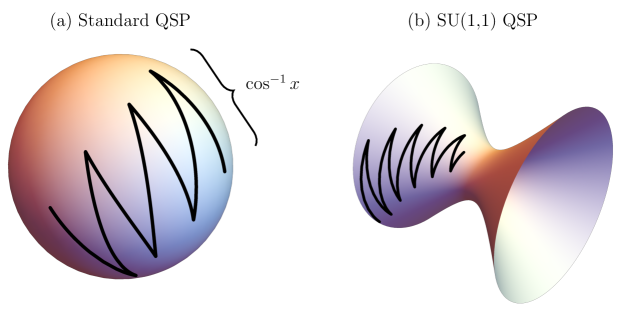
- Derive a modified QSP ansatz for SU(1,1) by replacing trigonometric functions with hyperbolic functions, mapping the interval $[-1,1]$ to $[1, ∞)$.
- Use the isomorphism between SU(1,1) and the real hyperbolic plane to construct unitary operations parameterized by hyperbolic angles $\beta$.
- Establish a correspondence between the polynomial functions achievable in SU(1,1) and those bounded by $|P(x)| \leq 1$ on $[-1,1]$ and $|P(x)| \geq 1$ on $[1,\infty)$, with definite parity.
- Prove that the modified ansatz remains dense in the set of continuous functions satisfying the new boundedness constraints, despite potential slow convergence.
- Construct explicit phase sequences for key functions: Chebyshev polynomials, monomials, and a tunable threshold function with adjustable step location and height.
- Analyze sensitivity to parameter variations, showing that SU(1,1) protocols are more sensitive than SU(2) counterparts, especially in long-length limits.
Experimental results
Research questions
- RQ1Can a QSP-like ansatz be successfully generalized from SU(2) to the non-compact group SU(1,1) in continuous-variable systems?
- RQ2What are the functional constraints on achievable polynomial transformations in the SU(1,1) framework, and how do they differ from the SU(2) case?
- RQ3Can efficient and analytically tractable protocols be constructed for specific functions such as Chebyshev polynomials, monomials, and threshold functions in SU(1,1)?
- RQ4How does the non-compactness of SU(1,1) affect the convergence rate and parameter sensitivity of QSP-like protocols?
- RQ5What are the implications of this extension for quantum measurement and amplification in continuous-variable quantum technologies?
Key findings
- A QSP-type ansatz can be successfully constructed for SU(1,1), despite the group's non-compactness, by replacing trigonometric with hyperbolic functions.
- The set of achievable functions in SU(1,1) QSP is characterized by polynomials bounded by 1 on $[-1,1]$ and bounded below by 1 on $[1,\infty)$, with definite parity.
- The modified ansatz remains dense in the set of continuous functions satisfying the new boundedness constraints, though worst-case protocol length may grow rapidly.
- Explicit phase prescriptions are derived for Chebyshev polynomials, monomials, and a tunable threshold function with precisely controllable step location and height.
- The threshold function, which had no natural analog in standard QSP, emerges as a powerful tool for signal processing in continuous-variable systems.
- SU(1,1) QSP protocols are significantly more sensitive to parameter variations than their SU(2) counterparts, indicating a trade-off between flexibility and robustness.

Read this paper
Open the full text in the Nubint reader and ask about any passage as you read.
Read this paper on NubintThis review was generated by AI from the original paper. Please check the paper before citing it.