
[Paper Review] Quasar Luminosity Function at z = 7
This study presents the first robust measurement of the quasar luminosity function (LF) at z=7 using 35 spectroscopically confirmed quasars, combining the SHELLQs survey (22 faint quasars) with 13 brighter quasars from the literature. It finds a significantly flattened faint-end slope, with a break magnitude of M*₁₄₅₀ = −25.60⁺⁰.⁴⁰₋₀.³⁰ and a bright-end slope of β = −3.34⁺⁰.⁴⁹₋₀.⁵⁷, indicating a high density of low-luminosity quasars at this early cosmic epoch.
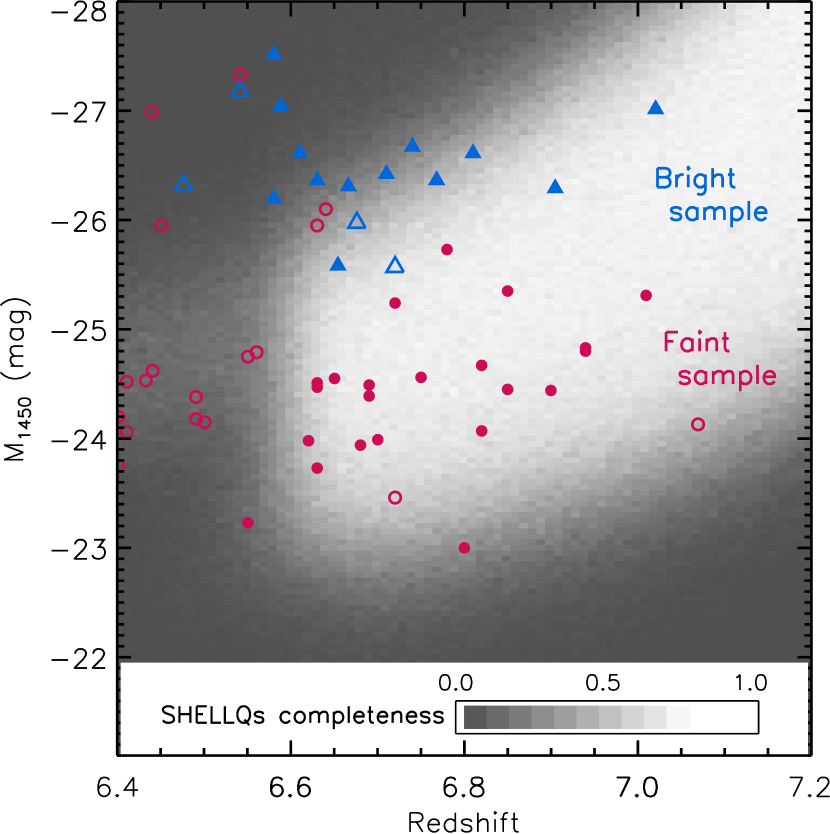
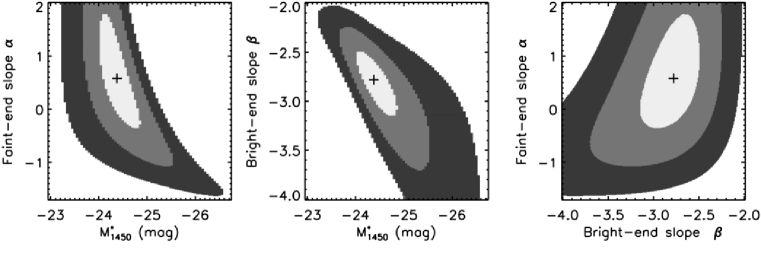
We present the quasar luminosity function (LF) at $z = 7$, measured with 35 spectroscopically confirmed quasars at $6.55 < z < 7.15$. The sample of 22 quasars from the Subaru High-$z$ Exploration of Low-Luminosity Quasars (SHELLQs) project, combined with 13 brighter quasars in the literature, covers an unprecedentedly wide range of rest-frame ultraviolet magnitudes over $-28 < M_{1450} < -23$. We found that the binned LF flattens significantly toward the faint end populated by the SHELLQs quasars. A maximum likelihood fit to a double power-law model has a break magnitude $M^*_{1450} = -25.60^{+0.40}_{-0.30}$, a characteristic density $Φ^* = 1.35^{+0.47}_{-0.30}$ Gpc$^{-3}$ mag$^{-1}$, and a bright-end slope $β= -3.34^{+0.49}_{-0.57}$, when the faint-end slope is fixed to $α= -1.2$ as observed at $z \le 6$. The overall LF shape remains remarkably similar from $z = 4$ to $7$, while the amplitude decreases substantially toward higher redshifts, with a clear indication of an accelerating decline at $z \ge 6$. The estimated ionizing photon density, $10^{48.2 \pm 0.1}$ s$^{-1}$ Mpc$^{-3}$, is less than 1 % of the critical rate to keep the intergalactic medium ionized at $z = 7$, and thus indicates that quasars are not a major contributor to cosmic reionization.
Motivation & Objective
- To measure the quasar luminosity function (LF) at z=7, a critical epoch for understanding supermassive black hole growth during cosmic reionization.
- To determine the shape and normalization of the LF across a wide luminosity range, particularly probing the faint-end population.
- To test whether the LF at z=7 deviates from the standard double power-law model observed at lower redshifts.
- To constrain the space density of low-luminosity quasars at z≈7, informing models of early black hole seeding and growth.
Proposed method
- Spectroscopic confirmation of 22 faint quasars from the Subaru High-z Exploration of Low-Luminosity Quasars (SHELLQs) survey using the FOCAS instrument on the Subaru Telescope.
- Combination of SHELLQs quasars with 13 brighter quasars from the literature to cover a broad rest-frame UV magnitude range (−28 < M₁₄₅₀ < −23).
- Binning of the observed quasars in magnitude bins to construct the observed luminosity function.
- Maximum likelihood fitting of a double power-law model to the binned LF, with the faint-end slope fixed at α = −1.2 based on z ≤ 6 observations.
- Use of the HSC-SSP DR3 data, which covers 278 of 330 allocated nights, to identify and select candidate quasars for spectroscopic follow-up.
- Statistical analysis to estimate the characteristic magnitude M*₁₄₅₀, characteristic density Φ*, and bright-end slope β with confidence intervals.
Experimental results
Research questions
- RQ1What is the shape of the quasar luminosity function at z=7, particularly at the faint end?
- RQ2How does the space density of low-luminosity quasars at z=7 compare to that at lower redshifts?
- RQ3Does the luminosity function at z=7 exhibit a significant flattening at the faint end, indicating a high number of low-luminosity active galactic nuclei?
- RQ4What is the normalization and break magnitude of the double power-law fit to the z=7 quasar LF?
- RQ5How do the results constrain models of early black hole seed formation and growth during the epoch of reionization?
Key findings
- The quasar luminosity function at z=7 shows a significant flattening toward the faint end, primarily due to the inclusion of 22 faint quasars from the SHELLQs survey.
- The best-fit double power-law model yields a break magnitude of M*₁₄₅₀ = −25.60⁺⁰.⁴⁰₋₀.³⁰, indicating a high-luminosity characteristic point.
- The characteristic density is Φ* = 1.35⁺⁰.⁴⁷₋₀.³⁰ Gpc⁻³ mag⁻¹, suggesting a high space density of quasars at this redshift.
- The bright-end slope is measured as β = −3.34⁺⁰.⁴⁹₋₀.⁵⁷, steeper than typical values at lower redshifts, indicating a rapid decline in the number of very bright quasars.
- The overall LF shape remains remarkably similar to those at z ≤ 6 when the faint-end slope is fixed at α = −1.2, suggesting continuity in quasar evolution across this redshift range.
- The results imply that low-luminosity quasars are common at z=7, supporting models with efficient early black hole seeding and growth.
Read this paper
Open the full text in the Nubint reader and ask about any passage as you read.
Read this paper on NubintThis review was generated by AI from the original paper. Please check the paper before citing it.