
[Paper Review] Real-time scheduling of renewable power systems through planning-based reinforcement learning
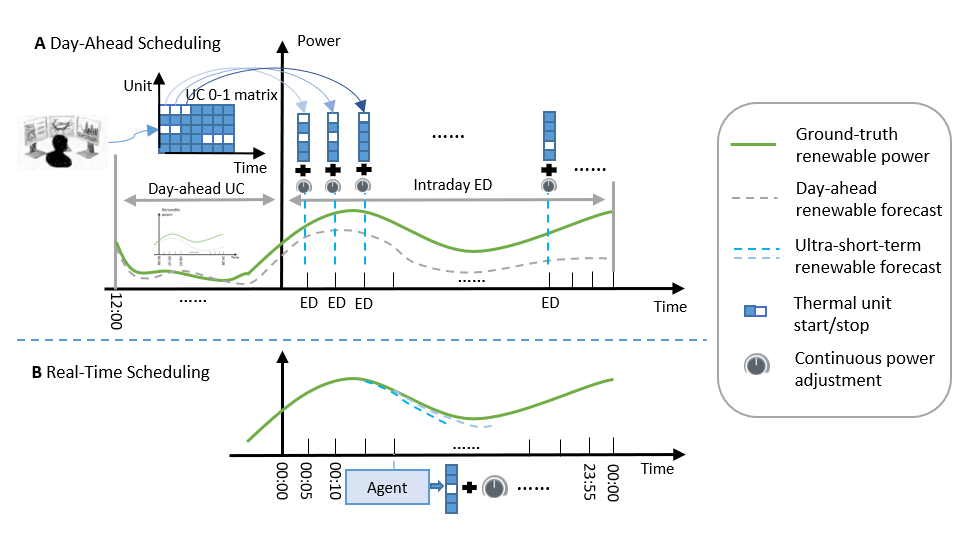
This paper proposes GridZero, a planning-based reinforcement learning framework for real-time scheduling of renewable power systems that jointly optimizes unit commitment and economic dispatch at high temporal resolution. By integrating Monte Carlo Tree Search with a safety layer and hybrid action space modeling, the method reduces renewable curtailment by 48% and load shedding by 62% compared to traditional day-ahead scheduling, significantly enhancing grid flexibility and renewable integration without hardware upgrades.
The growing renewable energy sources have posed significant challenges to traditional power scheduling. It is difficult for operators to obtain accurate day-ahead forecasts of renewable generation, thereby requiring the future scheduling system to make real-time scheduling decisions aligning with ultra-short-term forecasts. Restricted by the computation speed, traditional optimization-based methods can not solve this problem. Recent developments in reinforcement learning (RL) have demonstrated the potential to solve this challenge. However, the existing RL methods are inadequate in terms of constraint complexity, algorithm performance, and environment fidelity. We are the first to propose a systematic solution based on the state-of-the-art reinforcement learning algorithm and the real power grid environment. The proposed approach enables planning and finer time resolution adjustments of power generators, including unit commitment and economic dispatch, thus increasing the grid's ability to admit more renewable energy. The well-trained scheduling agent significantly reduces renewable curtailment and load shedding, which are issues arising from traditional scheduling's reliance on inaccurate day-ahead forecasts. High-frequency control decisions exploit the existing units' flexibility, reducing the power grid's dependence on hardware transformations and saving investment and operating costs, as demonstrated in experimental results. This research exhibits the potential of reinforcement learning in promoting low-carbon and intelligent power systems and represents a solid step toward sustainable electricity generation.
Motivation & Objective
- Address the limitations of traditional day-ahead scheduling in handling inaccurate forecasts of renewable generation.
- Overcome the computational infeasibility of conventional optimization methods for real-time, high-resolution scheduling under dynamic and uncertain conditions.
- Develop a reinforcement learning framework that jointly optimizes unit commitment and economic dispatch while respecting complex grid constraints such as transmission capacity and reactive power limits.
- Enable real-time, high-frequency control decisions that exploit existing generator flexibility to reduce reliance on costly hardware upgrades.
- Demonstrate the feasibility and superiority of end-to-end RL-based scheduling in a realistic power grid environment using a custom simulator (GridSim).
Proposed method
- Proposes GridZero, a hybrid action space framework combining continuous active power adjustments and discrete startup/shutdown actions for power generators.
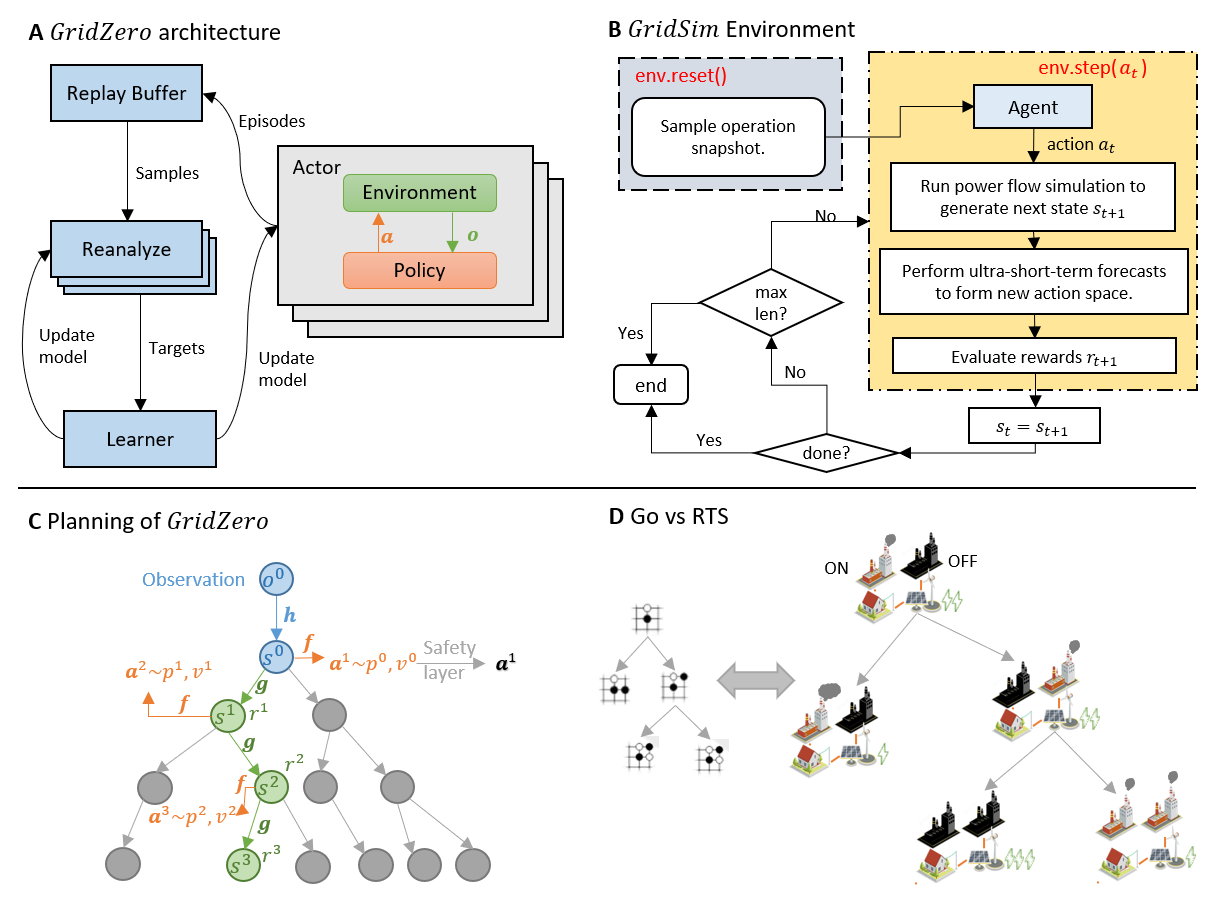
- Integrates Monte Carlo Tree Search (MCTS) with a safety layer that maps policy outputs to feasible, power-balanced action sets using dynamic adjustment rules based on generation limits.
- Employs a multi-noise exploration strategy: standard normal noise, variance-doubled Gaussian noise, and a mixture of sampled actions to balance exploration and stability.
- Designs a hybrid policy loss function combining KL divergence for continuous actions and cross-entropy for discrete actions, with visit count priors aligned to one-hot action targets.
- Uses a custom power system simulator (GridSim) to model a realistic transmission network with 118 buses, 176 lines, and 24 generators, including wind and solar integration.
- Applies a time-varying action space transformation via Eq. (12) to ensure real-time feasibility and enforce active power balance constraints.
Experimental results
Research questions
- RQ1Can a planning-based reinforcement learning framework effectively handle the joint optimization of unit commitment and economic dispatch in real-time power scheduling?
- RQ2How does the integration of MCTS with a safety layer improve constraint satisfaction and feasibility in high-dimensional, mixed-integer action spaces?
- RQ3To what extent can RL-based real-time scheduling reduce renewable curtailment and load shedding compared to traditional day-ahead scheduling?
- RQ4How does the proposed hybrid action space and multi-noise exploration strategy enhance learning stability and performance in complex power system environments?
- RQ5Can the framework be deployed efficiently in real-time without relying on expensive hardware upgrades or long computation times?
Key findings
- GridZero reduces renewable curtailment by 48% compared to traditional day-ahead scheduling, significantly improving renewable energy utilization.
- Load shedding is reduced by 62% under the same conditions, demonstrating enhanced system reliability and security.
- The framework achieves real-time scheduling with sub-second inference speed, enabling high-frequency control decisions that are computationally infeasible for traditional MIP-based methods.
- The safety layer ensures all actions satisfy active power balance and generator limits, maintaining system feasibility without violating operational constraints.
- The hybrid policy loss with visit count alignment enables stable training and effective joint optimization of continuous and discrete actions.
- Experimental results in GridSim show that the trained agent generalizes well across diverse scenarios, including high renewable penetration and fluctuating load conditions.
Read this paper
Open the full text in the Nubint reader and ask about any passage as you read.
Read this paper on NubintThis review was generated by AI from the original paper. Please check the paper before citing it.