
[Paper Review] Regular black holes in Einstein cubic gravity
This paper investigates Einstein cubic gravity (ECG) corrections to regular black hole solutions sourced by nonlinear electrodynamics (NLE), showing that perturbative ECG effects stabilize the solutions by forming a de Sitter-like core and regularizing the Hawking temperature. For small magnetic charge and ECG coupling, the black hole reaches a thermodynamically stable remnant with vanishing temperature at non-zero horizon radius, indicating a phase transition from unstable to stable configuration.
We investigate the effects of the Einstein cubic gravity (ECG) on regular black hole solutions driven by nonlinear electrodynamics (NLE) sources. The ECG tends to form a naked singularity at the origin for a high ECG coupling constant. Assuming that ECG provides only perturbative corrections to the regular magnetic charged solutions, we found modified regular solutions with a de Sitter-like core whose cosmological constant depends on the magnetic charge and the ECG coupling constant. The thermodynamic stability is investigated by means of the Hawking temperature and the heat capacity. In fact, for a small charge and ECG coupling, the Hawking temperature is regularized, leaving a thermodynamic stable remnant for a small $r_h eq 0$. The heat capacity reveals that the ECG regular black hole undergoes a phase transition between an unstable into a stable configuration.
Motivation & Objective
- To examine how Einstein cubic gravity (ECG) modifies regular black hole solutions sourced by nonlinear electrodynamics (NLE).
- To assess whether ECG can resolve spacetime singularities in regular black holes while preserving cosmic censorship.
- To analyze the thermodynamic stability of ECG-NLE black holes using Hawking temperature and heat capacity.
- To determine if ECG-induced corrections lead to stable, non-radiating remnants for small black holes.
Proposed method
- Formulate the ECG-NLE action with a two-parameter NLE Lagrangian that generates Bardeen, Hayward, and new class regular solutions.
- Derive the modified field equations for static, spherically symmetric spacetime in 4D ECG coupled to NLE.
- Perform numerical integration of the field equations to obtain metric solutions and analyze their behavior near the origin and at infinity.
- Compute the Hawking temperature and Wald entropy to evaluate thermodynamic properties.
- Analyze the heat capacity as a function of horizon radius to detect phase transitions.
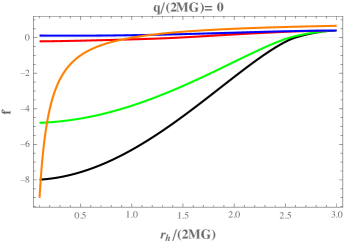
- Use graphical analysis to study the dependence of temperature and heat capacity on ECG coupling constant λ and magnetic charge q.
Experimental results
Research questions
- RQ1Does ECG introduce singularities or regularize the origin in NLE black hole solutions?
- RQ2Can perturbative ECG corrections stabilize small regular black holes and prevent total evaporation?
- RQ3How does the ECG coupling constant λ affect the phase structure of the black hole via heat capacity?
- RQ4Does the Hawking temperature vanish at non-zero horizon radius, indicating a stable remnant?
- RQ5How does the entropy of the ECG-NLE black hole deviate from the Bekenstein-Hawking formula?
Key findings
- For small magnetic charge and ECG coupling, the Hawking temperature vanishes at a non-zero horizon radius, indicating a stable remnant configuration.
- The heat capacity reveals a phase transition from negative (unstable) to positive (stable) values at a critical horizon radius, signaling thermodynamic stability in the final state.
- The ECG-NLE solutions exhibit a de Sitter-like core whose cosmological constant depends on both the magnetic charge and the ECG coupling constant λ.
- For large λ, the solutions develop naked singularities, suggesting an upper bound on λ to preserve cosmic censorship.
- The heat capacity diverges for the new class solution as r_h → ∞, indicating extreme instability in the large-horizon regime.
- The entropy does not follow the Bekenstein-Hawking formula, implying a more complex thermodynamic structure in ECG-NLE gravity.

Read this paper
Open the full text in the Nubint reader and ask about any passage as you read.
Read this paper on NubintThis review was generated by AI from the original paper. Please check the paper before citing it.