
[Paper Review] Relativistic Linear Response in Quantum-Electrodynamical Density Functional Theory
This paper develops a relativistic linear response framework within quantum-electrodynamical density functional theory (QEDFT) for describing light-matter interactions in heavy atoms and molecules, incorporating four-component Dirac-Kohn-Sham formalism and quantized cavity modes. It reveals a novel spin–orbit-like coupling mediated by cavity photons, enabling first-principles calculations of polaritonic states in large heavy-element systems such as mercury porphyrin.
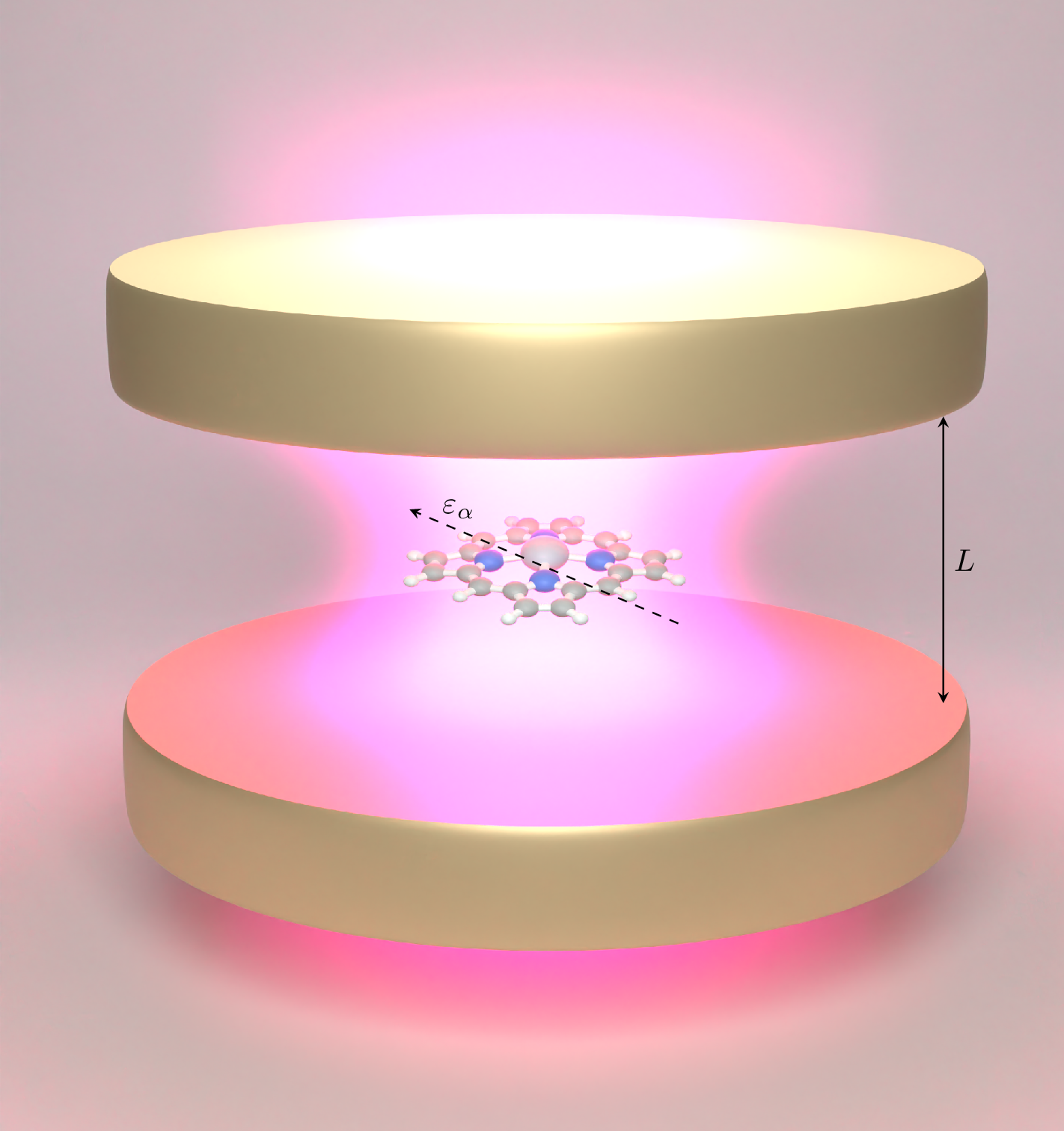
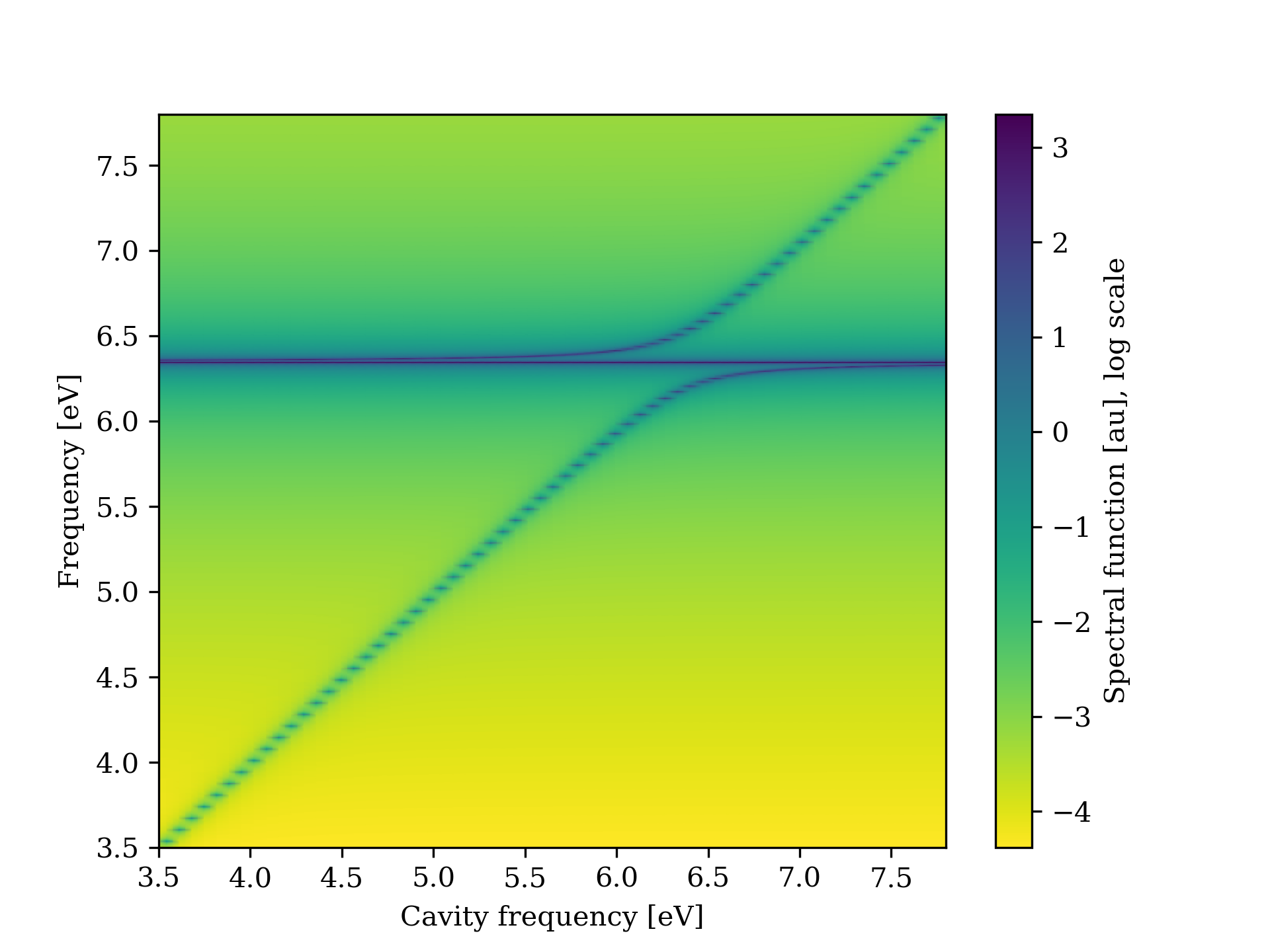
We present the theoretical derivation and numerical implementation of the linear response equations for relativistic quantum electrodynamical density functional theory (QEDFT). In contrast to previous works based on the Pauli-Fierz Hamiltonian, our approach describes electrons interacting with photonic cavity modes at the four-component Dirac-Kohn-Sham level, derived from fully relativistic QED through a series of established approximations. Moreover, we show that a new type of spin-orbit-like (SO) cavity-mediated interaction appears under the relativistic description of the coupling of matter with quantized cavity modes. Benchmark calculations performed for atoms of group 12 elements (Zn, Cd, Hg) demonstrate how a relativistic treatment enables the description of exciton polaritons which arise from the hybridization of formally forbidden singlet-triplet transitions with cavity modes. For atoms in cavities tuned on resonance with a singlet-triplet transition we discover a significant interplay between SO effects and coupling to an off-resonant intense singlet-singlet transition. This dynamic relationship highlights the crucial role of ab initio approaches in understanding cavity quantum electrodynamics. Finally, using the mercury porphyrin complex as an example, we show that relativistic linear response QEDFT provides computationally feasible first-principles calculations of polaritonic states in large heavy element-containing molecules of chemical interest.
Motivation & Objective
- To extend quantum-electrodynamical density functional theory (QEDFT) to include relativistic effects for accurate description of light-matter coupling in heavy elements.
- To develop a linear response formalism within relativistic QEDFT that accounts for quantized cavity modes and electron-photon interactions at the four-component Dirac-Kohn-Sham level.
- To investigate the emergence of spin–orbit-like interactions induced by cavity photons in relativistic systems.
- To enable computationally feasible, first-principles simulations of polaritonic states in large, heavy-element-containing molecules such as mercury porphyrin.
- To explore the interplay between relativistic effects, cavity-mediated couplings, and electronic transitions in group 12 elements (Zn, Cd, Hg)
Proposed method
- Derives the relativistic linear response equations for QEDFT using the four-component Dirac-Kohn-Sham formalism, derived from fully relativistic quantum electrodynamics via established approximations.
- Incorporates quantized cavity modes via a minimal coupling scheme, treating transverse photons as dynamical degrees of freedom in the Kohn-Sham framework.
- Solves the coupled matter-photon response equations using a generalized eigenvalue problem for the response matrix, with the polarizability tensor expressed in terms of right and left transition dipole moments.
- Utilizes the structure of the excitation spectrum, where eigenvalues appear in positive–negative pairs, to simplify the polarizability expression into a sum over distinct excitation modes.
- Employs a real-space grid-based implementation to solve the relativistic Kohn-Sham equations and compute the response properties numerically.
- Applies the formalism to benchmark systems including group 12 atoms and the mercury porphyrin complex, validating the method against known physical trends and symmetry considerations.
Experimental results
Research questions
- RQ1How does the inclusion of relativistic effects modify the nature of light-matter coupling in cavity quantum electrodynamics?
- RQ2What novel interactions—particularly spin–orbit-like couplings—emerge from the coupling of relativistic electrons to quantized cavity modes?
- RQ3Can relativistic linear response QEDFT describe the formation of exciton polaritons in atoms with formally forbidden singlet–triplet transitions?
- RQ4How do relativistic effects and cavity-mediated couplings interplay in systems with strong spin–orbit coupling, such as Hg-containing molecules?
- RQ5To what extent can this framework enable first-principles simulations of polaritonic states in large, heavy-element-containing molecules?
Key findings
- A new spin–orbit-like interaction mediated by cavity photons emerges in the relativistic QEDFT framework, absent in non-relativistic treatments.
- Benchmark calculations on Zn, Cd, and Hg atoms show that relativistic effects enable the description of exciton polaritons arising from hybridization of formally forbidden singlet–triplet transitions with cavity modes.
- For atoms in cavities resonant with singlet–triplet transitions, a significant dynamic interplay is observed between spin–orbit effects and coupling to off-resonant, intense singlet–singlet transitions.
- The formalism successfully describes polaritonic states in the mercury porphyrin complex, demonstrating its feasibility for large, chemically relevant systems with heavy elements.
- The frequency-dependent polarizability is computed via a closed-form expression involving right and left transition dipole moments, enabling efficient evaluation of optical response in the relativistic regime.
- The method reveals that relativistic effects are essential for accurately capturing the full spectrum of light-matter interactions in systems with strong spin–orbit coupling.
Read this paper
Open the full text in the Nubint reader and ask about any passage as you read.
Read this paper on NubintThis review was generated by AI from the original paper. Please check the paper before citing it.