
[Paper Review] Relaxing Hardware Requirements for Surface Code Circuits using Time-dynamics
This paper introduces a time-dynamic circuit design approach for surface code quantum error correction that relaxes hardware constraints without sacrificing logical performance. By rethinking stabilizers as time-evolving 'detecting regions,' the authors construct improved surface code circuits that use only three couplings per qubit, ISWAP gates instead of CNOT/CZ, and enable dynamic patch movement—all while maintaining four-layer entangling gate depth and teraquop footprints within 25% of standard surface code.
The typical time-independent view of quantum error correction (QEC) codes hides significant freedom in the decomposition into circuits that are executable on hardware. Using the concept of detecting regions, we design time-dynamic QEC circuits directly instead of designing static QEC codes to decompose into circuits. In particular, we improve on the standard circuit constructions for the surface code, presenting new circuits that can embed on a hexagonal grid instead of a square grid, that can use ISWAP gates instead of CNOT or CZ gates, that can exchange qubit data and measure roles, and that move logical patches around the physical qubit grid while executing. All these constructions use no additional entangling gate layers and display essentially the same logical performance, having teraquop footprints within 25% of the standard surface code circuit. We expect these circuits to be of great interest to quantum hardware engineers, because they achieve essentially the same logical performance as standard surface code circuits while relaxing demands on hardware.
Motivation & Objective
- Address the gap between static quantum error correcting (QEC) codes and the time-dynamic reality of physical quantum hardware.
- Overcome hardware limitations such as restricted connectivity, non-native gate sets (e.g., CNOT/CZ), and leakage susceptibility in surface code implementations.
- Develop a circuit-centric framework for QEC that prioritizes time dynamics over static code structures to enable more flexible and practical hardware integration.
- Demonstrate that logical performance can be preserved while significantly relaxing physical hardware requirements through direct circuit design.
Proposed method
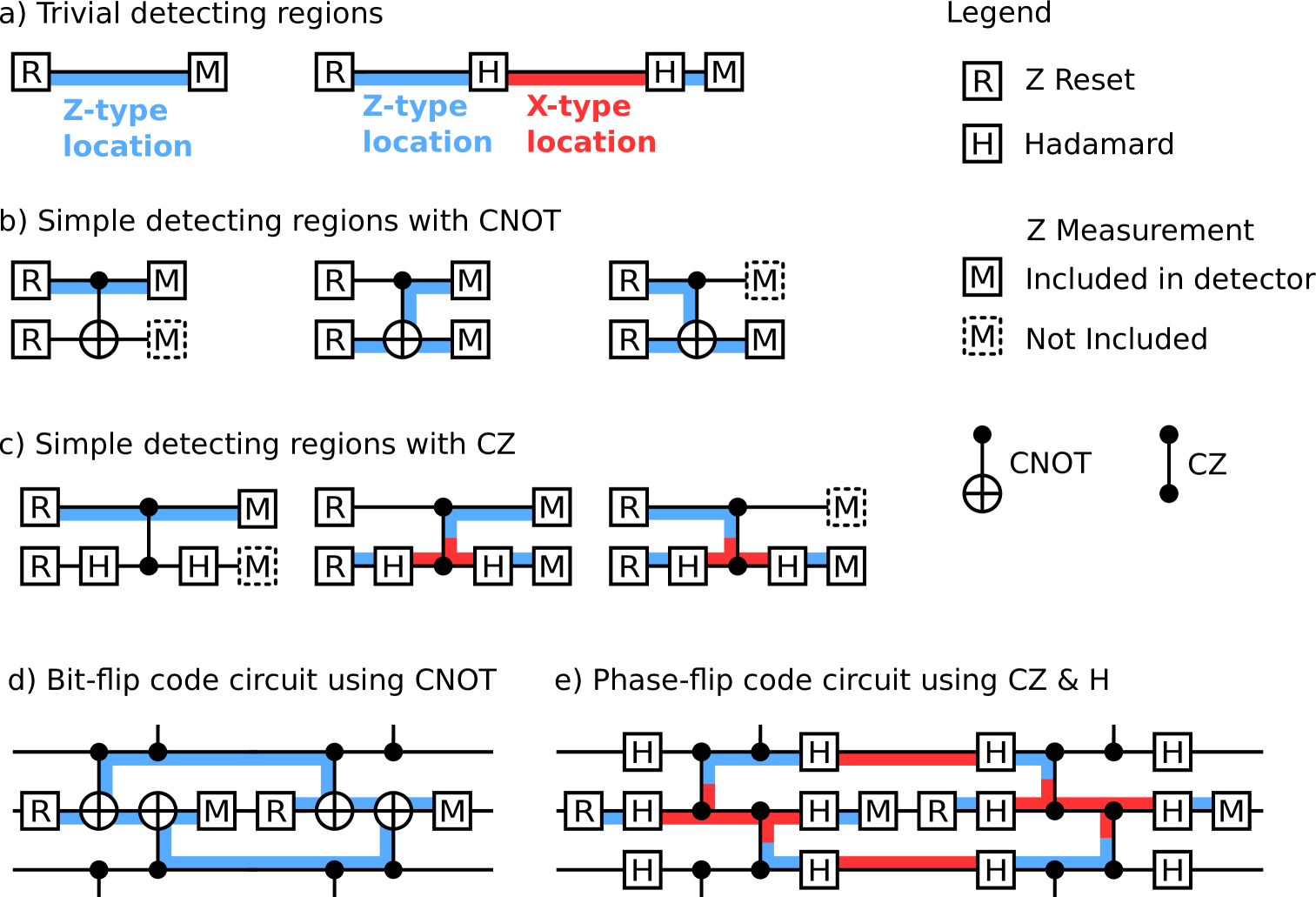
- Introduce the concept of 'detecting regions' as a generalization of stabilizers to time-dynamic circuits, enabling analysis of error detection across time.
- Use a circuit-based, spacetime picture of QEC where detector evolution is explicitly modeled and manipulated during circuit design.
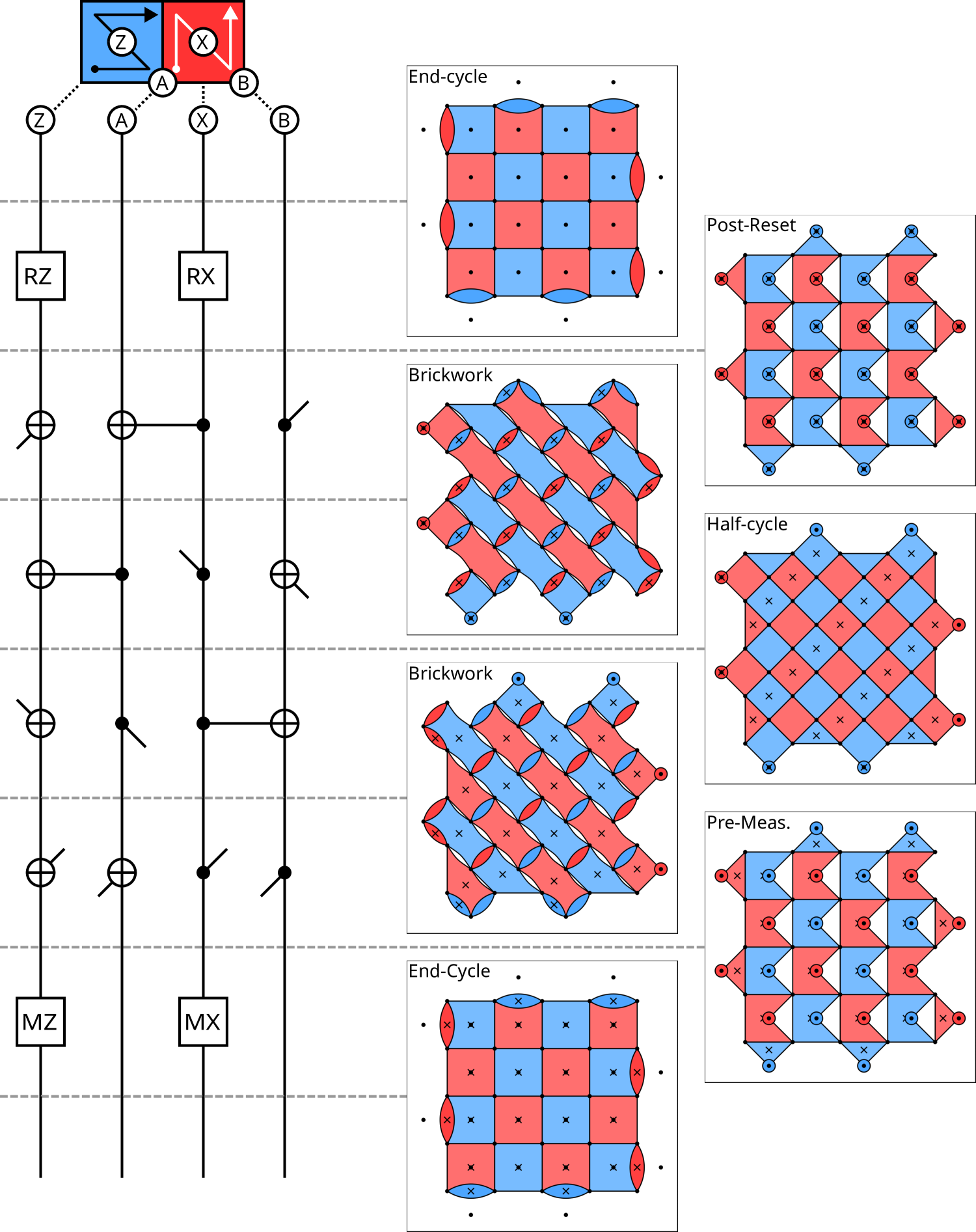
- Design new surface code circuits by reorganizing the temporal and spatial layout of detectors, allowing for alternative physical layouts (e.g., hexagonal grids) and gate sets (e.g., ISWAP).
- Apply the detecting region framework to reconfigure logical patch movement and qubit role exchange (data vs. measurement) during execution.
- Leverage software tools like Stim and custom visualization libraries to explore, verify, and benchmark circuit designs under realistic noise models.
- Ensure all constructions maintain only four layers of entangling gates, preserving circuit depth and logical performance.
Experimental results
Research questions
- RQ1Can quantum error correction circuits be designed directly based on time dynamics rather than static code structures?
- RQ2To what extent can hardware constraints—such as connectivity, gate set, and qubit role limitations—be relaxed without degrading logical performance?
- RQ3How can the concept of detecting regions be used to systematically improve surface code circuit designs?
- RQ4Can dynamic patch movement and qubit role exchange be implemented in surface code circuits without increasing circuit depth or error rates?
- RQ5What are the practical implications of time-dynamic circuit design for near-term quantum hardware architectures?
Key findings
- The proposed circuits achieve teraquop footprints within 25% of the standard surface code, indicating essentially equivalent logical performance.
- The hexagonal grid construction reduces required couplings per qubit from four to three, enabling implementation on lower-connectivity hardware.
- ISWAP-based circuits replace CNOT/CZ gates while maintaining the same four-layer entangling gate depth and logical error rates.
- The circuits support dynamic movement of logical patches across the physical qubit grid during execution, enabling new hardware utilization strategies.
- All constructions maintain full error detection capability and are compatible with efficient matching decoding, ensuring practical fault-tolerance.
- The framework enables improved resilience to leakage by involving measurements on all physical qubits, without introducing additional gate layers.
Read this paper
Open the full text in the Nubint reader and ask about any passage as you read.
Read this paper on NubintThis review was generated by AI from the original paper. Please check the paper before citing it.