
[Paper Review] Representation-space diffusion models for generating periodic materials
This paper introduces StructRepDiff, a novel diffusion model that generates periodic materials by denoising in a differentiable, physics-based representation space that inherently respects crystal symmetries and periodicity. By training on invariant structural descriptors and reconstructing Cartesian coordinates via gradient-based optimization, the method achieves state-of-the-art performance on benchmark datasets while simplifying training and ensuring invariance without custom loss functions.
Generative models hold the promise of significantly expediting the materials design process when compared to traditional human-guided or rule-based methodologies. However, effectively generating high-quality periodic structures of materials on limited but diverse datasets remains an ongoing challenge. Here we propose a novel approach for periodic structure generation which fully respect the intrinsic symmetries, periodicity, and invariances of the structure space. Namely, we utilize differentiable, physics-based, structural descriptors which can describe periodic systems and satisfy the necessary invariances, in conjunction with a denoising diffusion model which generates new materials within this descriptor or representation space. Reconstruction is then performed on these representations using gradient-based optimization to recover the corresponding Cartesian positions of the crystal structure. This approach differs significantly from current methods by generating materials in the representation space, rather than in the Cartesian space, which is made possible using an efficient reconstruction algorithm. Consequently, known issues with respecting periodic boundaries and translational and rotational invariances during generation can be avoided, and the model training process can be greatly simplified. We show this approach is able to provide competitive performance on established benchmarks compared to current state-of-the-art methods.
Motivation & Objective
- To address the challenge of generating high-quality periodic materials with proper invariance to translation, rotation, and periodicity.
- To overcome limitations in existing methods that generate in Cartesian space, where symmetries and boundaries are often violated.
- To simplify model training by operating in a representation space that naturally encodes structural invariances.
- To enable competitive generation performance on limited, diverse materials datasets using a unified, differentiable representation.
Proposed method
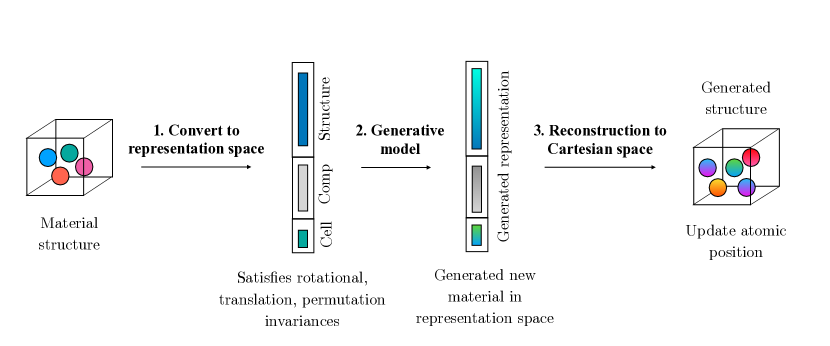
- The method uses differentiable, physics-based structural descriptors that are invariant to translation, rotation, and periodicity, forming the core representation space.
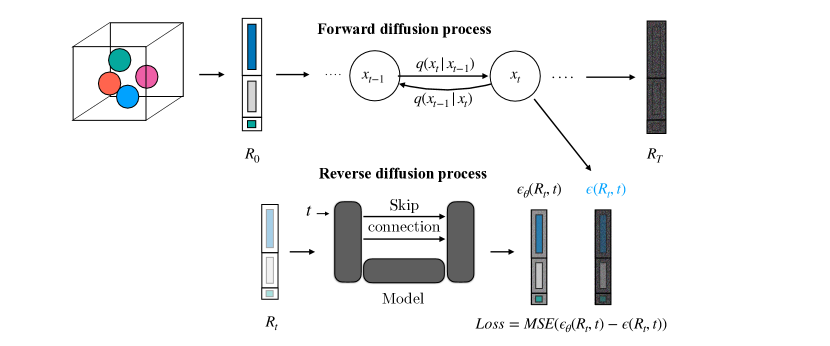
- A denoising diffusion model is trained directly on this representation space, generating new material structures without requiring explicit handling of symmetry constraints.
- The final representation vector combines structural descriptors, composition, and unit cell vectors to encode full crystal information.
- An efficient gradient-based reconstruction algorithm converts the generated representations back into 3D Cartesian coordinates within the unit cell.
- The approach avoids the need for custom score functions or architectural modifications to enforce invariance, as the representation space itself ensures these properties.
- The method is generalizable to any differentiable, invariant representation, enabling broad applicability beyond the current implementation.
Experimental results
Research questions
- RQ1Can a diffusion model trained in a representation space that inherently respects crystal symmetries outperform Cartesian-space generation in periodic materials?
- RQ2How does the use of differentiable, physics-based structural descriptors improve training stability and generation quality compared to raw coordinate-based models?
- RQ3To what extent can gradient-based reconstruction from representations preserve bond lengths and crystal symmetry while maintaining high generation fidelity?
- RQ4Does representation-space generation reduce the need for complex invariance-enforcing components in the model architecture?
- RQ5How does the method compare in performance and distribution coverage to state-of-the-art models on diverse materials benchmarks?
Key findings
- On the MP-20 dataset, StructRepDiff achieved 99.79% validity, 99.67% coverage, and 0.673 FID, ranking second in three metrics and first in validity.
- On the Perov-5 dataset, the model achieved 99.84% validity, 99.79% coverage, and 0.289 FID, ranking second in FID and first in validity.
- On the Carbon-24 dataset, StructRepDiff achieved 100.00% validity and 99.56% coverage, ranking second in FID with 0.1187.
- Generated structures closely matched training data distributions in PCA space, with generated samples (red) fully covering the training distribution (black) as shown in Figure 5.
- The model successfully generated perovskites with correct ABX3 stoichiometry and cubic/distorted cubic symmetry, and carbon structures with highly coordinated networks.
- The method demonstrated competitive performance without property optimization or conditional generation, highlighting its robustness and generalization on diverse, low-resource datasets.
Read this paper
Open the full text in the Nubint reader and ask about any passage as you read.
Read this paper on NubintThis review was generated by AI from the original paper. Please check the paper before citing it.