
[Paper Review] Researchy Questions: A Dataset of Multi-Perspective, Decompositional Questions for LLM Web Agents
This paper introduces Researchy Questions, a large-scale dataset of non-factoid, decompositional, multi-perspective questions mined from real search logs to study how LLM web agents handle unclear information needs, with 96k questions and associated decomposition plans and clicked evidence.
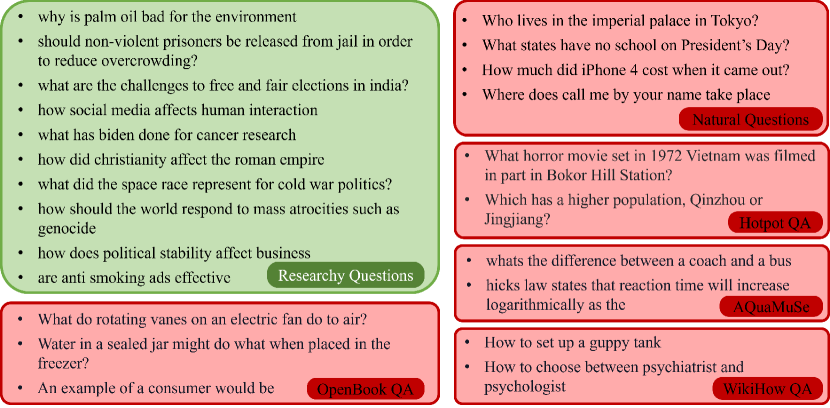
Existing question answering (QA) datasets are no longer challenging to most powerful Large Language Models (LLMs). Traditional QA benchmarks like TriviaQA, NaturalQuestions, ELI5 and HotpotQA mainly study ``known unknowns'' with clear indications of both what information is missing, and how to find it to answer the question. Hence, good performance on these benchmarks provides a false sense of security. A yet unmet need of the NLP community is a bank of non-factoid, multi-perspective questions involving a great deal of unclear information needs, i.e. ``unknown uknowns''. We claim we can find such questions in search engine logs, which is surprising because most question-intent queries are indeed factoid. We present Researchy Questions, a dataset of search engine queries tediously filtered to be non-factoid, ``decompositional'' and multi-perspective. We show that users spend a lot of ``effort'' on these questions in terms of signals like clicks and session length, and that they are also challenging for GPT-4. We also show that ``slow thinking'' answering techniques, like decomposition into sub-questions shows benefit over answering directly. We release $\sim$ 100k Researchy Questions, along with the Clueweb22 URLs that were clicked.
Motivation & Objective
- Motivate the need for complex, non-factoid questions that reveal unknowns in real-world user information needs.
- Describe the construction pipeline that mines, filters, and de-duplicates search-log queries into a decompositional QA dataset.
- Provide hierarchical decompositions and evidence signals (clicked URLs) to ground and evaluate LLM agent behavior.
- Offer baseline evaluations showing decompositional answering benefits and insights into user search behavior with Researchy Questions.
Proposed method
- Mine real-world English search logs to collect candidate questions with at least 50 distinct occurrences and multiple clicked URLs.
- Stage-wise filtering to isolate non-factoid, open-domain questions suitable for decompositional answering using classifiers and GPT-4 labeling.
- Perform agglomerative deduplication of query intent using ANCE-based embeddings and clustering to produce representative heads for groups.
- Apply final GPT-4 based quality checks to filter out ambiguous, incomplete, assumptive, or unsafe questions, yielding 96k questions.
- Provide a 2-level hierarchical decomposition for each question and publish the corresponding ClueWeb22 clicked URLs as evidence signals.
Experimental results
Research questions
- RQ1What are Researchy Questions, and how do they differ from traditional factoid QA benchmarks?
- RQ2Can non-factoid, decompositional questions mined from search logs effectively reveal unknown unknowns for LLM web agents?
- RQ3Do hierarchical decompositions improve retrieval and synthesis for complex, multi-document queries compared to direct answering?
- RQ4What behavioral signals (e.g., clicks, session length) indicate greater effort and complexity in Researchy Questions?
- RQ5How do decompositional answering techniques compare to direct answering on long-form, multi-perspective questions?
Key findings
- Researchy Questions are non-factoid, decompositional, and multi-perspective, requiring substantial research effort beyond a paragraph answer.
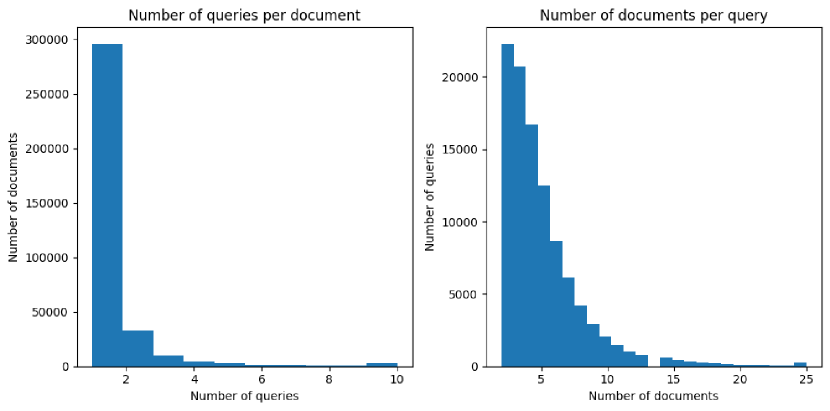
- Users spend more time and clicks on Researchy Questions, indicating higher information-seeking effort and diverse evidence needs.
- GPT-4-based decomposition approaches (especially factored decomposition) outperform direct closed-book answering on long-form, multi-faceted questions.
- Decompositional techniques yield accuracy and quality gains on long-form questions, with notable improvements for datasets like Wikihow and Researchy Questions.
- Approximately 96k questions are released, each with a 2-level hierarchical plan and a vector-based deduplication head, plus the associated ClueWeb22 clicked URLs.
Read this paper
Open the full text in the Nubint reader and ask about any passage as you read.
Read this paper on NubintThis review was generated by AI from the original paper. Please check the paper before citing it.