
[Paper Review] ResQuNNs: Towards Enabling Deep Learning in Quantum Convolution Neural Networks
This paper introduces ResQuNNs, a novel architecture that enables trainable quanvolutional layers in quantum convolutional neural networks by incorporating residual blocks to enhance gradient flow. The method significantly improves training performance and generalization, with empirical results showing that strategic placement of residual connections enables full gradient access across all layers, unlocking deeper and more effective quantum neural networks.
In this paper, we present a novel framework for enhancing the performance of Quanvolutional Neural Networks (QuNNs) by introducing trainable quanvolutional layers and addressing the critical challenges associated with them. Traditional quanvolutional layers, although beneficial for feature extraction, have largely been static, offering limited adaptability. Unlike state-of-the-art, our research overcomes this limitation by enabling training within these layers, significantly increasing the flexibility and potential of QuNNs. However, the introduction of multiple trainable quanvolutional layers induces complexities in gradient-based optimization, primarily due to the difficulty in accessing gradients across these layers. To resolve this, we propose a novel architecture, Residual Quanvolutional Neural Networks (ResQuNNs), leveraging the concept of residual learning, which facilitates the flow of gradients by adding skip connections between layers. By inserting residual blocks between quanvolutional layers, we ensure enhanced gradient access throughout the network, leading to improved training performance. Moreover, we provide empirical evidence on the strategic placement of these residual blocks within QuNNs. Through extensive experimentation, we identify an efficient configuration of residual blocks, which enables gradients across all the layers in the network that eventually results in efficient training. Our findings suggest that the precise location of residual blocks plays a crucial role in maximizing the performance gains in QuNNs. Our results mark a substantial step forward in the evolution of quantum deep learning, offering new avenues for both theoretical development and practical quantum computing applications.
Motivation & Objective
- To address the limitation of static, non-trainable quanvolutional layers in QuNNs, which restrict learning to only classical layers.
- To overcome the challenge of poor gradient flow in deep QuNNs with multiple trainable quanvolutional layers.
- To design a residual-based architecture that ensures gradient accessibility across all quanvolutional layers.
- To empirically identify optimal residual block configurations that maximize training efficiency and model generalization.
- To enable deeper, more flexible QuNNs by facilitating end-to-end training of quantum feature extraction layers.
Proposed method
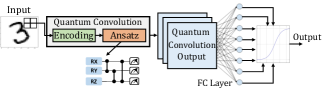
- Propose ResQuNNs, a residual learning framework that inserts residual blocks between quanvolutional layers to improve gradient flow.
- Use parameterized quantum circuits (PQCs) with Ry and CNOT gates as the quanvolutional layers, enabling backpropagation through quantum operations.
- Introduce skip connections that allow direct gradient propagation from deeper to shallower layers, mitigating vanishing gradient issues.
- Systematically evaluate different residual block placements (e.g., O1+O2, (X+O1)+O2) to identify configurations enabling full gradient access.
- Train models on MNIST using Adam optimizer with 0.01 learning rate, comparing configurations with and without residual connections.
- Analyze gradient propagation using visualization tools to verify that only specific configurations allow gradients through all quanvolutional layers.
Experimental results
Research questions
- RQ1How does enabling trainability in quanvolutional layers affect the performance of QuNNs compared to frozen layers?
- RQ2What architectural modifications are required to enable effective backpropagation through multiple trainable quanvolutional layers?
- RQ3How do different placements of residual blocks influence gradient flow and model generalization in deep QuNNs?
- RQ4Which residual configurations allow full gradient access across all quanvolutional layers in multi-layer QuNNs?
- RQ5Can residual connections in QuNNs improve both training accuracy and validation performance, indicating better generalization?
Key findings
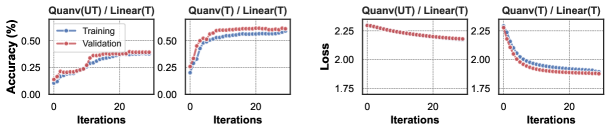
- Models with untrainable quanvolutional layers showed suboptimal performance, with learning dominated by the final fully connected layer.
- Enabling trainability in quanvolutional layers significantly improved training performance, demonstrating the necessity of optimizing quantum feature extractors.
- Residual connections drastically improved training, with models lacking them showing little to no learning.
- The O1+O2 residual configuration outperformed X+O1 in both training and validation accuracy, indicating superior gradient flow and generalization.
- Only two out of 15 possible residual configurations in three-layer QuNNs enabled full gradient access across all quanvolutional layers: (O1+O2)+O3 and ((X+O1)+O2)+O3.
- The (X+O1)+O2 configuration achieved higher validation accuracy than O1+O2, suggesting that direct input propagation may lead to memorization, while full gradient flow enhances generalization.
Read this paper
Open the full text in the Nubint reader and ask about any passage as you read.
Read this paper on NubintThis review was generated by AI from the original paper. Please check the paper before citing it.