
[Paper Review] Retrospective Motion Correction in Gradient Echo MRI by Explicit Motion Estimation Using Deep CNNs
This paper proposes a deep learning-based retrospective motion correction method for gradient echo MRI using explicit motion estimation via Deep CNNs. By leveraging SENSE redundancy and a two-stage network (estimation and correction), it achieves superior image quality over GANs and rigid models, with low residual error and data consistency, enabling clinically feasible 20-second reconstruction times using optimized NUFFT.
Magnetic Resonance Imaging allows high resolution data acquisition with the downside of motion sensitivity due to relatively long acquisition times. Even during the acquisition of a single 2D slice, motion can severely corrupt the image. Retrospective motion correction strategies do not interfere during acquisition time but operate on the motion affected data. Known methods suited to this scenario are compressed sensing (CS), generative adversarial networks (GANs), and motion estimation. In this paper we propose a strategy to correct for motion artifacts using Deep Convolutional Neuronal Networks (Deep CNNs) in a reliable and verifiable manner by explicit motion estimation. The sensitivity encoding (SENSE) redundancy that multiple receiver coils provide, has in the past been used for acceleration, noise reduction and rigid motion compensation. We show that using Deep CNNs the concepts of rigid motion compensation can be generalized to more complex motion fields. Using a simulated synthetic data set, our proposed supervised network is evaluated on motion corrupted MRIs of abdomen and head. We compare our results with rigid motion compensation and GANs.
Motivation & Objective
- Address motion artifacts in multishot gradient echo MRI, which degrade image quality due to physiological motion during long acquisitions.
- Overcome limitations of existing retrospective methods—especially GANs and implicit motion models—that lack data consistency or suffer from mode collapse.
- Develop a reliable, verifiable motion correction framework using explicit deformation field estimation via Deep CNNs.
- Improve upon rigid motion compensation by generalizing to non-rigid, complex motion fields using supervised learning on synthetic data.
- Ensure data consistency and low reconstruction error through explicit deformation field computation and iterative refinement.
Proposed method
- Use a supervised Deep CNN (estimation network) to predict deformation fields from motion-corrupted k-space data, leveraging SENSE redundancy from multiple receiver coils.
- Implement a cascaded correction network that refines the reconstruction using the estimated deformation fields, minimizing data inconsistency.
- Apply trajectory-optimized non-uniform fast Fourier transform (NUFFT) for efficient k-space to image space conversion, accelerating computation on GPU.
- Use conjugate gradient (CG) iterations to solve the data consistency problem in the image domain, ensuring the final reconstruction matches the acquired k-space data.
- Integrate total variation (TV) regularization in the correction network to suppress noise and enhance edge preservation.
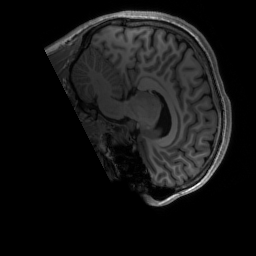
- Train the network on synthetic, motion-corrupted MR data of the brain and abdomen, simulating realistic motion patterns and noise levels.
Experimental results
Research questions
- RQ1Can explicit motion estimation via Deep CNNs outperform GAN-based and rigid motion correction methods in terms of image quality and data consistency?
- RQ2To what extent can a supervised CNN generalize from synthetic data to real motion artifacts in multishot GRE-MRI?
- RQ3How does the inclusion of explicit deformation fields improve reconstruction accuracy compared to implicit or adversarial approaches?
- RQ4What is the computational feasibility of the proposed method in a clinical setting, given reconstruction time and hardware constraints?
- RQ5Can the method maintain robustness under varying noise levels and complex motion patterns in abdominal and brain imaging?
Key findings
- The proposed method achieved a PSNR of 41.18 dB and SSIM of 0.9900 on the Brain Yale dataset with 0% noise, significantly outperforming GANs (PSNR 29.37 dB) and rigid models (PSNR 38.69 dB).
- On the Abdominal dataset with 0% noise, the method reached a PSNR of 37.38 dB and SSIM of 0.976, surpassing rigid correction (PSNR 30.74 dB) and GANs (PSNR 27.57 dB).
- With 5% noise, the method maintained high performance (PSNR 35.58 dB on abdomen, 41.39 dB on brain), demonstrating robustness to measurement noise.
- The residual error was reduced to 2.687 (abdomen, 5% noise) and 1.911 (brain, 0% noise), indicating strong data consistency and low reconstruction error.
- The overall computation time was approximately 20 seconds per scan using NUFFT, making clinical deployment feasible.
- The addition of TV regularization further improved SSIM and reduced MSE, confirming the benefit of regularization in enhancing image quality.

Better researchstarts right now
From reading papers to final review, dramatically reduce your research time.
No credit card · Free plan available
This review was created by AI and reviewed by human editors.