
[Paper Review] Revolutionizing Undergraduate Learning: CourseGPT and Its Generative AI Advancements
This paper introduces CourseGPT, a RAG-based generative AI assistant built on open-source Mistral LLMs to enhance undergraduate learning in domain-specific courses. It delivers accurate, context-aware responses to student queries using course-specific materials, with the Mixtral-8x7b model achieving 88.0% correctness and 66.6% faithfulness in evaluations on the CPR E 431 course.
Integrating Generative AI (GenAI) into educational contexts presents a transformative potential for enhancing learning experiences. This paper introduces CourseGPT, a generative AI tool designed to support instructors and enhance the educational experiences of undergraduate students. Built on open-source Large Language Models (LLMs) from Mistral AI, CourseGPT offers continuous instructor support and regular updates to course materials, enriching the learning environment. By utilizing course-specific content, such as slide decks and supplementary readings and references, CourseGPT provides precise, dynamically generated responses to student inquiries. Unlike generic AI models, CourseGPT allows instructors to manage and control the responses, thus extending the course scope without overwhelming details. The paper demonstrates the application of CourseGPT using the CPR E 431 - Basics of Information System Security course as a pilot. This course, with its large enrollments and diverse curriculum, serves as an ideal testbed for CourseGPT. The tool aims to enhance the learning experience, accelerate feedback processes, and streamline administrative tasks. The study evaluates CourseGPT's impact on student outcomes, focusing on correctness scores, context recall, and faithfulness of responses. Results indicate that the Mixtral-8x7b model, with a higher parameter count, outperforms smaller models, achieving an 88.0% correctness score and a 66.6% faithfulness score. Additionally, feedback from former students and teaching assistants on CourseGPT's accuracy, helpfulness, and overall performance was collected. The outcomes revealed that a significant majority found CourseGPT to be highly accurate and beneficial in addressing their queries, with many praising its ability to provide timely and relevant information.
Motivation & Objective
- To develop a scalable, instructor-controlled generative AI assistant tailored for university-level courses to improve student learning outcomes.
- To evaluate the impact of different LLM sizes on response correctness, context recall, and faithfulness in an educational RAG setting.
- To address challenges in memory efficiency, scalability, and data quality for deploying LLMs in academic environments.
- To demonstrate the feasibility and effectiveness of fine-tuned, open-source LLMs as real-time teaching assistants in large-enrollment courses.
- To provide a framework for integrating domain-specific knowledge into LLMs for reliable, precise, and timely student support.
Proposed method
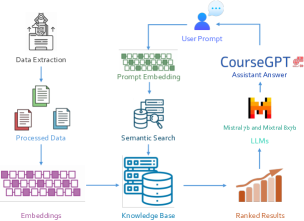
- CourseGPT is built on Mistral AI's open-source LLMs, including Mixtral-8x7b, and is fine-tuned using course-specific materials such as slide decks and supplementary readings.
- A Retrieval-Augmented Generation (RAG) framework retrieves relevant course content from a vector database to ground LLM responses in factual, course-specific information.
- The system uses a hybrid prompting strategy with initial and follow-up prompts to improve response quality and context retention.
- Evaluation metrics include correctness, context recall, and faithfulness, assessed via human evaluation from former students and teaching assistants.
- The deployment involves a server-hosted instance accessible to select users, with continuous updates to course materials and model responses.
- Memory management and computational efficiency are addressed through optimization strategies and infrastructure support to handle large-parameter models.
Experimental results
Research questions
- RQ1How do different LLM sizes (7B to 47B parameters) affect response correctness, context recall, and faithfulness in a course-specific RAG setting?
- RQ2To what extent can a fine-tuned, open-source LLM serve as an effective, accurate, and reliable teaching assistant in a large undergraduate course?
- RQ3What are the key challenges in deploying RAG-based LLMs in educational settings, particularly regarding memory usage, scalability, and data quality?
- RQ4How do human evaluators perceive the accuracy, helpfulness, and overall performance of CourseGPT in answering course-related queries?
- RQ5Can a domain-adapted, instructor-controlled LLM assistant reduce student frustration and improve learning efficiency through immediate, precise responses?
Key findings
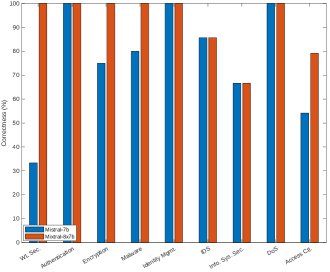
- The Mixtral-8x7b model achieved the highest correctness score of 88.0% among all evaluated LLMs, demonstrating superior performance in generating accurate responses.
- The same model achieved a faithfulness score of 66.6%, indicating that responses remained grounded in the retrieved course materials without hallucination.
- A majority of former students and teaching assistants reported that CourseGPT was highly accurate and beneficial in answering their queries, with strong praise for timeliness and relevance.
- Smaller LLMs showed lower correctness and faithfulness scores, highlighting the performance advantage of larger, more parameter-rich models in complex educational contexts.
- The system significantly reduced response latency and improved student access to course-specific information, enhancing workflow efficiency and reducing reliance on instructor or TA availability.
- Challenges in memory management, computational load, and data quality were identified, particularly with large models, necessitating ongoing optimization and data validation.
Read this paper
Open the full text in the Nubint reader and ask about any passage as you read.
Read this paper on NubintThis review was generated by AI from the original paper. Please check the paper before citing it.