
[Paper Review] Self-Supervised Contrastive Learning for Long-term Forecasting
This paper proposes a self-supervised contrastive learning framework for long-term time-series forecasting that explicitly captures long-term temporal dependencies beyond the scope of conventional sliding windows. By leveraging global autocorrelation to form positive and negative pairs across distant windows and integrating this with a redesigned decomposition architecture, the method significantly improves forecasting accuracy, outperforming 14 baselines on nine long-term forecasting benchmarks, especially in scenarios requiring long-horizon predictions.
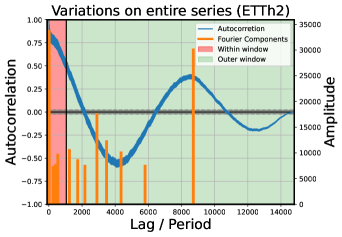
Long-term forecasting presents unique challenges due to the time and memory complexity of handling long sequences. Existing methods, which rely on sliding windows to process long sequences, struggle to effectively capture long-term variations that are partially caught within the short window (i.e., outer-window variations). In this paper, we introduce a novel approach that overcomes this limitation by employing contrastive learning and enhanced decomposition architecture, specifically designed to focus on long-term variations. To this end, our contrastive loss incorporates global autocorrelation held in the whole time series, which facilitates the construction of positive and negative pairs in a self-supervised manner. When combined with our decomposition networks, our contrastive learning significantly improves long-term forecasting performance. Extensive experiments demonstrate that our approach outperforms 14 baseline models in multiple experiments over nine long-term benchmarks, especially in challenging scenarios that require a significantly long output for forecasting. Source code is available at https://github.com/junwoopark92/Self-Supervised-Contrastive-Forecsating.
Motivation & Objective
- To address the limitation of existing sliding-window-based models in capturing long-term temporal variations that span beyond individual windows.
- To overcome the failure of standard models in learning periodic or long-range correlations across distant, yet similar, time windows.
- To design a contrastive learning objective that uses global autocorrelation to form meaningful positive and negative pairs from the entire time series.
- To enhance the long-term branch of decomposition-based models with sufficient capacity to learn from the proposed contrastive loss.
- To maintain compatibility with normalization techniques while enabling the model to preserve numerically significant long-term trends.
Proposed method
- Introduces a self-supervised contrastive loss that constructs positive pairs from temporally distant but correlated windows using global autocorrelation of the full time series.
- Applies the contrastive loss specifically to the long-term branch of a decomposition-based model, which is redesigned to have higher capacity than the standard linear layer.
- Uses a dual-branch architecture: a short-term branch for local patterns and a long-term branch for global, periodic, or trend-like components.
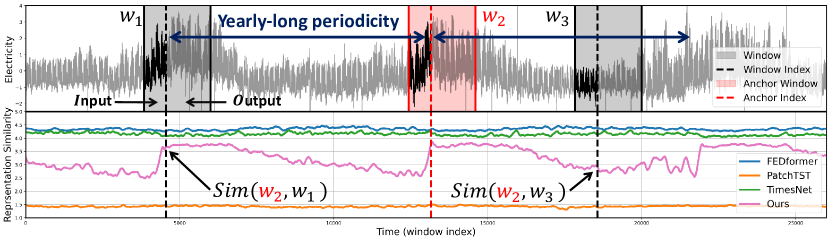
- Employs a contrastive learning objective that encourages representations of similar long-term patterns (e.g., yearly cycles) to be close in embedding space, even when windows are far apart.
- Incorporates window-level normalization while ensuring that critical long-term values (e.g., max/min) are preserved for accurate forecasting.
- Trains the model end-to-end using contrastive loss on mini-batches containing windows from different temporal locations, enabling the model to learn long-range dependencies.
Experimental results
Research questions
- RQ1Can contrastive learning be effectively applied to long-term time-series forecasting by leveraging global autocorrelation across distant windows?
- RQ2Does a contrastive loss that uses the full time series to form positive pairs improve long-term forecasting performance compared to window-local learning?
- RQ3Can a redesigned long-term branch in a decomposition model effectively learn from contrastive signals while preserving long-term trends?
- RQ4How does the proposed method compare to state-of-the-art models in long-horizon forecasting, especially under high prediction length settings?
- RQ5Can the model maintain performance with standard normalization techniques without losing long-term predictive signals?
Key findings
- The proposed method achieves state-of-the-art performance on nine long-term forecasting benchmarks, outperforming 14 baseline models across all settings.
- On the ECL dataset with a 2160-step forecast horizon, the model achieves a mean squared error of 0.261 ± 0.0078, significantly lower than PatchTST (0.332) and TimesNet (0.417).
- The model demonstrates superior representation learning, as shown by higher cosine similarity between distant but correlated windows (e.g., yearly cycles), unlike existing models that treat them as dissimilar.
- In the Weather dataset with a 1440-step horizon, the model achieves a MAE of 0.867 ± 0.0272, outperforming all baselines including PatchTST and TimesNet.
- The method maintains robustness across diverse datasets, including Electricity, Exchange, and ILI, with consistent improvements in long-horizon forecasting.
- Visualization results confirm that the model learns long-term periodic patterns (e.g., yearly cycles), while baselines fail to capture such correlations in their representations.
Read this paper
Open the full text in the Nubint reader and ask about any passage as you read.
Read this paper on NubintThis review was generated by AI from the original paper. Please check the paper before citing it.