
[Paper Review] Similarity-Based Parameter Transferability in the Quantum Approximate Optimization Algorithm
This paper proposes a similarity-based framework to predict and enable transferability of optimal QAOA parameters across different MaxCut problem instances by leveraging subgraph structure and graph parity. It demonstrates that parameters optimized on small graphs (e.g., N=6) can be transferred to larger graphs (up to N=256) with only 1–2% loss in approximation ratio, significantly accelerating QAOA optimization and reducing reliance on variational parameter search.
The quantum approximate optimization algorithm (QAOA) is one of the most promising candidates for achieving quantum advantage through quantum-enhanced combinatorial optimization. A near-optimal solution to the combinatorial optimization problem is achieved by preparing a quantum state through the optimization of quantum circuit parameters. Optimal QAOA parameter concentration effects for special MaxCut problem instances have been observed, but a rigorous study of the subject is still lacking. In this work we show clustering of optimal QAOA parameters around specific values; consequently, successful transferability of parameters between different QAOA instances can be explained and predicted based on local properties of the graphs, including the type of subgraphs (lightcones) from which graphs are composed as well as the overall degree of nodes in the graph (parity). We apply this approach to several instances of random graphs with a varying number of nodes as well as parity and show that one can use optimal donor graph QAOA parameters as near-optimal parameters for larger acceptor graphs with comparable approximation ratios. This work presents a pathway to identifying classes of combinatorial optimization instances for which variational quantum algorithms such as QAOA can be substantially accelerated.
Motivation & Objective
- To address the computational bottleneck of variational parameter optimization in QAOA for large-scale combinatorial optimization.
- To identify conditions under which optimal QAOA parameters from one graph can be effectively reused for another.
- To establish a predictive framework for parameter transferability based on local graph properties such as subgraph composition and node degree parity.
- To reduce the need for time-consuming parameter optimization on large quantum devices by enabling transfer from small, classically solvable instances.
- To accelerate QAOA deployment on near-term quantum hardware by minimizing variational optimization steps.
Proposed method
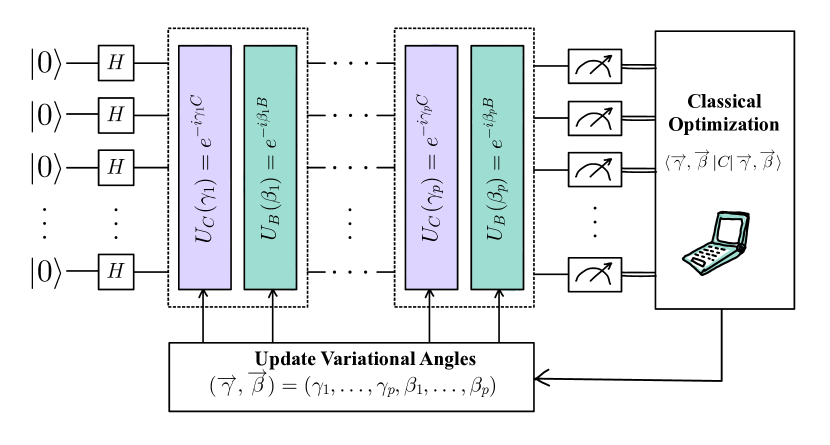
- The authors analyze subgraph-level similarity between donor and acceptor graphs using QAOA circuit depth p=1, focusing on local graph structures (lightcones) that define subgraphs.
- They compute QAOA energy for subgraphs using the QTensor tensor network simulator, enabling fast evaluation on graphs with up to 1,000 nodes.
- Transferability is assessed via the approximation ratio, comparing QAOA energy with optimized parameters from donor graphs to the classical optimal solution.
- Graph parity—defined by the overall degree parity of nodes—is used as a global similarity metric to predict transferability between donor-acceptor pairs.
- A transferability map is constructed for subgraphs with maximum node connectivity d_max=6, enabling systematic prediction of parameter reuse.
- The approach is validated across random graphs of varying sizes (6 to 256 nodes), with parameter reuse tested across both even- and odd-parity graph classes.
Experimental results
Research questions
- RQ1Can optimal QAOA parameters from small graphs be transferred to larger graphs with minimal loss in approximation ratio?
- RQ2How does subgraph-level similarity, particularly in lightcone structures, predict parameter transferability between QAOA instances?
- RQ3To what extent does graph parity—defined by the parity of node degrees—determine the success of parameter transfer between donor and acceptor graphs?
- RQ4Can parameter transferability be predicted without full optimization on large graphs, thereby accelerating QAOA execution?
- RQ5Does the proposed method remain effective when scaling to higher QAOA circuit depths (p > 1), despite increased subgraph complexity?
Key findings
- Optimal QAOA parameters from 6-node random graphs achieved an approximation ratio within 1–2% of the optimal solution when transferred to 64-, 128-, and 256-node random graphs.
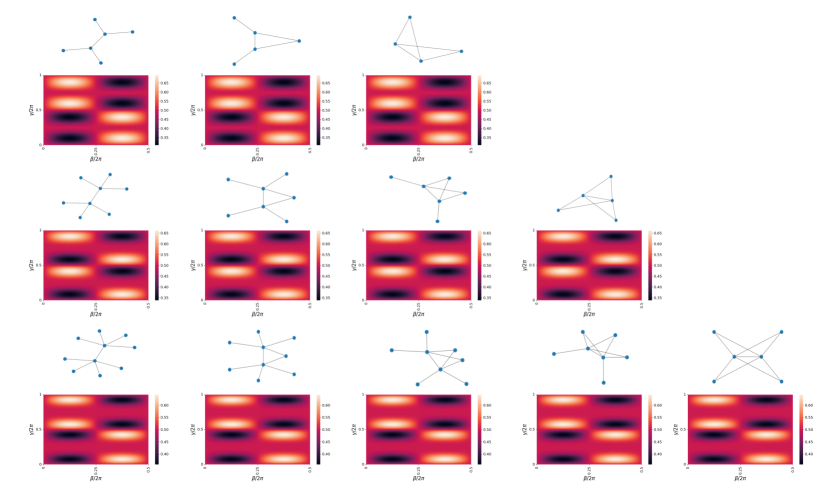
- Good parameter transferability was consistently observed between even-regular and odd-regular subgraphs, respectively, but poor transferability occurred between even- and odd-regular pairs.
- Subgraph similarity and parity similarity were found to be strongly correlated, with both factors jointly enabling accurate prediction of transferability.
- The QTensor tensor network simulator enabled fast energy evaluation for large graphs (N~1,000) at p=1, making subgraph-level analysis computationally feasible.
- Parameter transferability was robust even when donor graphs were much smaller than acceptor graphs, eliminating the need to scale up donor size.
- The method reduces the need for variational optimization on large graphs, potentially removing the optimization step entirely in favorable cases.
Read this paper
Open the full text in the Nubint reader and ask about any passage as you read.
Read this paper on NubintThis review was generated by AI from the original paper. Please check the paper before citing it.