
[Paper Review] Small LLMs Are Weak Tool Learners: A Multi-LLM Agent
This paper proposes α-UMi, a multi-LLM agent framework that decomposes tool learning into three specialized roles—planner, caller, and summarizer—each implemented by a separate small LLM. Using a global-to-local progressive fine-tuning strategy, α-UMi achieves superior performance on tool-use benchmarks, outperforming single-LLM agents even with smaller models, and demonstrates lower training and inference costs.
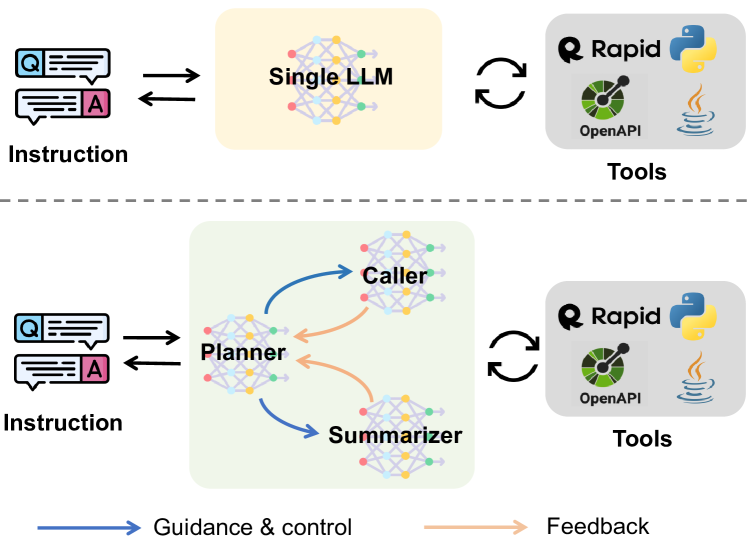
Large Language Model (LLM) agents significantly extend the capabilities of standalone LLMs, empowering them to interact with external tools (e.g., APIs, functions) and complete various tasks in a self-directed fashion. The challenge of tool use demands that LLMs not only understand user queries and generate answers accurately but also excel in task planning, tool invocation, and result summarization. While traditional works focus on training a single LLM with all these capabilities, performance limitations become apparent, particularly with smaller models. To overcome these challenges, we propose a novel approach that decomposes the aforementioned capabilities into a planner, caller, and summarizer. Each component is implemented by a single LLM that focuses on a specific capability and collaborates with others to accomplish the task. This modular framework facilitates individual updates and the potential use of smaller LLMs for building each capability. To effectively train this framework, we introduce a two-stage training paradigm. First, we fine-tune a backbone LLM on the entire dataset without discriminating sub-tasks, providing the model with a comprehensive understanding of the task. Second, the fine-tuned LLM is used to instantiate the planner, caller, and summarizer respectively, which are continually fine-tuned on respective sub-tasks. Evaluation across various tool-use benchmarks illustrates that our proposed multi-LLM framework surpasses the traditional single-LLM approach, highlighting its efficacy and advantages in tool learning.
Motivation & Objective
- Address the performance limitations of small LLMs in tool learning, where single models struggle with planning, tool invocation, and result summarization.
- Overcome the inflexibility and high cost of retraining large LLMs when tools evolve or require updates.
- Enable modular, maintainable, and cost-effective agent systems by decoupling tool learning into specialized components.
- Demonstrate that small LLMs can surpass larger single LLMs in tool learning performance through task decomposition and role-specific training.
Proposed method
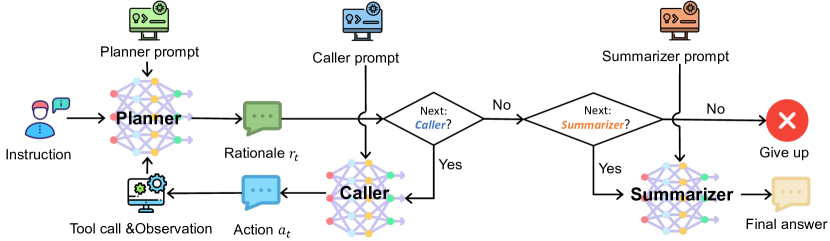
- Decompose tool learning into three distinct roles: planner (task reasoning and routing), caller (tool invocation), and summarizer (final answer generation).
- Implement each role using a separate small LLM, allowing specialization and independent updates.
- Introduce a two-stage global-to-local progressive fine-tuning (GLPFT) strategy: first pre-train a backbone LLM on the full dataset, then fine-tune each component on its specific sub-task.
- Use LLaMA-2 as the backbone model and instantiate three copies for planner, caller, and summarizer, each fine-tuned on task-specific data splits.
- Employ a collaborative inference pipeline where the planner guides the caller and summarizer based on intermediate outputs and execution states.
- Apply continual fine-tuning on reorganized datasets tailored to each component’s role, improving specialization and performance.
Experimental results
Research questions
- RQ1Can small LLMs achieve better tool learning performance when their capabilities are decomposed into specialized roles?
- RQ2Does a multi-LLM agent framework with role-specific training outperform a single-LLM agent on tool-use benchmarks?
- RQ3Can a global-to-local fine-tuning strategy effectively train modular components without performance degradation?
- RQ4Is the multi-LLM approach more cost-effective than training a larger single LLM for equivalent tool learning performance?
- RQ5How does the modular design improve robustness in handling tool failures or complex, multi-step tasks?
Key findings
- α-UMi with a 7B LLaMA-2 backbone outperforms a single-LLM agent with a 13B backbone on multiple tool-use benchmarks, demonstrating that smaller models can surpass larger ones when properly decomposed.
- The multi-LLM framework achieves higher success rates on complex, multi-step tasks, where the single-LLM baseline often fails due to misaligned planning or infinite loops.
- Inference latency for α-UMi is comparable to single-LLM baselines, with a median inference time of 11.09s for the 7B model, indicating efficient execution.
- Training costs for α-UMi with a 7B model are lower than for a single 13B model, both in terms of FLOPs and training time, confirming its cost-effectiveness.
- The planner in α-UMi successfully detects and recovers from failed API calls (e.g., broken YouTube search API), demonstrating robustness in dynamic tool environments.
- Ablation studies confirm that the global-to-local fine-tuning strategy significantly improves performance, especially in reasoning and tool selection accuracy.
Read this paper
Open the full text in the Nubint reader and ask about any passage as you read.
Read this paper on NubintThis review was generated by AI from the original paper. Please check the paper before citing it.