
[Paper Review] SnapKV: LLM Knows What You are Looking for Before Generation
SnapKV is a fine-tuning-free KV cache compression method that identifies and clusters important attention features per head from an observation window, enabling faster decoding and lower memory usage with comparable accuracy on long-context LLM tasks.
Large Language Models (LLMs) have made remarkable progress in processing extensive contexts, with the Key-Value (KV) cache playing a vital role in enhancing their performance. However, the growth of the KV cache in response to increasing input length poses challenges to memory and time efficiency. To address this problem, this paper introduces SnapKV, an innovative and fine-tuning-free approach that efficiently minimizes KV cache size while still delivering comparable performance in real-world applications. We discover that each attention head in the model consistently focuses on specific prompt attention features during generation. Meanwhile, this robust pattern can be obtained from an 'observation' window located at the end of the prompts. Drawing on this insight, SnapKV automatically compresses KV caches by selecting clustered important KV positions for each attention head. Our approach significantly reduces the growing computational overhead and memory footprint when processing long input sequences. Specifically, SnapKV achieves a consistent decoding speed with a 3.6x increase in generation speed and an 8.2x enhancement in memory efficiency compared to the baseline when processing inputs of 16K tokens. At the same time, it maintains comparable performance to the baseline models across 16 long sequence datasets. Moreover, SnapKV can process up to 380K context tokens on a single A100-80GB GPU using HuggingFace implementation with minor changes, exhibiting only a negligible accuracy drop in the Needle-in-a-Haystack test. Further comprehensive studies suggest SnapKV's potential for practical applications.
Motivation & Objective
- Investigate whether attention to prompt tokens follows consistent patterns during generation.
- Develop a KV cache compression method that reduces prompt KV size without sacrificing performance.
- Show that per-head feature clustering can preserve essential information while enabling efficient long-context processing.
- Evaluate SnapKV across multiple LLMs and long-context benchmarks to establish speed and memory benefits.
Proposed method
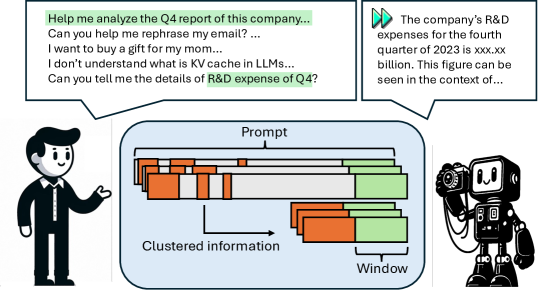
- Analyze prompt-to-prefix attention to identify consistent important KV positions using an observation window.
- Vote and aggregate attention weights to select top-K important positions per head (Top-k on pooled weights).
- Apply 1D pooling (kernel_size) to cluster nearby important positions for fine-grained compression.
- Concatenate the selected features with the observation window before storing the revised KV cache for generation.
- Provide a practical, minimal-code implementation of SnapKV that integrates with common frameworks.
- Evaluate accuracy and efficiency across long-context datasets and models, and test compatibility with parallel decoding.
Experimental results
Research questions
- RQ1Is there a consistent pattern in the attention allocated to prompt tokens across generation contexts?
- RQ2How do prompt length, instruction position, and task type affect the identified important KV features?
- RQ3Can context-aware KV compression maintain generation quality while dramatically reducing KV cache size?
Key findings
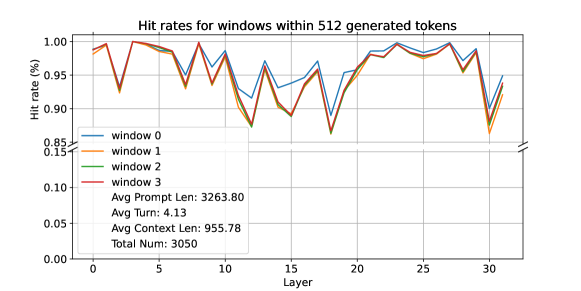
- Attention allocation to certain prompt keys remains remarkably consistent during generation across contexts.
- Instruction positioning (before vs after context) yields high hit rates, while different instructions shift which prefix keys are deemed important.
- Pooling-based clustering improves retrieval accuracy over naive top-K selection in KV compression.
- SnapKV achieves 3.6x faster decoding and 8.2x memory efficiency gains for 16K-token inputs compared to baselines.
- SnapKV can process up to 380K context tokens on a single A100-80GB GPU with negligible accuracy drop in Needle-in-a-Haystack tests.
- On LongBench, compressing prompt KV caches to 1024/2048/4096 tokens yields negligible performance loss, with an average 92% compression at 1024 and 68% at 4096.
Read this paper
Open the full text in the Nubint reader and ask about any passage as you read.
Read this paper on NubintThis review was generated by AI from the original paper. Please check the paper before citing it.