
[Paper Review] Snapshot High Dynamic Range Imaging with a Polarization Camera
This paper presents a low-cost, reversible method to transform an off-the-shelf polarization camera into a snapshot high dynamic range (HDR) imaging system by placing a linear polarizer in front of the lens, enabling simultaneous capture of four differently exposed images via polarization angle modulation. The authors introduce a self-calibrating, outlier-robust HDR reconstruction algorithm that outperforms state-of-the-art software-only and polarization-based HDR methods, achieving high accuracy even with imperfect polarizers.
High dynamic range (HDR) images are important for a range of tasks, from navigation to consumer photography. Accordingly, a host of specialized HDR sensors have been developed, the most successful of which are based on capturing variable per-pixel exposures. In essence, these methods capture an entire exposure bracket sequence at once in a single shot. This paper presents a straightforward but highly effective approach for turning an off-the-shelf polarization camera into a high-performance HDR camera. By placing a linear polarizer in front of the polarization camera, we are able to simultaneously capture four images with varied exposures, which are determined by the orientation of the polarizer. We develop an outlier-robust and self-calibrating algorithm to reconstruct an HDR image (at a single polarity) from these measurements. Finally, we demonstrate the efficacy of our approach with extensive real-world experiments.
Motivation & Objective
- To enable high dynamic range (HDR) imaging with minimal hardware modification to existing polarization cameras.
- To address motion-induced ghosting in multi-shot HDR by enabling single-shot HDR capture using polarization multiplexing.
- To develop a self-calibrating, outlier-robust HDR reconstruction algorithm that compensates for imperfect polarizers and light leakage.
- To evaluate the impact of polarizer imperfections and highly polarized scenes on HDR reconstruction quality.
- To demonstrate that the method achieves superior HDR reconstruction performance compared to software-only and existing polarization-based HDR techniques.
Proposed method
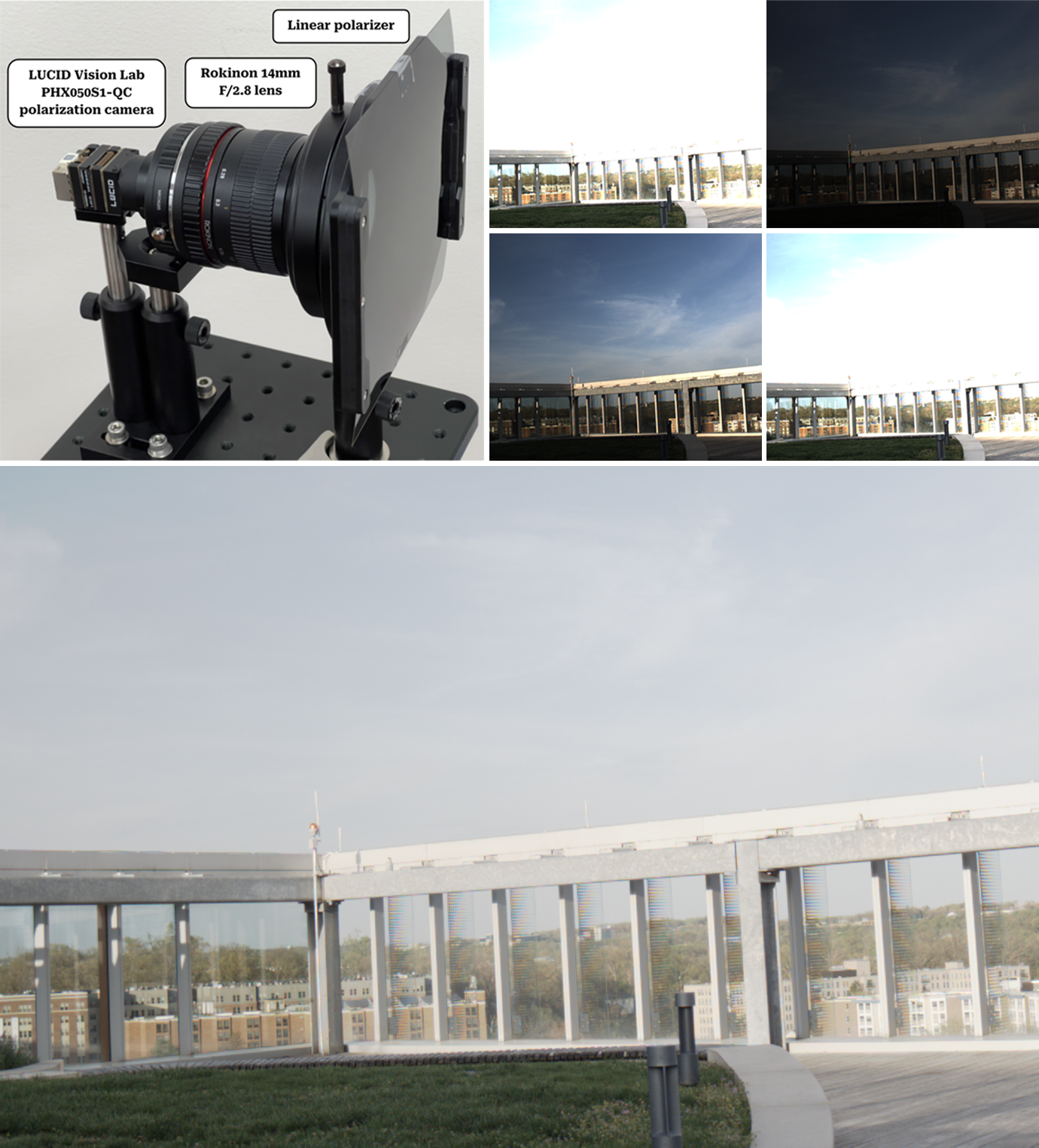
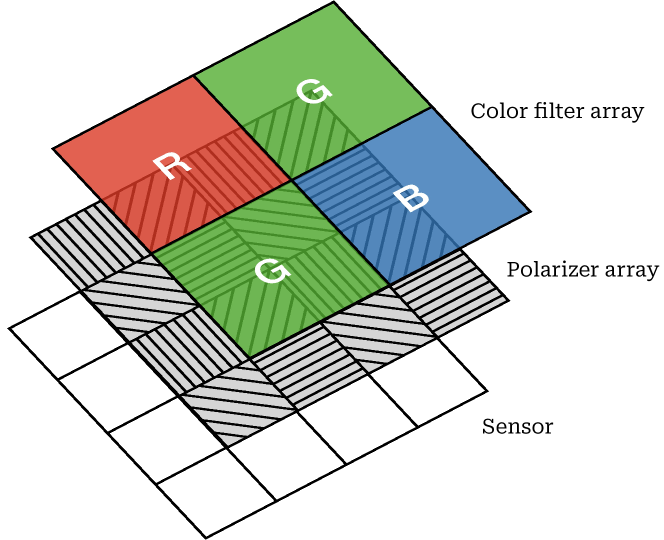
- A linear polarizer is placed in front of a polarization camera’s lens, enabling four distinct exposure levels based on the relative angle between the polarizer and the camera’s underlying polarization grid.
- The system captures four multi-exposure images in a single shot by exploiting the angular dependence of transmitted light intensity through the polarizer and polarization array.
- A self-calibrating HDR reconstruction algorithm estimates the true scene radiance by solving a non-linear optimization problem that accounts for polarizer extinction ratio and misalignment.
- The algorithm incorporates outlier rejection to mitigate errors from light leakage and imperfect polarizers, improving robustness in real-world conditions.
- The method leverages the fact that orthogonal polarization states (e.g., 0° and 90°) produce significantly different exposures, enabling dynamic range extension.
- The approach is reversible: removing the polarizer restores the camera’s original polarization imaging capability for applications like reflection removal and material classification.
Experimental results
Research questions
- RQ1Can a standard polarization camera be repurposed for snapshot HDR imaging with minimal hardware modification?
- RQ2How does the extinction ratio of a linear polarizer affect HDR reconstruction accuracy and dynamic range extension?
- RQ3Can a self-calibrating, outlier-robust algorithm effectively reconstruct HDR images from multi-exposure polarization measurements under real-world imperfections?
- RQ4How does the incident light’s polarization state (e.g., from specular reflections) influence the reconstructed HDR image quality?
- RQ5Does the proposed method outperform existing software-only and polarization-based HDR reconstruction techniques in practice?
Key findings
- The method achieves high-quality HDR reconstruction with a 2.93% error in angle estimation when using a polarizer with an extinction ratio of 1:500, demonstrating robustness to real-world imperfections.
- The proposed HDR reconstruction algorithm significantly outperforms state-of-the-art software-only HDR methods and existing polarization-camera-based HDR techniques in both quantitative metrics and visual quality.
- The system effectively filters out specular reflections when the polarizer is oriented vertically, enabling clear imaging of underlying surfaces such as riverbeds, which is not possible with standard HDR methods.
- The method maintains high dynamic range performance even when the incident light is highly polarized, with reconstruction quality preserved across varying polarization angles.
- The approach is reversible and dual-purpose: the same hardware can be used for both HDR imaging and polarization-sensitive imaging, offering flexibility and cost efficiency.
- The system achieves a cost of as little as $40 for users who already own a polarization camera, compared to specialized mosaiced HDR sensors that cost over $500.
Read this paper
Open the full text in the Nubint reader and ask about any passage as you read.
Read this paper on NubintThis review was generated by AI from the original paper. Please check the paper before citing it.