
[Paper Review] Specificity-Preserving Federated Learning for MR Image Reconstruction
This paper proposes FedMRI, a specificity-preserving federated learning framework for MR image reconstruction that decouples a globally shared encoder from client-specific decoders in both k-space and image space. By introducing a weighted contrastive regularization to correct local gradient drift, FedMRI achieves state-of-the-art reconstruction performance on multi-institutional data while preserving domain-specific scanner characteristics.
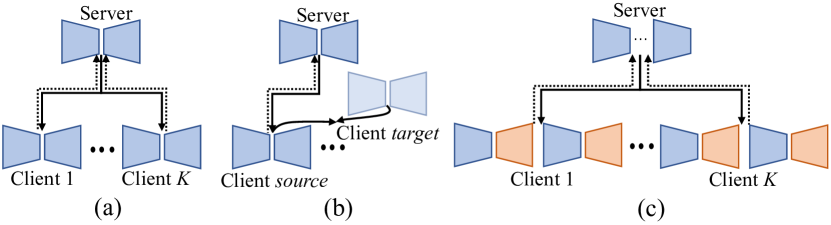
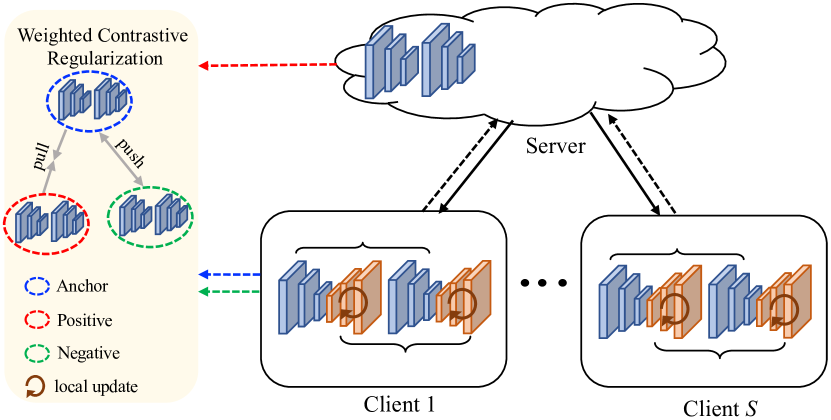
Federated learning (FL) can be used to improve data privacy and efficiency in magnetic resonance (MR) image reconstruction by enabling multiple institutions to collaborate without needing to aggregate local data. However, the domain shift caused by different MR imaging protocols can substantially degrade the performance of FL models. Recent FL techniques tend to solve this by enhancing the generalization of the global model, but they ignore the domain-specific features, which may contain important information about the device properties and be useful for local reconstruction. In this paper, we propose a specificity-preserving FL algorithm for MR image reconstruction (FedMRI). The core idea is to divide the MR reconstruction model into two parts: a globally shared encoder to obtain a generalized representation at the global level, and a client-specific decoder to preserve the domain-specific properties of each client, which is important for collaborative reconstruction when the clients have unique distribution. Such scheme is then executed in the frequency space and the image space respectively, allowing exploration of generalized representation and client-specific properties simultaneously in different spaces. Moreover, to further boost the convergence of the globally shared encoder when a domain shift is present, a weighted contrastive regularization is introduced to directly correct any deviation between the client and server during optimization. Extensive experiments demonstrate that our FedMRI's reconstructed results are the closest to the ground-truth for multi-institutional data, and that it outperforms state-of-the-art FL methods.
Motivation & Objective
- Address the domain shift problem in multi-institutional MR image reconstruction caused by heterogeneous scanning protocols and hardware.
- Preserve client-specific imaging characteristics (e.g., scanner-specific properties) that are lost in conventional federated learning due to model averaging.
- Improve global model generalization without sacrificing local reconstruction fidelity by jointly optimizing in both k-space and image space.
- Develop a lightweight, efficient training mechanism that avoids repeated client-to-client alignment and reduces communication overhead.
Proposed method
- Decompose the MR reconstruction model into a globally shared encoder and client-specific decoders, enabling joint learning of generalized and domain-specific features.
- Perform model training simultaneously in both k-space (frequency domain) and image space to capture complementary representations.
- Introduce a weighted contrastive regularization term that compares model weights (not features) across clients to correct local gradient deviation during optimization.
- Use the L1 norm in the weighted contrastive loss to improve robustness and convergence, avoiding reliance on large batch sizes common in feature-based contrastive learning.
- Train the shared encoder using a client-averaged update rule that incorporates the contrastive regularization to align local updates toward a common global representation.
- Limit model sharing to only the encoder and first downsampling layers to preserve client-specific information in the decoder.
Experimental results
Research questions
- RQ1Can preserving client-specific imaging characteristics improve reconstruction quality in federated MR image reconstruction under domain shift?
- RQ2Does joint optimization in both k-space and image space lead to better generalization and fidelity than single-space training?
- RQ3Can a weight-based contrastive regularization mechanism effectively correct local gradient drift without requiring feature-level alignment or large batch sizes?
- RQ4How does the proportion of shared model parameters affect reconstruction performance and privacy preservation in a federated setting?
Key findings
- FedMRI achieves the highest PSNR and SSIM scores on multi-institutional MR datasets, outperforming state-of-the-art FL methods including FedAvg, FedProx, and FL-MRCM.
- The ablation study shows that sharing the entire local model (Ours₁) degrades performance, confirming that preserving client-specific decoders is essential.
- The L1-norm based weighted contrastive regularization yields the best reconstruction accuracy—1.53 dB higher than L2 and 1.78 dB higher than NT-Xent loss—demonstrating its superiority in handling domain shift.
- FedMRI’s training time is comparable to FedAvg and FedBN, with only a marginal increase due to the contrastive regularization, making it computationally feasible for real-world deployment.
- The method reduces communication cost by avoiding repeated adversarial training between source and target clients, which doubles training time in FL-MRCM.
- Results show that preserving domain-specific properties in both k-space and image space leads to more accurate and robust reconstruction than methods that optimize only in the image space.
Read this paper
Open the full text in the Nubint reader and ask about any passage as you read.
Read this paper on NubintThis review was generated by AI from the original paper. Please check the paper before citing it.