
[Paper Review] Spectroscopic performance evaluation and modeling of a low background HPGe detector using GEANT4
This study evaluates and models a low-background HPGe detector at IIT Ropar using GEANT4 Monte Carlo simulations to optimize spectroscopic performance for environmental radioactivity measurements. The simulated full-energy peak efficiency matched experimental data within 7% deviation (93% confidence), enabling improved detection limits for primordial radionuclides (U/Th/K) in soil and rock samples.
Low background gamma spectrometry employing HPGe detectors is a sensitive technique for measuring low-level radioactivity in environmental applications, material screening, and for rare decay searches. This work presents spectroscopic performance evaluation and modelling of a low background measurement setup developed at IIT Ropar in Punjab, India, to measure trace natural radioactive elements, with a particular interest in studying low-level radioactivity in soil and/or rock samples to generate specific inputs for low background experiments. The performance test and characterization of a low background cryocooled HPGe detector with relative efficiency of $\sim$33% have been carried out. An effective detector model has been developed using GEANT4 Monte Carlo simulation to determine the response of the detector over an energy range of 80.9-1408 keV and compared with the experimental performance of the detector. The response of the detector obtained using Monte Carlo simulations agrees reasonably well within 93% level of confidence, indicating only 7% deviation in the comparison. The present setup offers improved detection limits of primordial radionuclides (U/Th and K) to measure radioactive contamination in environmental matrices, which has been used elsewhere [1].
Motivation & Objective
- To develop a low-background HPGe detector setup at IIT Ropar for measuring trace natural radioactivity in environmental matrices.
- To characterize the detector’s spectroscopic performance, including peak efficiency, resolution, and background contributions.
- To validate experimental results using GEANT4 Monte Carlo simulations for accurate detector response modeling.
- To improve detection limits for primordial radionuclides (238U, 232Th, 40K) in soil and rock samples to support rare decay physics.
- To identify background sources and propose shielding and veto system upgrades to enhance sensitivity for future low-background experiments.
Proposed method
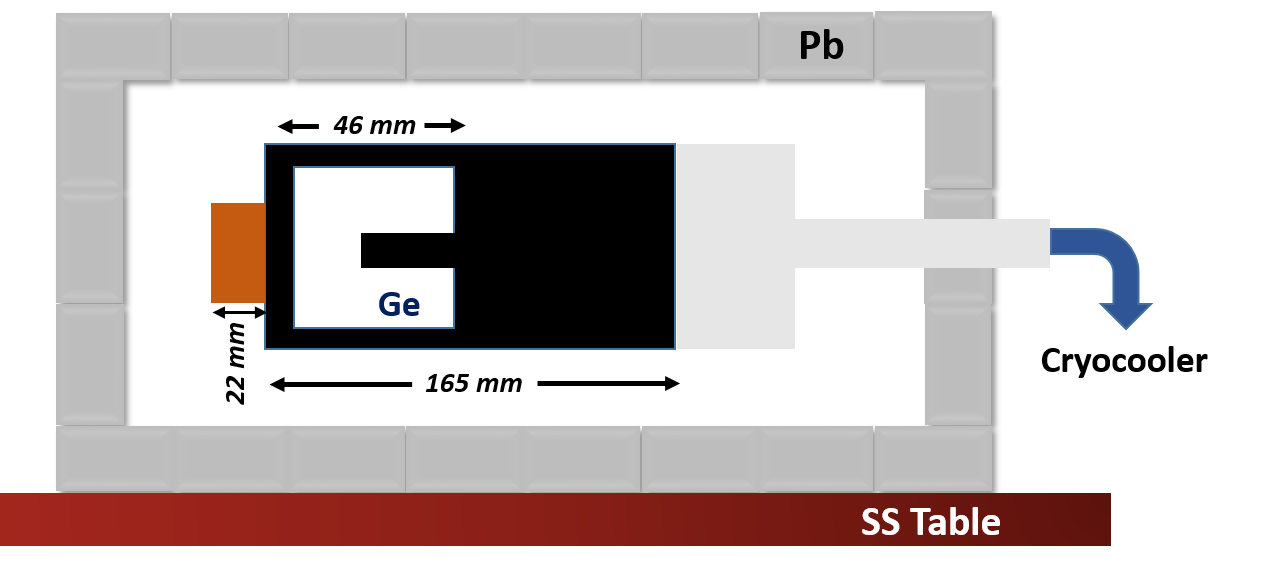
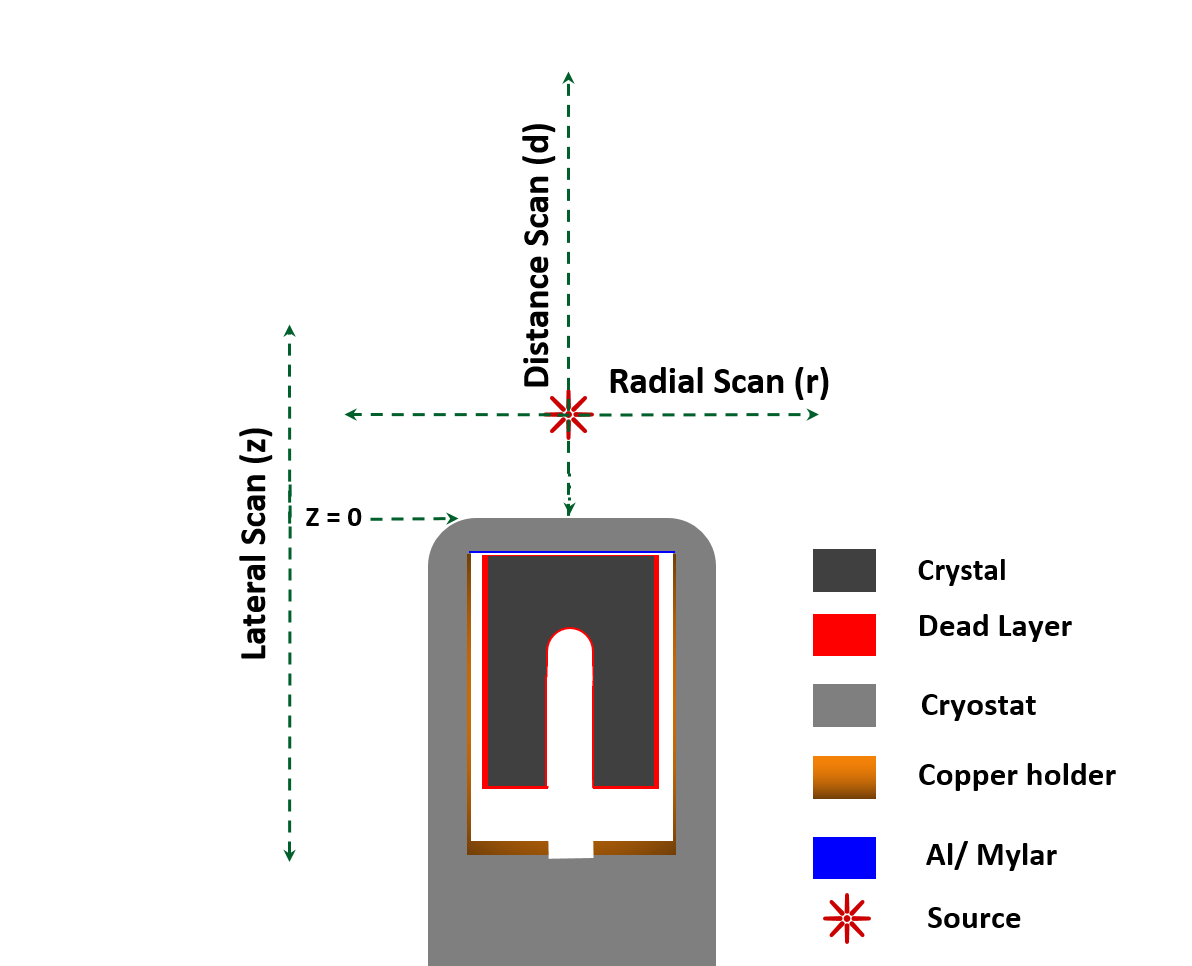
- Developed a detailed GEANT4 Monte Carlo model of the HPGe detector, including crystal geometry, dead layers, and shielding components.
- Performed lateral, radial, and axial scanning of the germanium crystal using mono-energetic gamma sources to map internal structure and optimize detector parameters.
- Calculated full-energy peak efficiency (FEPE) across 80.9–1408 keV using simulated and experimental data for comparison.
- Used the equation $ A_{ ext{γ}} = rac{N_{ ext{γ}}}{I_{ ext{γ}} imes m imes ho_{ ext{γ}} imes t} $ to determine specific activity from net peak counts after background correction.
- Conducted point-source measurements to evaluate peak shape, peak-to-compton ratio (P/C), and figure of merit (FOM).
- Applied background correction and efficiency calibration to determine activity concentrations in soil and rock samples.
Experimental results
Research questions
- RQ1How accurately can GEANT4 simulate the full-energy peak efficiency of a low-background HPGe detector across a wide energy range (80.9–1408 keV)?
- RQ2What are the dominant background contributions in above-ground HPGe measurements, and how do they affect detection limits for primordial radionuclides?
- RQ3To what extent do detector geometry, crystal dimensions, and dead layers influence spectroscopic performance and efficiency?
- RQ4What are the specific activity concentrations of 238U, 232Th, and 40K in soil and rock samples from the IIT Ropar site, and how do they compare to literature values?
- RQ5What shielding and veto system upgrades are necessary to reduce background and improve detection limits for rare decay searches?
Key findings
- The GEANT4-simulated full-energy peak efficiency of the HPGe detector agreed with experimental measurements within 7% deviation, indicating 93% confidence in the model's accuracy.
- The mean specific activity of 238U, 232Th, and 40K in soil samples from the agricultural test site was 50, 85, and 670 Bq/kg, respectively, with consistent distributions for U and Th and higher variability for K.
- In rock samples, 238U activity was measured at 7 (1) Bq/kg, while 232Th and 40K were below detectable limits with the current setup.
- The current setup requires an order-of-magnitude reduction in background to detect 232Th and 40K in rock samples, necessitating thicker low-activity lead and copper shielding.
- Cosmic muon-induced interactions dominate the background in above-ground setups, and adding a cosmic muon veto system could reduce background by approximately 50%.
- Future upgrades, including low-activity shielding and plastic veto detectors, are underway to enhance sensitivity for rare decay physics experiments.
Read this paper
Open the full text in the Nubint reader and ask about any passage as you read.
Read this paper on NubintThis review was generated by AI from the original paper. Please check the paper before citing it.