
[Paper Review] The low multipoles in the Pantheon+SH0ES data
This paper analyzes the monopole, dipole, and quadrupole components in the Pantheon+SH0ES supernova data, finding significant detections of all three at high statistical significance. It shows that the observed anisotropies—particularly the dipole and quadrupole—align with a bulk flow of approximately 380 km/s within a 112 h⁻¹ Mpc radius, consistent with predictions from the standard ΛCDM model, suggesting the data may reflect large-scale peculiar velocities rather than a violation of the cosmological principle.
In previous work we have shown that the dipole in the low redshift supernovae of the Pantheon+SH0ES data does not agree with the one inferred from the velocity of the solar system as obtained from CMB data. We interpreted this as the presence of significant bulk velocities. In this paper we study the monopole, dipole and quadrupole in the Pantheon+SH0ES data. We find that in addition to the dipole also both, the monopole and the quadrupole are detected with high significance. They are of similar amplitudes as the bulk flow. While the monopole is only significant at very low redshift, the quadrupole even increases with redshift.
Motivation & Objective
- To investigate whether the anomalous dipole in the Pantheon+SH0ES supernova data—previously found to differ from the CMB dipole—can be explained by a bulk flow of matter.
- To test the hypothesis that the observed dipole is due to the solar system's motion relative to a bulk flow, rather than a global cosmological dipole.
- To determine whether the monopole and quadrupole components in the supernova data are also significantly detected and consistent with the same bulk flow.
- To assess the statistical significance of the observed anisotropies and their compatibility with the standard ΛCDM model.
- To evaluate whether the observed bulk velocity is a rare fluctuation or a plausible outcome within the standard cosmological framework.
Proposed method
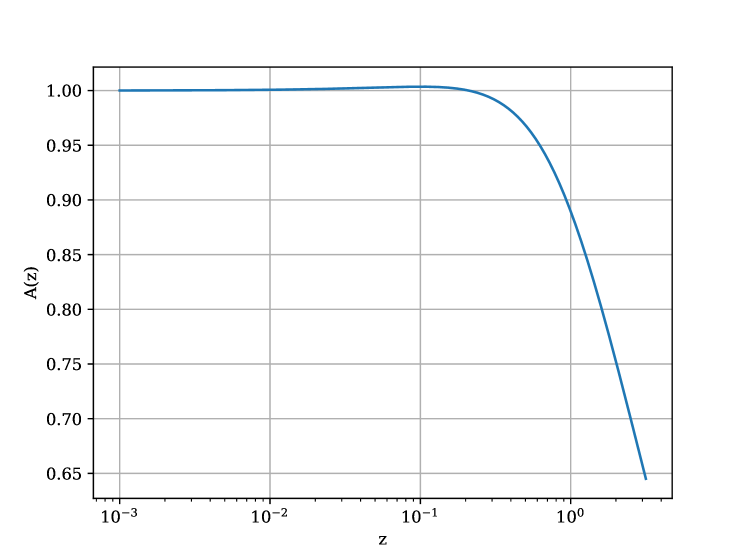
- The authors use cosmological perturbation theory to model the luminosity distance of type Ia supernovae as a function of direction and redshift, including contributions from observer velocity, source peculiar velocity, and metric perturbations.
- They decompose the supernova distance data into spherical harmonics to extract the monopole, dipole, and quadrupole components, using a likelihood analysis to estimate amplitudes and uncertainties.
- The analysis includes redshift cuts (e.g., z ≤ 0.0375) to isolate low-redshift structures and improve signal-to-noise for bulk flow estimation.
- They compute the expected velocity dispersion in the ΛCDM model using the power spectrum of density fluctuations and a top-hat window function in real space.
- The probability of observing a bulk velocity of 380 km/s on a scale of 112 h⁻¹ Mpc is evaluated using a χ² distribution with 3 degrees of freedom.
- The model assumes a spatially flat Friedmann-Lemaître universe with linear scalar perturbations in Newtonian gauge, using the Bardeen potentials Φ and Ψ.
Experimental results
Research questions
- RQ1Is the observed dipole in the Pantheon+SH0ES supernova data consistent with the solar system's motion as inferred from CMB data?
- RQ2Are the monopole and quadrupole components in the supernova data also significantly detected, and do they have amplitudes comparable to the dipole?
- RQ3Can the observed anisotropies be explained by a bulk flow of matter, rather than a violation of the cosmological principle?
- RQ4What is the probability of observing a bulk velocity of ~380 km/s on a scale of 112 h⁻¹ Mpc within the ΛCDM model?
- RQ5How do the monopole and quadrupole amplitudes evolve with redshift, and what does this imply about the underlying velocity field?
Key findings
- The monopole, dipole, and quadrupole components in the Pantheon+SH0ES data are all detected with high significance, indicating large-scale anisotropies in the supernova distance distribution.
- The quadrupole amplitude increases with redshift, suggesting a coherent structure extending to higher redshifts, unlike the dipole which decays rapidly.
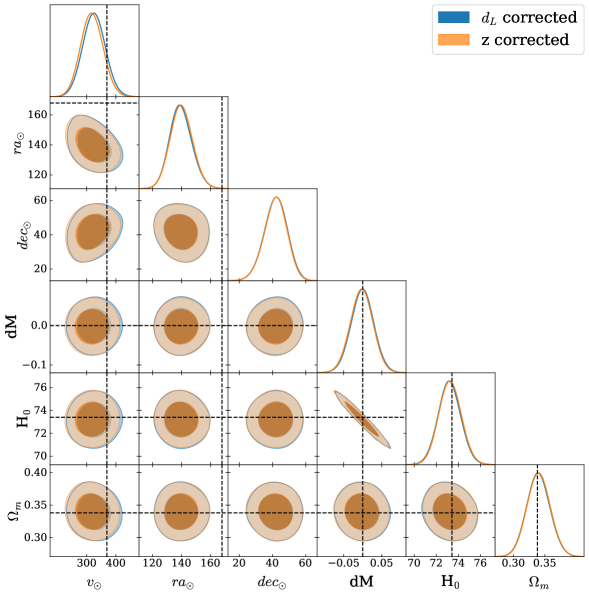
- The bulk velocity inferred from the data is approximately 380 km/s within a redshift cut of z ≤ 0.0375 (corresponding to R ≈ 112 h⁻¹ Mpc), consistent with the CMB-based velocity of the solar system.
- The probability of observing such a bulk velocity in the ΛCDM model is about 8.18%, indicating it is not extremely unlikely and thus not in strong tension with standard cosmology.
- The monopole is only significant at very low redshifts (z < 0.0175), while the quadrupole remains detectable and even grows with redshift, suggesting a non-trivial spatial structure.
- The results support the interpretation that the observed dipole and higher multipoles arise from a local bulk flow, not a global cosmological dipole, and are consistent with the standard ΛCDM model.
Read this paper
Open the full text in the Nubint reader and ask about any passage as you read.
Read this paper on NubintThis review was generated by AI from the original paper. Please check the paper before citing it.