
[Paper Review] The Protein Engineering Tournament: An Open Science Benchmark for Protein Modeling and Design
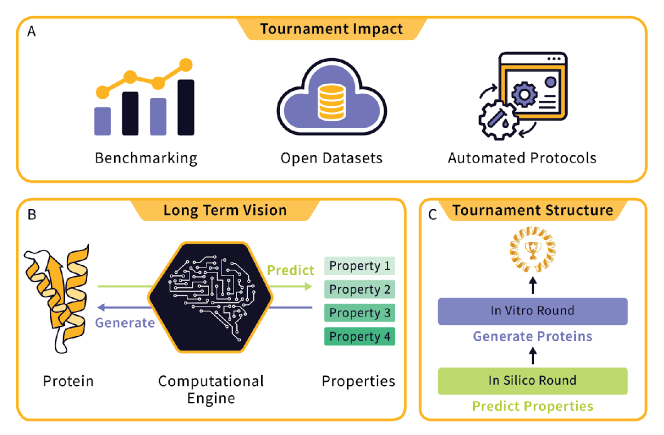
The Protein Engineering Tournament is a biennial, open-science competition that benchmarks computational protein design through two rounds: in silico prediction of protein properties and in vitro experimental validation of designed sequences using cloud labs. It provides open datasets, standardized automated protocols, and a transparent platform to accelerate progress in computational protein engineering.
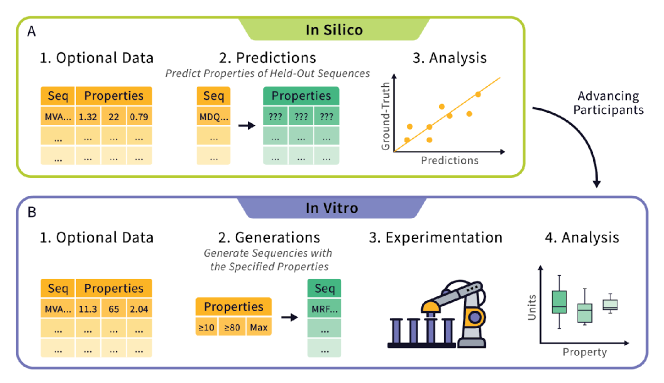
The grand challenge of protein engineering is the development of computational models that can characterize and generate protein sequences for any arbitrary function. However, progress today is limited by lack of 1) benchmarks with which to compare computational techniques, 2) large datasets of protein function, and 3) democratized access to experimental protein characterization. Here, we introduce the Protein Engineering Tournament, a fully-remote, biennial competition for the development and benchmarking of computational methods in protein engineering. The tournament consists of two rounds: a first in silico round, where participants use computational models to predict biophysical properties for a set of protein sequences, and a second in vitro round, where participants are challenged to design new protein sequences, which are experimentally measured with open-source, automated methods to determine a winner. At the Tournament's conclusion, the experimental protocols and all collected data will be open-sourced for continued benchmarking and advancement of computational models. We hope the Protein Engineering Tournament will provide a transparent platform with which to evaluate progress in this field and mobilize the scientific community to conquer the grand challenge of computational protein engineering.
Motivation & Objective
- Address the lack of standardized benchmarks for evaluating computational protein engineering models.
- Overcome limitations in existing datasets, which are often simple, non-reproducible, or inaccessible.
- Democratize access to experimental protein characterization by leveraging cloud laboratories for high-throughput, reproducible assays.
- Create a community-driven platform that accelerates innovation in protein engineering through competition and collaboration.
- Promote transparency and reproducibility by open-sourcing all experimental protocols, datasets, and results after each tournament.
Proposed method
- Organize a biennial, fully remote competition with two sequential rounds: in silico and in vitro.
- Use computational models to predict biophysical properties of protein sequences in the in silico round, with optional training data provided per event.
- Employ cloud laboratories to perform high-throughput, automated, and reproducible in vitro characterization of designed protein sequences.
- Evaluate in vitro performance using event-specific, weighted metrics based on desired protein properties.
- Open-source all experimental protocols, datasets, and results post-tournament to enable ongoing benchmarking and model validation.
- Integrate community input through volunteer-led teams in target selection, data science, outreach, and assay development, coordinated by Align to Innovate.
Experimental results
Research questions
- RQ1Can a standardized, community-driven benchmark improve the evaluation and development of computational protein engineering models?
- RQ2How do different computational methods perform in predicting protein biophysical properties across diverse, real-world challenges?
- RQ3To what extent can cloud-based automation enable scalable, reproducible, and accessible experimental validation of protein designs?
- RQ4Can open-sourcing experimental protocols and datasets sustain long-term model benchmarking beyond the tournament timeframe?
- RQ5How can a tournament format mobilize diverse participants—including academics, industry, and independent researchers—toward solving high-impact protein engineering challenges?
Key findings
- The pilot tournament, launched in May 2023 with a focus on enzyme design, attracted over 30 teams from academia, industry, and independent research, including participants from high school to Nobel laureate level.
- The in silico round successfully evaluated computational predictions against ground-truth experimental data, enabling performance comparison across diverse modeling approaches.
- In vitro experiments were performed in-house during the pilot using corporate partner infrastructure, validating the feasibility of high-throughput protein characterization.
- Development of cloud laboratory assays for future tournaments is underway, signaling a scalable path toward standardized, automated experimental workflows.
- All experimental protocols and datasets generated during the tournament will be open-sourced, enabling continued benchmarking and model validation by the broader scientific community.
- The tournament framework successfully integrates computational modeling with experimental validation, creating a dynamic, evolving benchmark for protein engineering.
Read this paper
Open the full text in the Nubint reader and ask about any passage as you read.
Read this paper on NubintThis review was generated by AI from the original paper. Please check the paper before citing it.