
[Paper Review] Topological responses from gapped Weyl points in 2D altermagnets
This paper identifies and classifies symmetry-protected Weyl points in two-dimensional altermagnets, where spin-degenerate bands split due to altermagnetic order, leading to topologically non-trivial phases when gapped by mass terms. It demonstrates quantized $π$-Berry phases and predicts anomalous electronic and thermal Hall responses, including spin Nernst effects in magnon systems, with distinct topological invariants (Chern and spin Chern numbers) governing edge states and transport responses in gapped phases.
We study the symmetry requirements for topologically protected spin-polarized Weyl points in 2D altermagnets. The topology is characterized by a quantized $π$-Berry phase and the degeneracy is protected by spin-space group symmetries. Gapped phases with finite Chern and/or spin/chirality Chern numbers emerge under different symmetry-breaking mass terms. We investigate the surface and transport properties of these gapped phases using representative electronic tight-binding and magnonic linear spin-wave models. In particular, we calculate the electronic and magnonic Hall currents and discuss implications for experiments.
Motivation & Objective
- To classify all spin-wallpaper groups that protect Weyl point degeneracies in 2D altermagnets with same-spin band crossings.
- To establish the role of time-reversal and mirror symmetries in protecting topological Weyl points without net magnetization.
- To construct electronic and magnonic models that realize these Weyl points and study their gapped topological phases.
- To investigate topological responses such as anomalous Hall, spin Hall, and thermal Hall effects in the resulting gapped phases.
- To link symmetry-breaking mass terms (e.g., strain, light coupling) to phase transitions between topologically distinct states with quantized responses.
Proposed method
- Classify all spin-wallpaper groups compatible with altermagnetic order that protect Weyl points via group theory and spin-space group analysis.
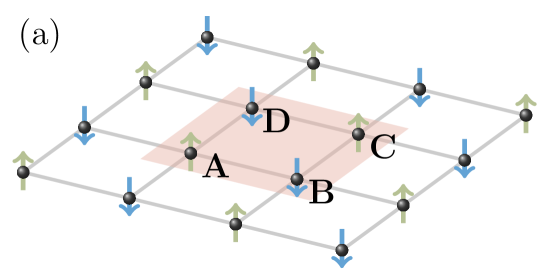
- Construct a spin-dependent electronic tight-binding Hamiltonian for the p${}^{\overline{1}}$4${}^{\overline{1}}$m1m group, realizing four symmetry-related Weyl points with spin-polarized bands.
- Develop a linear spin-wave model for magnons in the same symmetry group to study topological magnonic band structures.
- Compute topological invariants: Chern number $C$ and spin Chern number $C_{\vartheta}$, using Berry curvature integration over the Brillouin zone.
- Derive expressions for thermal Hall conductivity $\kappa^{xy}(T)$ and magnon spin Nernst coefficient $\alpha^{xy}(T)$ using bosonic distribution functions and Berry curvature.
- Analyze edge states and transport responses under various mass terms, including time-reversal-breaking perturbations induced by light or substrates.
Experimental results
Research questions
- RQ1Which spin-wallpaper groups in 2D altermagnets can protect Weyl points between bands of the same spin quantum number?
- RQ2How do symmetry-protected Weyl points in altermagnets lead to quantized $\pi$-Berry phases and non-trivial topology?
- RQ3What are the emergent topological phases when Weyl points are gapped by symmetry-breaking mass terms, and what topological invariants characterize them?
- RQ4How do electronic and magnonic systems in these altermagnets exhibit anomalous Hall and Nernst responses in the gapped phases?
- RQ5Can external perturbations like circularly polarized light induce topological phase transitions and valley-specific responses in these systems?
Key findings
- The paper identifies 12 spin-wallpaper groups that protect Weyl points in 2D altermagnets, with non-trivial topology characterized by a quantized $\pi$-Berry phase.
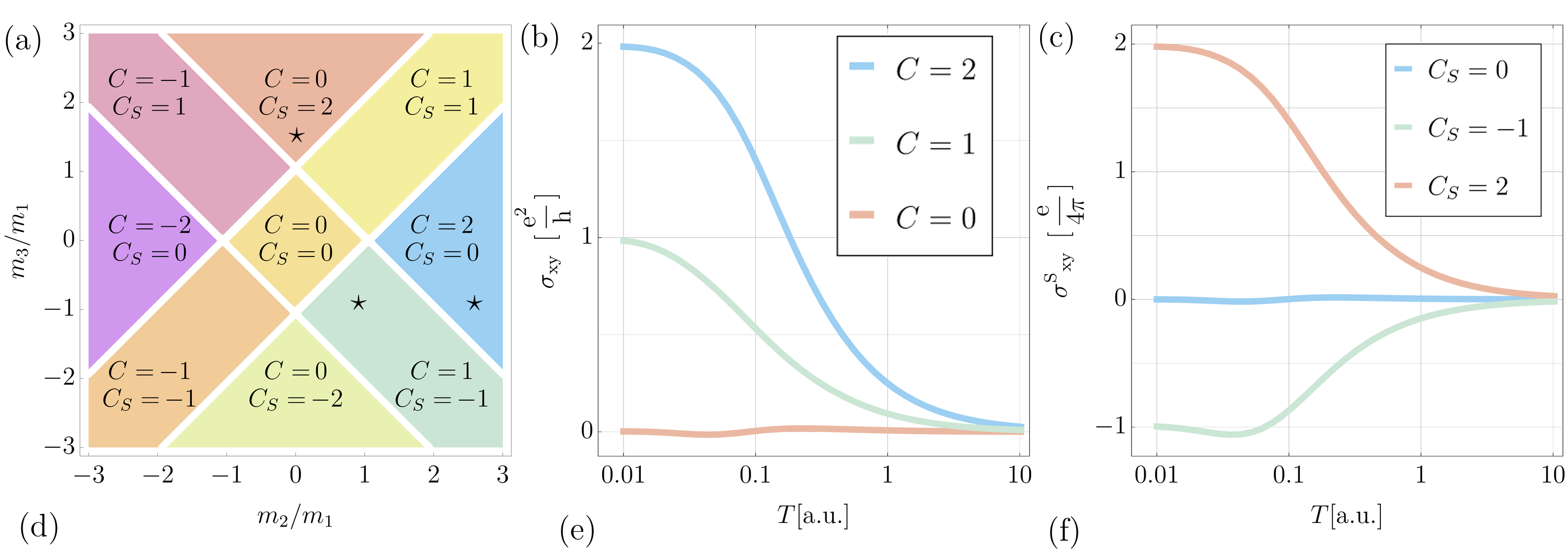
- In the electronic model, gapped phases with $C=2$, $C=1$, and $C=0$ exhibit distinct edge state configurations and quantized Hall responses.
- For magnons, the phase with $C=2$ and $C_{\vartheta}=0$ hosts two degenerate edge states of opposite chirality, while $C=0$ and $C_{\vartheta}=2$ supports two counter-propagating edge states.
- Thermal Hall conductivity $\kappa^{xy}(T)$ is finite only in phases with $C \neq 0$, and the magnon spin Nernst coefficient $\alpha^{xy}(T)$ is finite only when $C_{\vartheta} \neq 0$, confirming topological responses.
- In the trivial phase, both $\kappa^{xy}(T)$ and $\alpha^{xy}(T)$ vanish, confirming the topological origin of the responses.
- The system exhibits a valley Hall effect in trivial phases due to selective coupling to circularly polarized light, with right and left circularly polarized light coupling to valleys with opposite Chern number contributions.
Read this paper
Open the full text in the Nubint reader and ask about any passage as you read.
Read this paper on NubintThis review was generated by AI from the original paper. Please check the paper before citing it.