
[Paper Review] Topologically controlled multiskyrmions in photonic gradient-index lenses
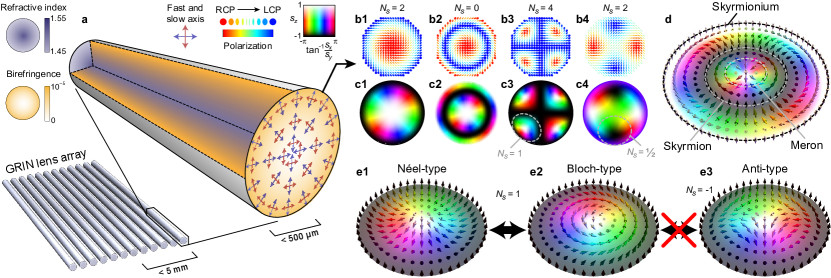
This paper proposes a compact, integrated photonic platform using gradient-index (GRIN) lenses to generate and control topologically complex quasiparticles—multiskyrmions and multimerons—by shaping vectorial structured light. The system enables programmable, topologically protected photonic states with tunable skyrmion numbers, radiality, and vorticity, demonstrating a scalable route to high-capacity topological information encoding with experimental validation of higher-order topological textures.
Skyrmions are topologically protected quasiparticles, originally studied in condensed-matter systems and recently in photonics, with great potential in ultra-high-capacity information storage. Despite the recent attention, most optical solutions require complex and expensive systems yet produce limited topologies. Here we demonstrate an extended family of quasiparticles beyond normal skyrmions, which are controlled in confined photonic gradient-index media, extending to higher-order members such as multiskyrmions and multimerons, with increasingly complex topologies. We introduce new topological numbers to describe these complex photonic quasiparticles and propose how this new zoology of particles could be used in future high-capacity information transfer. Our compact creation system lends integrated and programmable solutions of complex particle textures, with potential impacts on both photonic and condensed-matter systems for revolutionizing topological informatics and logic devices.
Motivation & Objective
- To extend photonic skyrmion systems beyond fundamental skyrmions to higher-order topological quasiparticles such as multiskyrmions and multimerons.
- To develop a compact, integrated, and programmable platform for generating complex photonic quasiparticles using GRIN lenses and cascaded optical elements.
- To introduce new topological invariants—radiality $N_r$, centrality $N_c$, vorticity $N_v$, and polarity $N_p$—to classify and quantify complex photonic textures.
- To demonstrate experimentally and theoretically the topological robustness and controllability of these quasiparticles in a scalable optical architecture.
- To explore the feasibility of using these topological states for secure, high-capacity information transfer and future topological logic devices.
Proposed method
- Utilizes cascaded GRIN lenses with controlled fast-axis orientations to shape vectorial structured light into complex polarization textures.
- Employs Stokes polarimetry with a 4f imaging system and Mueller matrix analysis to reconstruct full Stokes vector fields $S_{ ext{in}}(x,y) = [1, s_1, s_2, s_3]$ from intensity measurements.
- Applies a singularity detection algorithm (Wang et al., 2022) to count transverse component singularities $[s_1, s_2]$ in the core region to determine $N_c$.
- Calculates skyrmion density $\rho_s(x,y) = \mathbf{s}(x,y) \cdot (\partial_x \mathbf{s} \times \partial_y \mathbf{s})$ and integrates over the core to extract $N_s$.
- Uses input circular polarization (RCP/LCP) to control polarity $N_p = \text{sgn}(N_s)$, while $N_r$ is determined by radially nested structures.
- Designs modular cascades of HWP, QWP, and GRIN lenses (e.g., C1, C2 configurations) to achieve specific topological numbers $(N_r, N_c, N_v)$, as detailed in Table 1.
Experimental results
Research questions
- RQ1Can higher-order photonic quasiparticles such as multiskyrmions and multimerons be generated in a compact, integrated photonic platform?
- RQ2How can new topological invariants—$N_r$, $N_c$, $N_v$, and $N_p$—be used to classify and quantify complex photonic textures in GRIN media?
- RQ3To what extent are these topological states robust against perturbations and capable of maintaining their structure during propagation?
- RQ4Can the system be programmably tuned to generate specific topological quasiparticles for secure, high-capacity information encoding?
- RQ5What is the experimental feasibility and scalability of generating and detecting these complex topological states using standard optical components?
Key findings
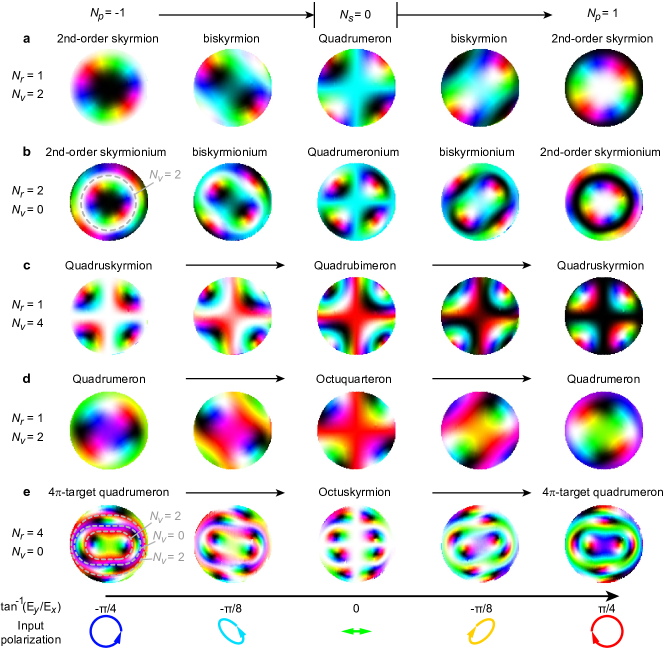
- The authors experimentally demonstrate the generation of multiskyrmions with $N_s = 4$ (quadruskyrmion) and multimerons with $N_s = 2$ (quadrumeron), composed of four elementary skyrmions or merons, respectively.
- Topological protection is confirmed: a Néel-type skyrmion ($N_s = 1$) transforms into a Bloch-type skyrmion under propagation but cannot be converted into an anti-skyrmion ($N_s = -1$), proving topological robustness.
- The system achieves full control over four topological numbers: $N_p = \pm 1$, $N_r = 1$ to $5$, $N_c = 1$ to $4$, and $N_v = 2$ or $4$, enabling a rich family of photonic quasiparticles.
- A modular cascade design (e.g., C1, C2) using GRIN lenses, HWP, and QWP allows programmable generation of specific topological states, with configurations listed in Table 1.
- The skyrmion density distribution $\rho_s(x,y)$ exhibits radially nested structures for $N_r > 1$, confirming the hierarchical topology of the generated quasiparticles.
- The method enables detection and quantification of complex topological textures using a combination of Stokes vector reconstruction, singularity counting, and skyrmion number integration.
Better researchstarts right now
From reading papers to final review, dramatically reduce your research time.
No credit card · Free plan available
This review was created by AI and reviewed by human editors.