
[Paper Review] Unifying and benchmarking state-of-the-art quantum error mitigation techniques
This paper unifies zero-noise extrapolation (ZNE), Clifford-data regression (CDR), and virtual distillation (VD) into a single data-driven framework called UNITED (UNIfied Technique for Error mitigation with Data). By combining noisy expectation values from varied noise levels and state copies, UNITED achieves superior error mitigation performance, especially at high shot budgets, outperforming individual methods in both random quantum circuits and QAOA applications on a trapped-ion noise model.
Error mitigation is an essential component of achieving a practical quantum advantage in the near term, and a number of different approaches have been proposed. In this work, we recognize that many state-of-the-art error mitigation methods share a common feature: they are data-driven, employing classical data obtained from runs of different quantum circuits. For example, Zero-noise extrapolation (ZNE) uses variable noise data and Clifford-data regression (CDR) uses data from near-Clifford circuits. We show that Virtual Distillation (VD) can be viewed in a similar manner by considering classical data produced from different numbers of state preparations. Observing this fact allows us to unify these three methods under a general data-driven error mitigation framework that we call UNIfied Technique for Error mitigation with Data (UNITED). In certain situations, we find that our UNITED method can outperform the individual methods (i.e., the whole is better than the individual parts). Specifically, we employ a realistic noise model obtained from a trapped ion quantum computer to benchmark UNITED, as well as other state-of-the-art methods, in mitigating observables produced from random quantum circuits and the Quantum Alternating Operator Ansatz (QAOA) applied to Max-Cut problems with various numbers of qubits, circuit depths and total numbers of shots. We find that the performance of different techniques depends strongly on shot budgets, with more powerful methods requiring more shots for optimal performance. For our largest considered shot budget ($10^{10}$), we find that UNITED gives the most accurate mitigation. Hence, our work represents a benchmarking of current error mitigation methods and provides a guide for the regimes when certain methods are most useful.
Motivation & Objective
- To unify disparate state-of-the-art quantum error mitigation techniques under a common data-driven framework.
- To benchmark the performance of UNITED against ZNE, CDR, VD, and vnCDR under realistic noise conditions.
- To identify optimal error mitigation strategies based on shot budget, circuit depth, and problem type.
- To provide a practical guide for selecting error mitigation methods in near-term quantum computing applications.
Proposed method
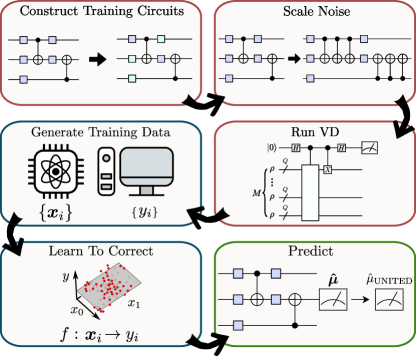
- UNITED integrates data from multiple noise levels (ZNE), near-Clifford circuits (CDR), and varying numbers of state copies (VD) into a single regression framework.
- The method uses classical fitting of an ansatz to map noisy and VD-mitigated expectation values to the exact value, trained on auxiliary circuits.
- Training data includes both quantum-measured noisy values and classically computed exact values for near-Clifford circuits.
- The unified ansatz is then applied to the target circuit’s noisy and VD-mitigated data to produce a single, improved estimate.
- The framework generalizes existing methods, with vnCDR as a special case.
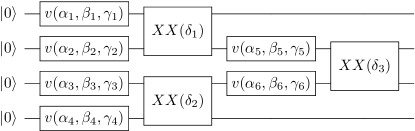
- Performance is evaluated using a realistic trapped-ion noise model across random circuits and QAOA for Max-Cut.
Experimental results
Research questions
- RQ1Can ZNE, CDR, and VD be unified under a single data-driven error mitigation framework?
- RQ2How does the performance of UNITED compare to individual methods across varying shot budgets and circuit types?
- RQ3What is the optimal error mitigation strategy for different combinations of shot count, circuit depth, and noise level?
- RQ4Does combining data from multiple mitigation techniques yield better results than using them individually?
- RQ5At what shot budget does UNITED surpass VD and other methods in mitigation accuracy?
Key findings
- UNITED achieved the most accurate mitigation in both random quantum circuits and QAOA applications at the highest shot budget of $10^{10}$.
- For $N_{ m tot} = 10^6$ and $10^8$, vnCDR outperformed other methods in random quantum circuits, while ZNE was optimal at $10^5$ shots for shallow circuits.
- In QAOA, VD was optimal across all shot budgets except $10^{10}$, where UNITED surpassed it due to lower noise floor in the solution state.
- The performance ceiling of each method depends on the shot budget, with UNITED reaching the highest ceiling due to its use of richer data.
- Increasing shot count improves mitigation accuracy until a performance ceiling is reached, which varies by method.
- The convergence of the mitigated observable with increasing shots can be used as a practical indicator of whether the performance ceiling has been reached.
Read this paper
Open the full text in the Nubint reader and ask about any passage as you read.
Read this paper on NubintThis review was generated by AI from the original paper. Please check the paper before citing it.