
[Paper Review] Valuing Distributed Energy Resources for Non-Wires Alternatives
This paper proposes a bilevel optimization framework that determines optimal, co-designed price signals to incentivize distributed energy resource (DER) investments while minimizing system operator costs. By aligning DER investors' required returns with system efficiency, the framework reduces the need for traditional upgrades, cuts capital and operating costs, and achieves nearly $3M in net present value savings over 20 years compared to conventional upgrades.
Distributed energy resources (DER) as non-wires alternatives, regardless of owner, have the potential to reduce system operating costs and delay system upgrades. However, it is difficult to determine the appropriate economic signal to incentivize DER investors to install capacity that will benefit both the DER investors and the system operator. In an attempt to determine this co-optimal price signal, we present a bilevel optimization framework for determining the least cost solution to distribution system over-loads. A key output of the framework is a spatiotemporal price signal to DER owners that simultaneously guarantees the DER owners' required rate of return and minimizes the system operation costs. The framework is demonstrated with a case by which the system operator considers utility owned battery energy storage systems, traditional system upgrades, and energy purchase from DER owners. The results show that by valuing DER for non-wires alternatives the utility owned storage system sizes can be reduced, less hardware upgrades are necessary, and upfront capital costs as well as operating costs are reduced.
Motivation & Objective
- To address the challenge of aligning incentives between distribution system operators (DSOs) and distributed energy resource (DER) investors for non-wires alternatives.
- To develop an economic signal that ensures DER investors achieve their required rate of return while minimizing total system operating costs.
- To demonstrate how valuing DER for non-wires alternatives can reduce reliance on traditional infrastructure upgrades and lower lifecycle costs.
Proposed method
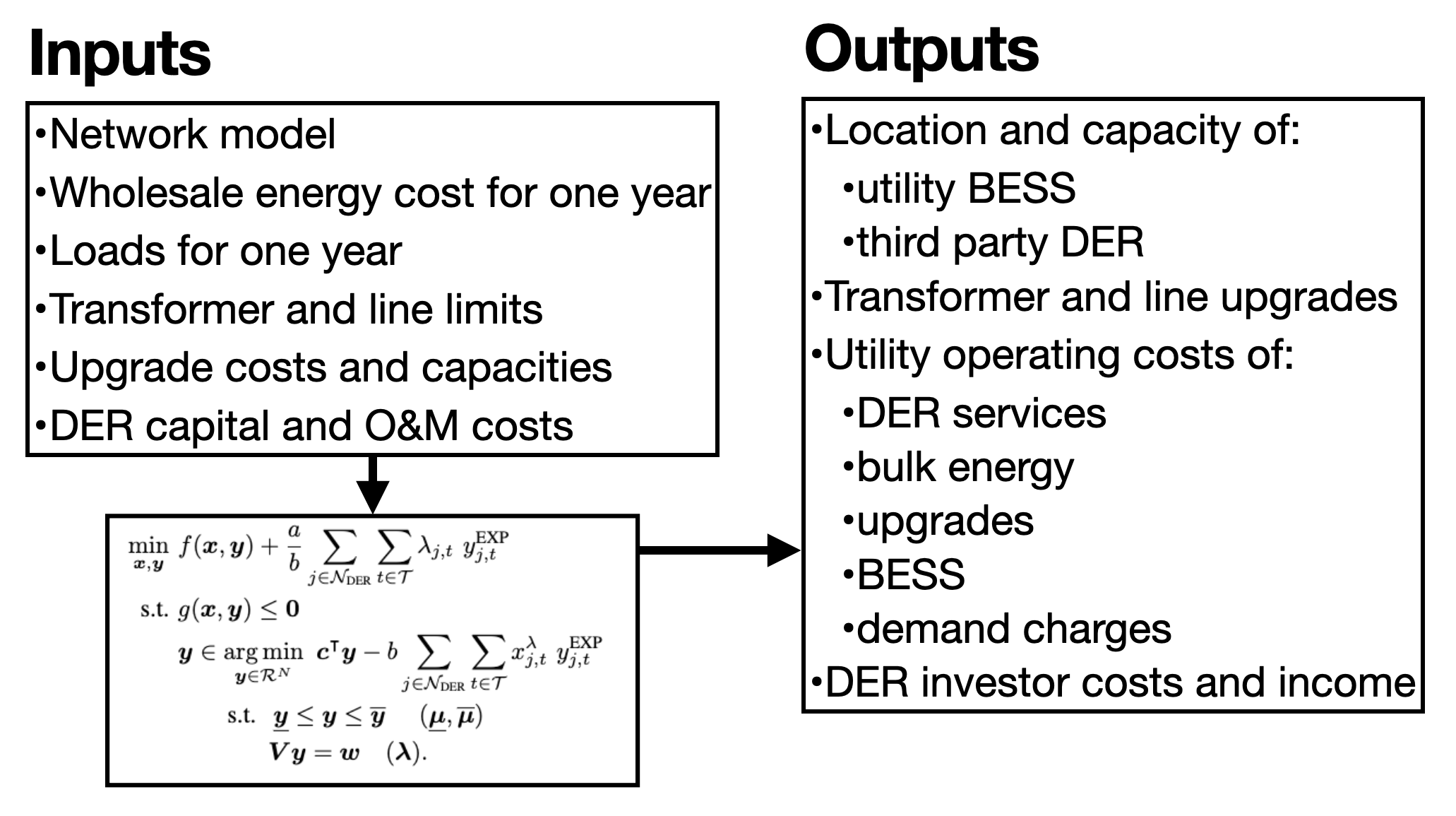
- The framework uses a bilevel optimization structure: the upper level minimizes system costs including DER investments and upgrades, while the lower level ensures DER investors achieve their required rate of return.
- The upper level includes decisions on utility-owned battery storage, transformer and line upgrades, and energy purchases from DER owners.
- The lower level models DER investors’ behavior, maximizing their net present value subject to technical constraints and energy flow limits.
- The framework incorporates spatiotemporal price signals that reflect locational value and time-varying energy flows across distribution network nodes.
- It uses linear programming for the lower level and mixed-integer programming for the upper level, including binary variables for equipment upgrade decisions.
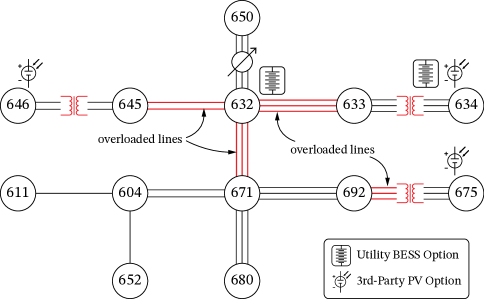
- The model is tested on a real distribution feeder with 123 buses, incorporating PV systems, battery storage, and load growth projections through 2040.
Experimental results
Research questions
- RQ1How can a co-optimal price signal be designed to simultaneously satisfy DER investors’ required rate of return and minimize system operating costs?
- RQ2What is the impact of valuing DER as non-wires alternatives on the need for traditional distribution upgrades?
- RQ3How does the inclusion of third-party DER compare to relying solely on utility-owned energy storage in terms of lifecycle cost savings?
- RQ4To what extent can the framework reduce capital and operating expenditures in distribution systems under increasing electrification and load growth?
Key findings
- The framework reduces the need for traditional infrastructure upgrades, avoiding the need to upgrade most overloaded components in the test case.
- By valuing DER for non-wires alternatives, the system achieves a net present value savings of nearly $3M over 20 years compared to conventional upgrade paths.
- The inclusion of third-party DER investment, enabled by the co-optimal price signal, yields an additional $1M in net present value savings compared to a scenario with only utility-owned batteries.
- The DER investors’ net present cost remains unchanged ($2.79M) with or without the price signal, confirming that their required rate of return is met in both cases.
- The price signal enables larger DER installations—up to 550 kW at bus 675—while offsetting higher capital costs through energy sales and savings, increasing system efficiency.
- The bilevel model achieved an optimality gap of less than 2% within a one-hour solve time on a standard laptop, indicating practical feasibility despite computational complexity.
Read this paper
Open the full text in the Nubint reader and ask about any passage as you read.
Read this paper on NubintThis review was generated by AI from the original paper. Please check the paper before citing it.