
[Paper Review] Warlock: an automated computational workflow for simulating spatially structured tumour evolution
Warlock is an open-source, Snakemake-based computational workflow that enables fast, parallel simulations of spatially structured tumour evolution using a deme-based agent-based model (demon). It bridges agent-based simulations with analytical population genetics by modeling intratumour evolution on 2D grids with biologically realistic parameters, enabling direct comparison to multi-region and single-cell sequencing data for model selection and parameter inference.
A primary goal of modern cancer research is to characterize tumour growth and evolution, to improve clinical forecasting and individualized treatment. Agent-based models support this endeavour but existing models either oversimplify spatial structure or are mathematically intractable. Here we present warlock, an open-source automated computational workflow for fast, efficient simulation of intratumour population genetics in any of a diverse set of spatial structures. Warlock encapsulates a deme-based oncology model (demon), designed to bridge the divide between agent-based simulations and analytical population genetics models, such as the spatial Moran process. Model output can be readily compared to multi-region and single-cell sequencing data for model selection or biological parameter inference. An interface for High Performance Computing permits hundreds of simulations to be run in parallel. We discuss prior applications of this workflow to investigating human cancer evolution.
Motivation & Objective
- To address the gap between computationally intensive agent-based models and mathematically tractable population genetics models in studying spatial tumour evolution.
- To develop a scalable, reproducible, and accessible computational workflow for simulating intratumour population genetics across diverse spatial structures.
- To enable efficient parallel execution of hundreds of simulations using High Performance Computing (HPC) via SLURM integration.
- To support direct comparison of simulation outputs with multi-region and single-cell sequencing data for model validation and parameter inference.
- To provide a user-friendly, open-source platform that integrates simulation, analysis, and visualization for computational oncologists and population geneticists.
Proposed method
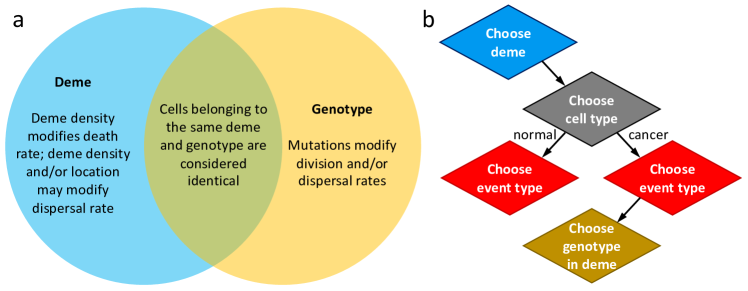
- Employs a deme-based oncology model (demon) where each deme represents a well-mixed cell population on a 2D grid, with cell events (division, death, dispersal) governed by the Gillespie stochastic simulation algorithm.
- Tracks population sizes of genotypes and demes rather than individual cells, improving computational efficiency using binary search trees for event selection.
- Supports biologically relevant parameters including mutation rates (up to one per cell division), driver and passenger mutations under the infinite sites assumption, and variable cell dispersal modes (invasive or deme fission).
- Uses Snakemake to automate the computational workflow, enabling local and HPC execution with SLURM workload manager support.
- Integrates with Anaconda for dependency management and provides an R package (demonanalysis) for post-processing and visualization of results.
- Supports simulation of normal tissue invasion, with normal cells dividing and dying but not mutating or dispersing, enabling study of early tumour evolution.
Experimental results
Research questions
- RQ1How does spatial structure influence the emergence and dynamics of intratumour genetic heterogeneity in glandular tumours?
- RQ2Can simulated tumour evolution under different spatial configurations reproduce evolutionary patterns observed in human cancer multi-region sequencing data?
- RQ3To what extent can model outputs, such as variant allele frequency distributions and phylogenetic trees, be used to infer biological parameters or select among competing evolutionary models?
- RQ4How efficiently can high-throughput simulation of diverse parameter sets be performed to enable sensitivity analysis and model selection?
- RQ5Can the integration of HPC with a modular, reproducible workflow streamline the simulation pipeline for computational oncology research?
Key findings
- Warlock enables fast, scalable simulation of intratumour evolution across diverse spatial structures, with hundreds of simulations executable in parallel via HPC.
- The deme-based model (demon) accurately reproduces key population genetics processes such as the spatial Moran process, Eden growth, and voter models.
- Simulations show that differences in tumour architecture—such as spatial constraints and dispersal modes—can explain the diversity of evolutionary modes observed in human cancers.
- Model outputs, including Muller plots and spatial clone distributions, can be directly compared to clinical multi-region and single-cell sequencing data for model validation.
- The workflow successfully supports the generation of synthetic sequencing data and phylogenetic trees, which are essential for biomarker discovery and treatment response forecasting.
- The integration of Snakemake, SLURM, and Anaconda ensures reproducibility, portability, and accessibility across different computational environments.

Read this paper
Open the full text in the Nubint reader and ask about any passage as you read.
Read this paper on NubintThis review was generated by AI from the original paper. Please check the paper before citing it.