
[论文解读] Gradient-free neural topology optimization: Towards effective fracture-resistant designs
本文提出了一种基于预训练潜在-伯努利自编码器(LBAE)的无梯度神经拓扑优化框架,通过将设计重新参数化到低维潜在空间,将迭代次数至少减少一个数量级。该方法能够在梯度方法失效的非可微、抗断裂设计中实现有效优化,展现出对分布外问题的强大泛化能力,并在性能上显著优于传统黑箱优化方法。
Gradient-free optimizers allow for tackling problems regardless of the smoothness or differentiability of their objective function, but they require many more iterations to converge when compared to gradient-based algorithms. This has made them unviable for topology optimization due to the high computational cost per iteration and the high dimensionality of these problems. We propose a gradient-free neural topology optimization method using a pre-trained neural reparameterization strategy that addresses two key challenges in the literature. First, the method leads to at least one order of magnitude decrease in iteration count to reach minimum compliance when optimizing designs in latent space, as opposed to the conventional gradient-free approach without latent parameterization. This helps to bridge the large performance gap between gradient-free and gradient-based topology optimization for smooth and differentiable problems like compliance optimization, as demonstrated via extensive computational experiments in- and out-of-distribution with the training data. Second, we also show that the proposed method can optimize toughness of a structure undergoing brittle fracture more effectively than a traditional gradient-based optimizer, delivering an objective improvement in the order of 30% for all tested configurations. Although gradient-based topology optimization is more efficient for problems that are differentiable and well-behaved, such as compliance optimization, we believe that this work opens up a new path for problems where gradient-based algorithms have limitations.
研究动机与目标
- 解决高维拓扑优化问题中无梯度优化方法计算成本高、收敛慢的问题。
- 克服无梯度方法在拓扑优化中维度灾难与可扩展性差的问题,尤其针对如断裂等非可微目标函数。
- 实现对复杂、非光滑目标函数(如抗断裂性能)的有效优化,这些目标函数因梯度不连续或噪声大而使基于梯度的方法不可行。
- 证明使用预训练LBAE进行潜在空间优化可显著缩小无梯度方法与基于梯度方法之间的性能差距。
- 研究模型在无需微调的情况下对分布外问题及新物理领域问题的泛化能力,验证其鲁棒性与可迁移性。
提出的方法
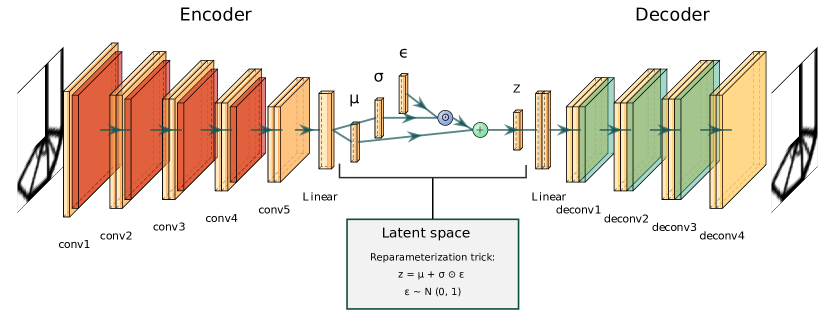
- 利用潜在-伯努利自编码器(LBAE)从多样化训练样本数据集中学习拓扑设计的低维、解耦潜在表征。
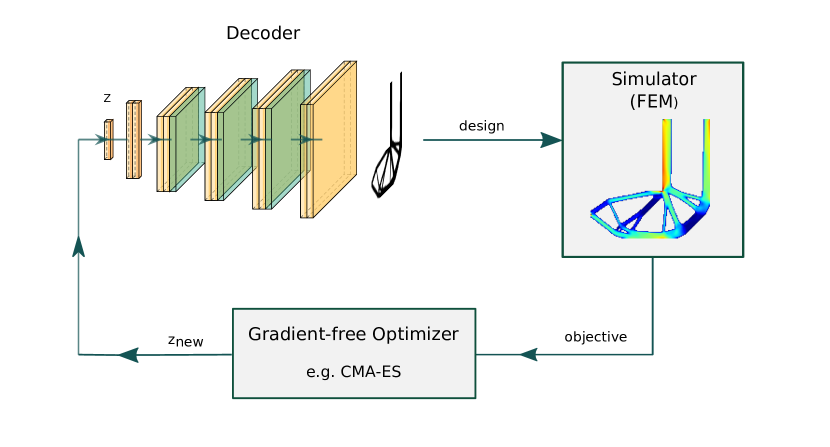
- 将拓扑优化问题重参数化至LBAE的潜在空间,降低设计变量的维度,提升优化效率。
- 在潜在空间中使用无梯度优化器(CMA-ES)基于FEM仿真结果的性能评估迭代更新设计。
- 通过将优化限制在对应特定约束值的流形上,在潜在空间中强制实施硬约束(如体积分数)。
- 在包含不同体积分数与拓扑结构的多样化设计分布上训练LBAE,以提升泛化能力与表达能力。
- 在固定仿真预算(FEM评估次数)下进行性能基准测试,同时考虑并行种群评估以反映实际运行时间。
实验结果
研究问题
- RQ1通过预训练自编码器进行潜在空间重参数化,是否能显著减少无梯度拓扑优化中达到收敛所需的迭代次数?
- RQ2在收敛速度与解质量方面,潜在空间优化方法相较于传统黑箱优化方法表现如何?
- RQ3在不进行微调的情况下,仅在一类拓扑问题(如结构柔顺性)上训练的模型,能多大程度泛化到分布外问题(如热柔顺性)?
- RQ4所提出方法是否能有效优化如抗断裂性等非可微目标函数,而这些目标函数在基于梯度的方法中会因失败而无法处理?
- RQ5潜在空间表征是否能支持多尺度下的多样化设计特征,还是存在对特定拓扑模式的偏向?
主要发现
- 所提出的潜在空间重参数化方法相比无重参数化的传统黑箱优化,将收敛所需迭代次数至少减少一个数量级。
- 即使在最坏情况(仅考虑不同随机初始化下的最差运行结果),LBAE方法仍显著优于基线方法。
- 该方法能有效泛化到分布外问题,包括新物理问题(如热柔顺性优化),性能接近基于梯度的基线方法。
- 模型在面对与训练数据中显著不同的设计特征时,仍表现出良好的泛化能力,表明其具备鲁棒性与可迁移性。
- 当前方法对特定特征尺度存在偏向,提示可通过采用更具表达能力的架构或改进潜在空间中的约束施加方式,进一步提升解的多样性。
- 尽管缺乏梯度信息,该方法在非可微场景下(尤其是抗断裂设计)仍能达到与基于梯度方法相当的性能。
更好的研究,从现在开始
从阅读论文到最终审阅,大幅缩短您的研究时间。
无需绑定信用卡
本解读由 AI 生成,并经人工编辑审核。