
[論文レビュー] A Rapid Adapting and Continual Learning Spiking Neural Network Path Planning Algorithm for Mobile Robots
本論文では、E-prop学習を用いてエネルギー、障害物の近接度、地形勾配などの複数の走行コストをリアルタイムで継続的に学習・適応可能なスパikingニューラルネットワークベースのパスプランニングシステムを提示している。スパikingウェーブフロントプランナーは、シミュレーションにおいてA*やRRT*を上回り、パスコストと長さの最小化を達成しており、物理的ロボットプラットフォームで12時間のオンライン学習のみで優れた効率性を示している。
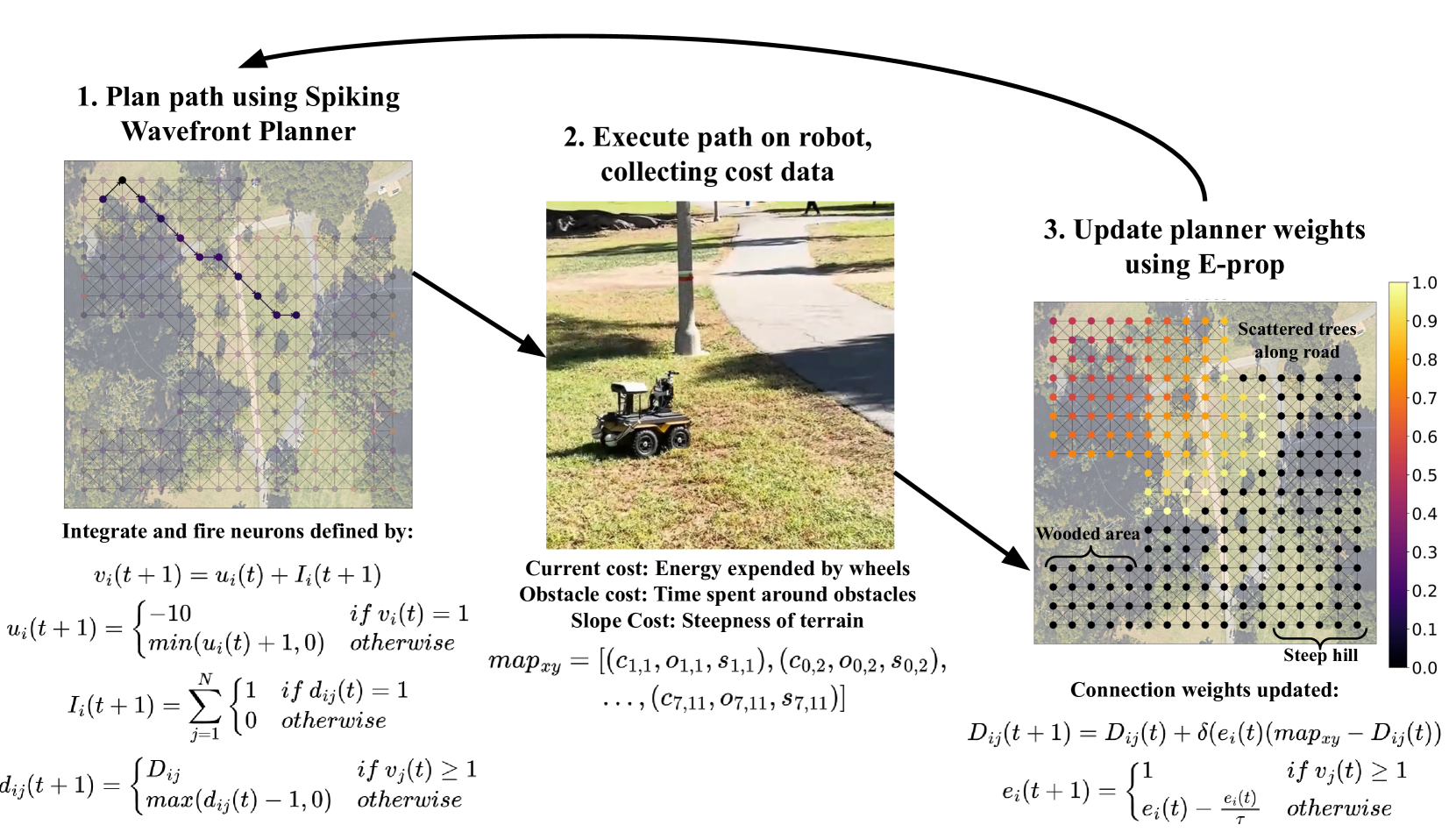
Mapping traversal costs in an environment and planning paths based on this map are important for autonomous navigation. We present a neurobotic navigation system that utilizes a Spiking Neural Network Wavefront Planner and E-prop learning to concurrently map and plan paths in a large and complex environment. We incorporate a novel method for mapping which, when combined with the Spiking Wavefront Planner, allows for adaptive planning by selectively considering any combination of costs. The system is tested on a mobile robot platform in an outdoor environment with obstacles and varying terrain. Results indicate that the system is capable of discerning features in the environment using three measures of cost, (1) energy expenditure by the wheels, (2) time spent in the presence of obstacles, and (3) terrain slope. In just twelve hours of online training, E-prop learns and incorporates traversal costs into the path planning maps by updating the delays in the Spiking Wavefront Planner. On simulated paths, the Spiking Wavefront Planner plans significantly shorter and lower cost paths than A* and RRT*. The spiking wavefront planner is compatible with neuromorphic hardware and could be used for applications requiring low size, weight, and power.
研究の動機と目的
- オフライン再トレーニングを必要とせず、環境の走行コストをリアルタイムで継続的に学習可能な神経ロボティクスナビゲーションシステムの開発。
- エネルギー、障害物、地形勾配といった複数のコスト指標に基づき、オンライン経験に応じて動的に適応するパスプランニングの実現。
- 低消費電力・小型要件を満たす物理ハードウェアにスパキングニューラルネットワークプランナーを実装する可能性と効率性の実証。
- スパキングウェーブフロントプランナーの性能を、A*、RRT*、および単純なユークリッドプランナーと、シミュレーションおよび実世界環境で比較すること。
提案手法
- ニューロンが空間的位置を表すスパキングウェーブフロントプランナーを採用し、スパイクの伝播によってパス計画を実現する。
- 走行コストは、車輪電流(エネルギー)、障害物の近接度、地形勾配といったリアルタイムのセンサデータを用いてマップ化する。
- E-prop学習により、エリギビリティトレースに基づいてシナプス遅延を更新し、走行コストの継続的かつオンライン学習を可能にする。
- コストマップはロボットの経験をもとに段階的に学習され、遅延が学習済みコスト分布を反映するように調整される。
- 現在のコストマップに基づいてパスを再評価することで、動的再プランニングが可能となり、環境変化への適応が可能となる。
- 性能評価は、学習済みコストマップ上での全パスのシミュレーションと、屋外で複雑な地形を走行する地上ロボットを用いた実世界テストによって実施される。
実験結果
リサーチクエスチョン
- RQ1スパキングニューラルネットワークパスプランナーは、オフライン再トレーニングを必要とせず、複数の動的走行コストをリアルタイムで学習・適応可能か?
- RQ2スパキングウェーブフロントプランナーは、A*やRRT*と比較して、多様なコスト指標においてパス長とコストの最小化でどの程度優れているか?
- RQ3新たな障害物などの環境変化に対して、再トレーニングなしに数回の試行でどの程度の適応が可能か?
- RQ4実世界のセンサデータでトレーニングされた場合、スパキングウェーブフロントプランナーは従来のアルゴリズムよりも低コストで短いパスを達成できるか?
主な発見
- 学習済みコストマップ上でのシミュレーションパス評価において、スパキングウェーブフロントプランナーはRRT*やA*を著しく上回り、パス長と正規化コストの両方を最小化した。平均コストは19.36であり、RRT*の22.07およびA*の19.55を下回った。
- 物理的ロボット試行では、スパキングウェーブフロントプランナーはRRT*よりも著しく短いパスと低い障害物コストを達成した。障害物コストのp値は0.05未満(2.06 vs. 3.95)。
- システムは12時間未満のオンライン学習で機能的なコストマップを学習し、再トレーニングを最小限に抑えつつ、新たな環境条件への迅速な適応を可能にした。
- スパキングウェーブフロントプランナーは、各コストタイプごとにカスタムヒューリスティックを必要としないまま、A*と同等の性能を達成した。
- パス長が延びるほど、スパキングウェーブフロントプランナーとRRT*の性能差は拡大し、コスト効率において常に前者が優れていた。
- スパキングの性質に起因し、神経形態的ハードウェアとの互換性を示し、低消費電力で埋め込み型デプロイメントを可能にした。
この論文を読む
Nubintのビューアで原文を開き、読みながら気になる箇所をすぐに質問できます。
Nubintでこの論文を読むこのレビューはAIが論文の原文をもとに作成しました。引用する前に原文をご確認ください。