
[論文レビュー] Consolidated Control Barrier Functions: Synthesis and Online Verification via Adaptation under Input Constraints
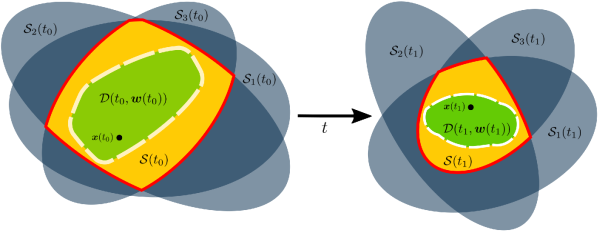
本稿では、入力制約下でも制御の妥当性を保証するため、時間変動する複数の制御バリア関数(CBF)を1つの統合CBF(C-CBF)に適応的に統合する新規な手法を提案する。予測・補正型内点法に基づく重みの適応則を用い、二次計画法(QP)に基づく制御則の妥当性を保証する。非線形システムに複数の空間的・時間的制約が存在する場合でも、相対次数が高くても安全で滑らかでグローバルに妥当な制御を実現する。
In this paper, we develop a novel adaptation-based approach to constrained control design under multiple state and input constraints. Specifically, we introduce a method for synthesizing any number of time-varying candidate control barrier functions (CBF) into one consolidated CBF (C-CBF) candidate, and propose a predictor-corrector optimization-based adaptation law for the weights of the constituent constraint functions that certifies the C-CBF as valid for a class of nonlinear, control-affine systems. We prove this result by showing that the adapted weights are guaranteed to confer sufficient control authority to meet the new, adaptive C-CBF condition in perpetuity despite input constraints, which thereby permits its use in a quadratic program based control law. We then illustrate the performance of our controller on an academic example, and further highlight that it is successful even for constraint functions with higher or mixed relative-degree by simulating a reach-avoid problem for bicycle robots, which we use to demonstrate how our approach out-performs two baseline approaches.
研究の動機と目的
- 複数の時間変動する空間的・時間的制約および入力制限下での制御設計における妥当性と安全性を確保する課題に対処すること。
- 複数の制約下で失敗するか、手動による調整やオフライン検証を要する既存のCBF手法の限界を克服すること。
- 任意の数のCBF候補を1つの統合CBF(C-CBF)に統合する統一的で適応的なフレームワークを構築すること。
- 入力制約下でもC-CBF条件の持続的妥当性を保証するために、構成するCBFの重みを動的に適応させること。
- 制約の相対次数が混合的または高次であっても、振動や急激なスイッチングを伴わずに、ロバストで滑らかな制御行動を実現すること。
提案手法
- 時間変動する複数のCBF候補を凸結合により組み合わせることで、一般化された統合CBF(C-CBF)のクラスを形式化する。重みは適応的である。
- 予測・補正型内点法に基づく適応則を設計し、構成するCBFの重みをリアルタイムで更新する。
- 適応された重みが、入力制約下でも常にC-CBF条件を満たす十分な制御能力を保証することを証明する。
- C-CBFを二次計画法(QP)に基づく制御則に統合し、制御時間窓全体で妥当性と安全性を保証する。
- 予測ステップで将来の重み動的変化を推定し、補正ステップでプライマル・双対妥当性を強制することで、内点法の最適化を模倣する。
- 本手法を1次元の不安定系および相対次数2の制約を含む8つの制約を持つ自転車ロボットの到達・回避問題に適用する。
実験結果
リサーチクエスチョン
- RQ1複数の時間変動するCBF候補から、入力制約下でも前向き不変性を保証する1つの統合CBFを構築できるか?
- RQ2制御能力が制限される状況下でも、C-CBF条件の有効性を無期限に維持できる適応的重み更新則を設計できるか?
- RQ3入力制約下でもQPに基づく制御則の妥当性を保ちつつ、滑らかで振動のない制御行動を実現できるか?
- RQ4相対次数が混合的または高次である系において、C-CBFの微分が高次動的特性にのみ依存する場合でも、本手法は効果を発揮するか?
- RQ5保守的パラメータや入力制約の変動に応じて、既存のベースライン手法(HO-CBF-QPおよびE-CBF-QP)を上回る性能を発揮できるか?
主な発見
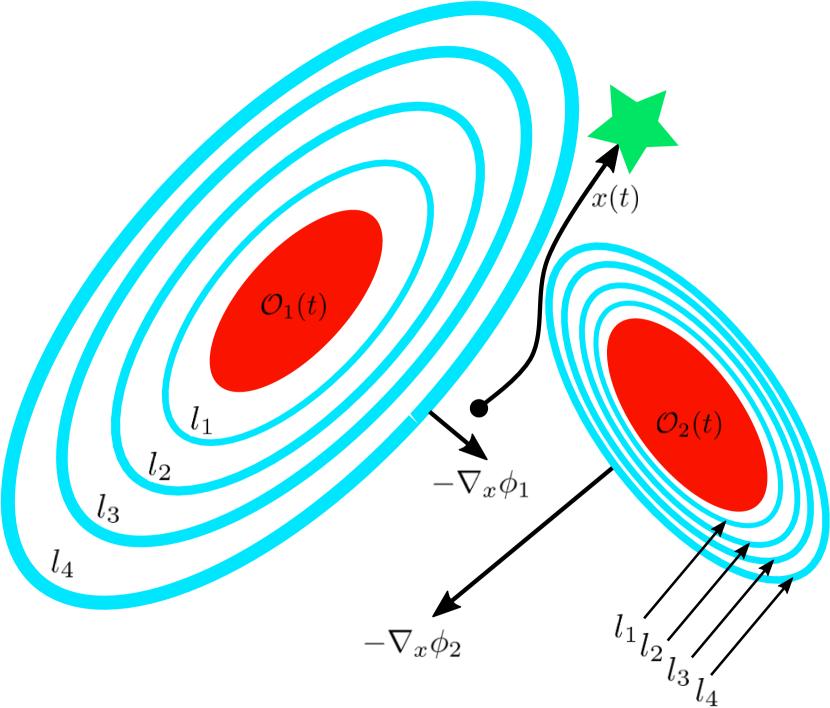
- 提案された適応的C-CBFコントローラは、相対次数2の制約を含む8つの時間変動する制約がある到達・回避問題において、自転車ロボットを目的位置に安全に誘導した。
- 入力制約のため、すべての4回のシミュレーションで不成立となったHO-CBF-QPコントローラとは異なり、適応的C-CBFコントローラは妥当性を維持し、目的に到達した。
- E-CBF-QPコントローラは熟練した調整を要し、ゲイン選定に敏感であった:過度に保守的なゲインは不成立を引き起こし、攻撃的なゲインは衝突を引き起こした。
- C-CBFの重みは時間経過とともに滑らかに変化した(図11参照)、急激なスイッチングを回避し、振動を伴わない滑らかな制御入力を実現した。
- 全8つの制約関数が操業中を通じて満たされ、C-CBF条件は妥当性を保った。6つの制約はHの1階微分に寄与しなかったが、依然として有効であった。
- オフライン検証や手動による調整に依存せず、動的環境および未知の摂動に対してロバストである安全で安定した、グローバルに妥当な制御を実現した。
この論文を読む
Nubintのビューアで原文を開き、読みながら気になる箇所をすぐに質問できます。
Nubintでこの論文を読むこのレビューはAIが論文の原文をもとに作成しました。引用する前に原文をご確認ください。