
[論文レビュー] Directly imaging spin polarons in a kinetically frustrated Hubbard system
本研究では、超低温原子を用いて、運動的フラストレーションを持つ三角格子フェルミ=ハッバード系において、移動性スピンポラロンを直接像として観測した。穴ドーピング付近では反強磁性相関が、粒子ドーピング付近では強磁性相関が観測された。結果は、高温でもスピン交換相互作用が存在しない状況においても、運動的フラストレーションがクーリング状態の形成を促進することを示し、フラストレーションを持つモット絶縁体における準粒子のコherentlyな形成に関する従来の仮定に挑戦するものである。
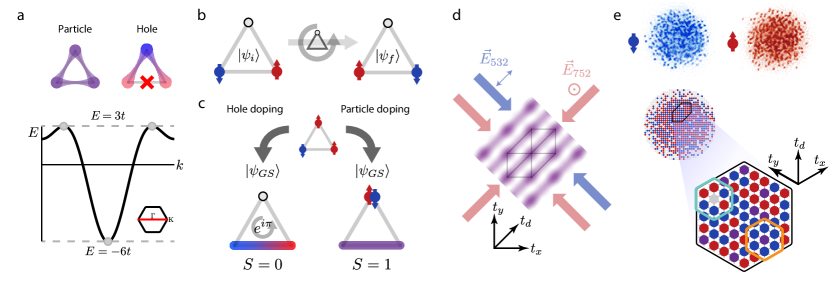
The emergence of quasiparticles in quantum many-body systems underlies the rich phenomenology in many strongly interacting materials. In the context of doped Mott insulators, magnetic polarons are quasiparticles that usually arise from an interplay between the kinetic energy of doped charge carriers and superexchange spin interactions. However, in kinetically frustrated lattices, itinerant spin polarons - bound states of a dopant and a spin-flip - have been theoretically predicted even in the absence of superexchange coupling. Despite their important role in the theory of kinetic magnetism, a microscopic observation of these polarons is lacking. Here we directly image itinerant spin polarons in a triangular lattice Hubbard system realised with ultracold atoms, revealing enhanced antiferromagnetic correlations in the local environment of a hole dopant. In contrast, around a charge dopant, we find ferromagnetic correlations, a manifestation of the elusive Nagaoka effect. We study the evolution of these correlations with interactions and doping, and use higher-order correlation functions to further elucidate the relative contributions of superexchange and kinetic mechanisms. The robustness of itinerant spin polarons at high temperature paves the way for exploring potential mechanisms for hole pairing and superconductivity in frustrated systems. Furthermore, our work provides microscopic insights into related phenomena in triangular lattice moiré materials.
研究の動機と目的
- 運動的フラストレーションを持つ三角格子ハッバード系において、移動性スピンポラロンを実験的に観測すること。
- ドーピングされたモット絶縁体における運動的フラストレーションと磁気相関の相乗的相互作用を調査すること。
- ポラロン形成におけるスピン交換相互作用と運動的メカニズムの役割を区別すること。
- 高温および長距離磁気秩序が存在しない状況下でも、準粒子の頑健性を調べること。
- 三角格子モアレ材料および高温超伝導体における顕在的現象に関する微視的洞察を提供すること。
提案手法
- 可調節可能な相互作用およびトンネル項を有する光格子内の超低温40K原子を用いて、三角格子フェルミ=ハッバード系を実現すること。
- 個々のスピンアップおよびスピンダウン原子(ドーピング原子およびその局所的スピン環境を含む)を、イン・サイトでの単一サイト解像度の蛍光像像法で検出すること。
- スピンスピン相関関数(三および四点相関関数)を測定し、ドーピング周辺のポラロン的構造および磁気秩序を特定すること。
- DQMC理論との比較に際し、検出効率の低さを補正するため、損失イメージングの忠実度補正(約0.96)を実験データに適用すること。
- 多数体系をモデル化し、実験データと比較するため、動的量子モンテカルロ(DQMC)シミュレーションを実施し、U/t、T/t、ドーピングレベルの変動に応じて解析すること。
- 高次相関関数を用いて、ポラロン形成におけるスピン交換と運動的メカニズムの寄与を分離すること。
実験結果
リサーチクエスチョン
- RQ1スピン交換相互作用が存在しない運動的フラストレーションを持つハッバード系において、移動性スピンポラロンを直接像として観測できるか?
- RQ2三角格子モット絶縁体における穴ドーピングおよび粒子ドーピング周辺で、スピン相関はどのように変化するか?
- RQ3フラストレーションを持つ格子におけるポラロン形成に、スピン交換と運動的フラストレーションのどちらが相対的に寄与しているか?
- RQ4長距離磁気秩序が存在せず、高温にあっても準粒子はどれほど頑健か?
- RQ5超低温原子で観測された相関は、モアレ材料および高温超伝導体においても同様に再現されるか、どの程度類似しているか?
主な発見
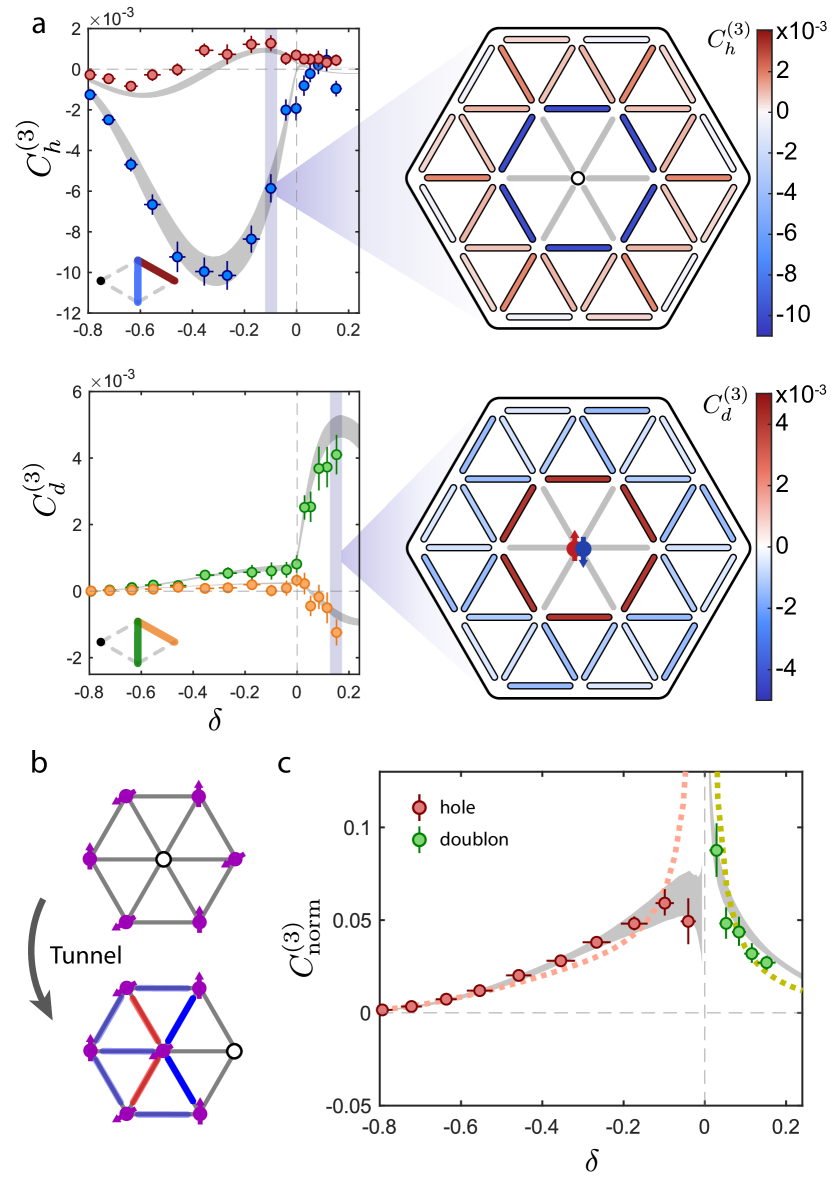
- 直接的イメージングにより、穴ドーピングの局所的環境に反強磁性スピン相関が確認され、移動性スピンポラロンの形成が裏付けられた。
- 粒子ドーピングは強磁性スピン相関を誘発し、三角格子におけるナガオカ効果の実験的証明が得られた。
- スピン交換エネルギー尺度が抑制されても、高温(T/t ≈ 0.95)においてもポラロンが頑健に保たれ、運動的フラストレーションが準粒子形成を駆動していることを示した。
- 三地点スピン相関関数 $ C^{(3)}_{h} $ はドーピング ≈ -0.3 で最小値を示し、$ C^{(3)}_{d} $ は ≈ +0.15 でピークを示すため、穴と粒子のポラロン的挙動に顕著な差が存在することが示された。
- イメージング忠実度補正を施したDQMCシミュレーションは、実験データと良好な一致を示し、運動的フラストレーションが支配的メカニズムである理論的モデルの妥当性が裏付けられた。
- 半フィルイン付近で $ C^{(3)} $ の鋭い特徴の出現が、相互作用強度(U/t)の増加に伴い顕著に強化され、強い関連性下でポラロン的性質が強化されることを示した。
より良い研究を、今すぐ始めましょう
論文の読解から最終レビューまで、研究時間を劇的に削減しましょう。
クレジットカード登録不要
このレビューはAIが作成し、人間の編集者が確認しました。