
[論文レビュー] Fermionic quantum criticality through the lens of topological holography
本稿は、(1+1)d系におけるフェルミオン的量子臨界点およびギャップなし相を研究するための位相的ホログラフィー枠組みを導入する。1つ高い次元における対称性位相的場理論(SymTFT)を用いて、フェルミオン的グローバル対称性とスピン構造を符号化する。フェルミオン化されたSymTFT境界と、$Χ_2^F$、$Χ_2\timesΧ_2^F$、$Χ_4^F$、非可逆的$\text{Rep}(S_3)$対称性の下でのギャップあり相および遷移の分類を通じて、特異な量子臨界性、特にフェルミオン的対称性拡張およびギャップなしSPT/SSB相を同定する。
We utilize the topological holographic framework to characterize and gain insights into the nature of quantum critical points and gapless phases in fermionic quantum systems. Topological holography is a general framework that describes the generalized global symmetry and the symmetry charges of a local quantum system in terms of a slab of a topological order, termed as the symmetry topological field theory (SymTFT), in one higher dimension. In this work, we consider a generalization of the topological holographic picture for $(1+1)d$ fermionic quantum phases of matter. We discuss how spin structures are encoded in the SymTFT and establish the connection between the formal fermionization formula in quantum field theory and the choice of fermionic gapped boundary conditions of the SymTFT. We demonstrate the identification and the characterization of the fermionic gapped phases and phase transitions through detailed analysis of various examples, including the fermionic systems with $\mathbb{Z}_{2}^{F}$, $\mathbb{Z}_{2} imes \mathbb{Z}_{2}^{F}$, $\mathbb{Z}_{4}^{F}$, and the fermionic version of the non-invertible $ ext{Rep}(S_{3})$ symmetry. Our work uncovers many exotic fermionic quantum critical points and gapless phases, including two kinds of fermionic symmetry enriched quantum critical points, a fermionic gapless symmetry protected topological (SPT) phase, and a fermionic gapless spontaneous symmetry breaking (SSB) phase that breaks the fermionic non-invertible symmetry.
研究の動機と目的
- 位相的ホログラフィー枠組みを(1+1)d系に拡張し、一般化されたグローバル対称性およびそれらの異常を記述する。
- SymTFTのフェルミオン的ギャップあり境界条件と、量子場理論におけるフェルミオン化手順との正確な対応関係を確立する。
- 様々なフェルミオン的グローバル対称性、特に$Χ_2^F$、$Χ_2\timesΧ_2^F$、$Χ_4^F$、非可逆的$\text{Rep}(S_3)$の下でのフェルミオン的ギャップあり相および量子臨界点の分類と特徴付けを行う。
- 明示的な例を通じて、対称性拡張、ギャップなしSPT、ギャップなしSSB相を含む、新しいフェルミオン的量子臨界点を同定・分析する。
- スピン構造およびフェルミオン統計が、位相的バルク(SymTFT)からどのように生じ、境界条件および任意子凝縮パターンに符号化されるかを示す。
提案手法
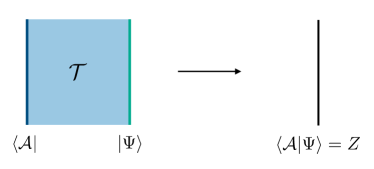
- (2+1)次元のSymTFTを用いた位相的ホログラフィーの「サンドイッチ」構成を用い、(1+1)次元のフェルミオン系を、指定された任意子的バルクおよびギャップあり境界条件を持つ(2+1)次元SymTFTの境界として実現する。
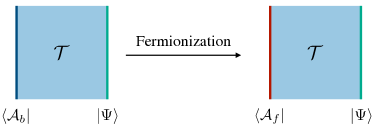
- SymTFTにおけるスーパーラグランジュ代数構造を用いたフェルミオン化を適用し、フェルミオン的境界条件の選択が境界理論のスピン構造および統計にどのように関連するかを結びつける。
- QFTにおける形式的フェルミオン化公式を用い、境界での任意子凝縮を通じて$Χ_2$対称性を持つボソン的SymTFTをフェルミオン的SymTFTに写像する。
- 特に$e$、$m$、$f$およびそれらの組み合わせの任意子の凝縮に注目して、SymTFTバルク内の可能な任意子凝縮の分類を通じて、ギャップあり相および相転移を分析する。
- トーラス上の任意子基底の分配関数と、トーラスコードにおけるA/Pスピン構造の分配関数の対応関係を用い、フェルミオン的最小模型の分配関数を導出する。
- スーパーラグランジュ代数の概念を用いて、フェルミオン的ギャップあり境界の分類を行い、境界CFTにおけるフェルミオン的対称性電荷および統計の出現を同定する。
実験結果
リサーチクエスチョン
- RQ1位相的ホログラフィー枠組みを、(1+1)d量子系におけるフェルミオン的グローバル対称性およびそれらの異常を記述するためにどのように一般化できるか?
- RQ2スピン構造がSymTFT構成において果たす正確な役割は何か? そして、境界条件および任意子凝縮パターンにどのように符号化されるか?
- RQ3非可逆的または高次元対称性(例:$Χ_4^F$ や $\text{Rep}(S_3)$)を持つフェルミオン系では、どのような特異な量子臨界点が出現するか?
- RQ4SymTFTバルクにおけるフェルミオン化および任意子凝縮は、境界理論にギャップなしSPTおよびSSB相をどのように生じさせるか?
- RQ5SymTFT枠組みを用いて、$Χ_2^F$、$Χ_2\timesΧ_2^F$、$Χ_4^F$、および$\text{Rep}(S_3)$対称性を持つフェルミオン鎖におけるギャップあり相および相転移をどのように分類できるか?
主な発見
- 本稿は、非自明な任意子凝縮パターンに起因するSymTFT構成を通じて、2種類の異なるフェルミオン的対称性拡張量子臨界点(SPT-SSBおよびSPTキタエフ)を同定する。
- $Χ_4^F$ 対称性を持つ鎖では、フェルミオン的非可逆的ギャップなしSPT相が新たに発見され、フェルミオン的対称性を保存するがバルクのトポロジカル秩序を破壊する非自明な任意子凝縮パターンによって特徴づけられる。
- $Χ_2\timesΧ_2^F$ 対称性では、自明な状態とキタエフ状態の間の遷移が、$Χ_2^D$で割ったイジング模型によって記述され、中心電荷$c=1/2$の非自明な固定点として臨界点が特定される。
- $Χ_2\timesΧ_2^F$系におけるGWとSSB相の間の遷移は、マヨラナフェルミオンと結合したイジング模型によって記述される臨界理論にマッピングされ、中心電荷$c=1$である。
- $Χ_4^F$ 対称性を持つ系では、自明な状態とSSB相の間の臨界点が、自由なマヨラナフェルミオンと結合した3状態ポッツ模型によって記述され、中心電荷$c=1.75$である。
- 非可逆的$\text{Rep}(S_3)$対称性では、自明な状態とSSB相の間の臨界点は、$m=5$のフェルミオン的最小模型(中心電荷$c=1.75$)として特定され、キタエフ状態とSSB相の間の遷移も同様に同じ$m=5$のフェルミオン的最小模型によって記述される。
この論文を読む
Nubintのビューアで原文を開き、読みながら気になる箇所をすぐに質問できます。
Nubintでこの論文を読むこのレビューはAIが論文の原文をもとに作成しました。引用する前に原文をご確認ください。