
[論文レビュー] Graph-based Simultaneous Coverage and Exploration Planning for Fast Multi-robot Search
本論文は、未知の環境における高速なマルチロボット探索のため、統合的グラフベース計画法Pose Graph Aware Random Trees (PGART) と階層的タスク割り当て法HIGHを提案する。PGARTはマルチロボットSLAMから得られるポーズグラフに根ざしたランダムツリーを用いることで、木の剪定を低減し、同時に探索とカバレッジ計画を可能にする。一方、HIGHは階層的情報ヒューリスティックを用いて高情報量のタスクを優先する。本手法は、最先端の手法と比較して20%高いカバレッジ効率と34.2%優れた探索時間の合計を達成した。
In large unknown environments, search operations can be much more time-efficient with the use of multi-robot fleets by parallelizing efforts. This means robots must efficiently perform collaborative mapping (exploration) while simultaneously searching an area for victims (coverage). Previous simultaneous mapping and planning techniques treat these problems as separate and do not take advantage of the possibility for a unified approach. We propose a novel exploration-coverage planner which bridges the mapping and search domains by growing sets of random trees rooted upon a pose graph produced through mapping to generate points of interest, or tasks. Furthermore, it is important for the robots to first prioritize high information tasks to locate the greatest number of victims in minimum time by balancing coverage and exploration, which current methods do not address. Towards this goal, we also present a new multi-robot task allocator that formulates a notion of a hierarchical information heuristic for time-critical collaborative search. Our results show that our algorithm produces 20% more coverage efficiency, defined as average covered area per second, compared to the existing state-of-the-art. Our algorithms and the rest of our multi-robot search stack is based in ROS and made open source
研究の動機と目的
- 災害救助におけるマルチロボット探索で、探索とカバレッジを別々の問題として扱う非効率性を是正すること。
- 探索とカバレッジ計画を統合することで、オンラインマルチロボット探索における計算コストの低減と一貫性の向上を図ること。
- 被災者分布の事前知識がなくても、高情報量の領域を優先するタスク割り当て手法の開発。
- 最小限のバックトラッキングと動的マップ適合を伴い、リアルタイムでスケーラブルかつ繰り返し可能なマルチロボット探索の実現。
- 既存の最先端手法と比較して、シミュレーションおよび実世界実験の両方で優れた性能を示すこと。
提案手法
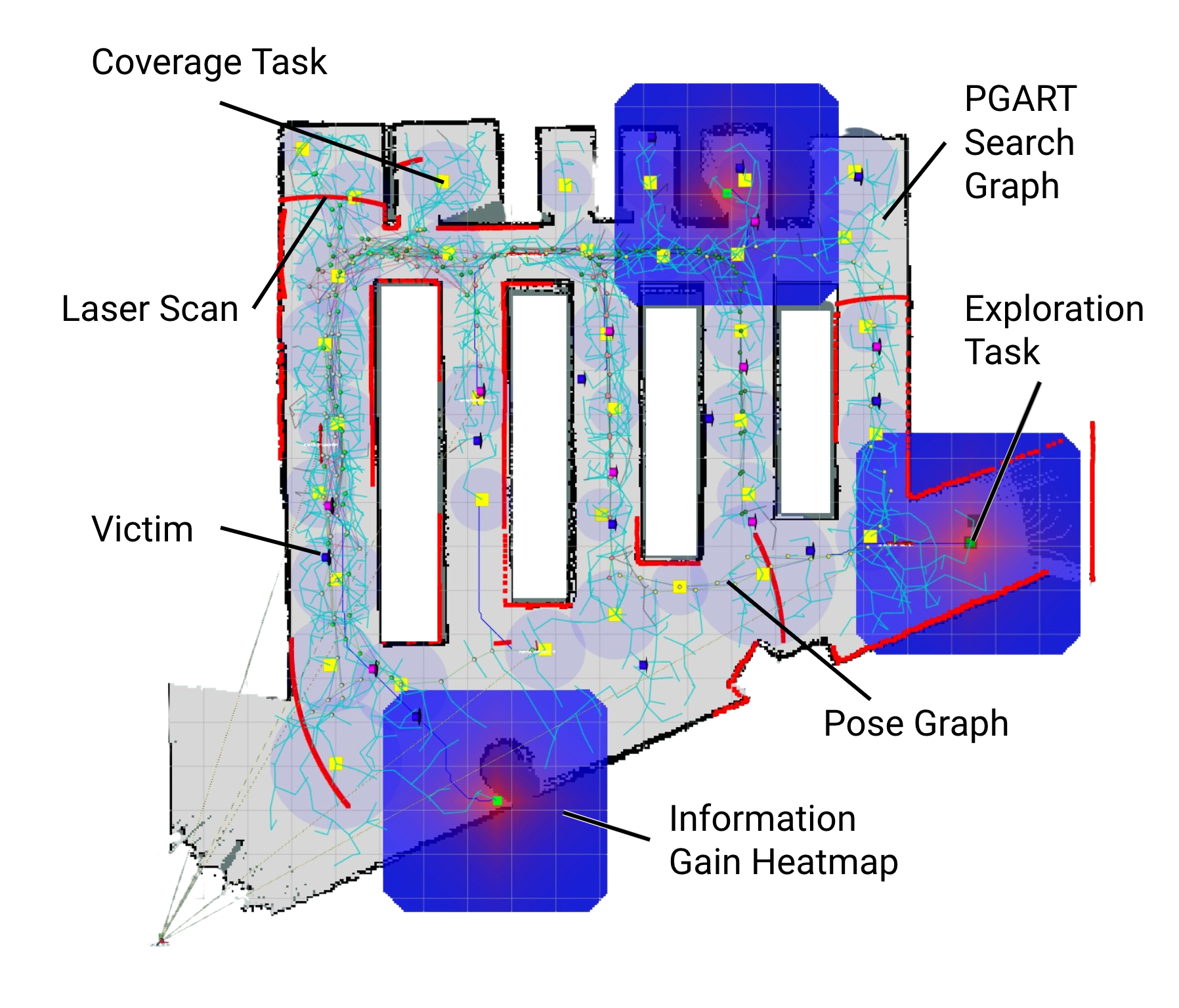
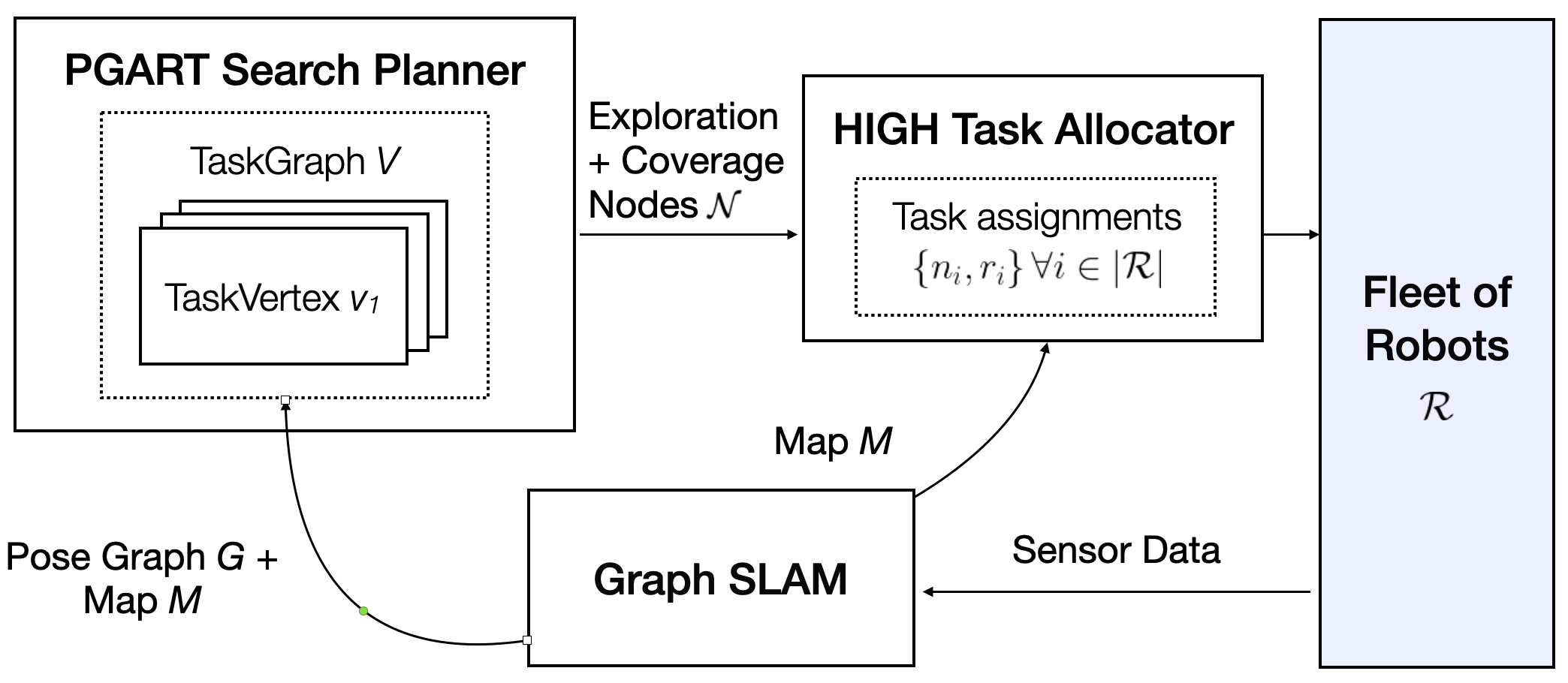
- PGARTは、グラフベースSLAMによって生成されたポーズグラフに根ざしたランダムツリーを構築し、ループクロージャーが発生してもタスクの持続的表現を可能にする。
- ポーズグラフは、艦隊全体の安定的で共有可能な記憶として機能し、重複するツリー構築を低減し、マップ更新時の剪定を最小限に抑える。
- PGARTはポーズグラフのノードからツリーを成長させることで、探索(フロントラー)およびカバレッジ(領域スイープ)の両方のタスクを生成し、すでにカバー済みの領域への再訪問を回避する。
- HIGH割り当て器は、階層的情報ヒューリスティックツリーを用いて被災者分布を推定し、情報量の増加、距離コスト、カバレッジ/探索のバランスに基づいてタスクの相対的重要性を割り当てる。
- HIGHでは、情報価値、移動コスト、タスク優先度のバランスを最適化するためのカスタム報酬関数を採用し、被災者検出を迅速化する。
- 本システムはROSに実装され、公開されており、実世界の屋内環境におけるKhepera IVロボットを用いたリアルタイム動作をサポートする。
実験結果
リサーチクエスチョン
- RQ1探索とカバレッジを別々の問題として扱わず、統合的計画法が未知のマルチロボット探索において、探索とカバレッジのバランスを効果的にとれるか。
- RQ2ポーズグラフに基づくツリー成長法が、動的SLAM環境において、どのように木の剪定を低減し、タスクの持続性を向上させるか。
- RQ3被災者分布が未知の状況下で、階層的情報ヒューリスティックが、時間的に重要な探索におけるタスク割り当てをどの程度改善できるか。
- RQ4提案されたPGARTとHIGHフレームワークは、カバレッジ効率および被災者検出速度の面で、最先端手法と比較してどの程度優れているか。
- RQ5本手法は多様な環境に一般化可能であり、シミュレーションから実世界への展開において、効果的に転送可能か。
主な発見
- PGARTは、最先端のRRTおよびNBVP手法と比較して、20%高いカバレッジ効率(1秒あたりの平均被覆面積として定義)を達成した。
- PGARTは、RRTの26.7%と比較して、ノードの剪定率を5.3%まで低減し、木の拡張とタスク保持のより一貫性のある性能を示した。
- HIGHは、NBVPと同程度の被災者検出率を維持しながら、探索時間の合計(SST)を34.2%低減し、被災者検出がより迅速であることを示した。
- HIGHは96.9%の被災者検出率を達成し、NBVP(91.6%)およびRRT(91.1%)を上回り、優れたカバレッジと探索のバランスを示した。
- HIGHは、NBVPと比較してSSTの標準偏差を47.1%低減し、実行間での一貫性と再現性の高い性能を示した。
- 5台のKhepera IVロボットを用いた実世界実験では、HIGHはNBVPと比較して20.0%高い探索効率と30.1%優れたSSTを達成し、シミュレーションから実世界への転送性を実証した。
この論文を読む
Nubintのビューアで原文を開き、読みながら気になる箇所をすぐに質問できます。
Nubintでこの論文を読むこのレビューはAIが論文の原文をもとに作成しました。引用する前に原文をご確認ください。