
[論文レビュー] High-fidelity remote entanglement of trapped atoms mediated by time-bin photons
本論文は、時間-bin符号化された光子を用いて、2つの捕獲された 138Ba+ 系で高忠実度の遠隔もつれを実現し、ベル状態の忠実度を 97.0(4)% に達成した。このプロトコルは、時間-bin光子量子ビットの報知付き干渉を用い、特に原子の反動とレーザー強度の揺らぎによる主要な誤りを抑制することで、99.9% を超える忠実度を持つスケーラブルでモジュラーな量子ネットワークへの道筋を示している。
Photonic interconnects between quantum processing nodes are likely the only way to achieve large-scale quantum computers and networks. The bottleneck in such an architecture is the interface between well-isolated quantum memories and flying photons. We establish high-fidelity entanglement between remotely separated trapped atomic qubit memories, mediated by photonic qubits stored in the timing of their pulses. Such time-bin encoding removes sensitivity to polarization errors, enables long-distance quantum communication, and is extensible to quantum memories with more than two states. Using a measurement-based error detection process and suppressing a fundamental source of error due to atomic recoil, we achieve an entanglement fidelity of 97% and show that fidelities beyond 99.9% are feasible.
研究の動機と目的
- 捕獲イオン量子ビット間の高忠実度で長距離にわたる量子インターロックを、光ファイバーを介して実現すること。
- 光学素子やファイバーにおける屈折率の異方性に敏感な偏光符号化光子量子ビットの限界を克服すること。
- 時間-bin符号化が、高忠実度と低誤り率で、耐障害性の高いスケーラブルな遠隔もつれを実現できることを実証すること。
- 原子の反動、レーザー強度の揺らぎ、検出器のダークカウントといった主要な誤り要因を特定し、それらを実験的に抑制すること。
- 99.9% を超える忠実度が現在の実験的手法で達成可能であることを示し、モジュラーな量子計算と長距離量子通信を可能にすること。
提案手法
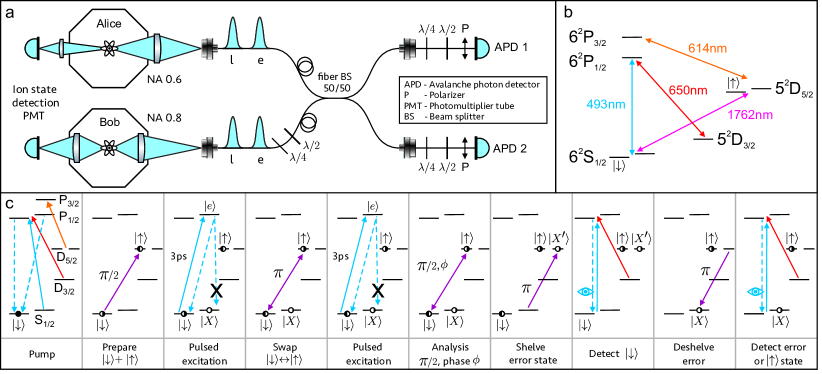
- 時間-bin符号化を用いて、捕獲された 138Ba+ 系から放出される単一光子の時間的プロファイルに量子ビットを格納する。
- 2つの遠隔に位置するイオンから発生する光子を高数値孔径のオブジェクティブラを介して収集し、ビームスプリッタで干渉させて報知付きベル状態測定を実行する。
- 測定に基づく誤り検出プロトコルにより、誤りの除去と最小限のオーバーヘッドで消去誤りを特定・浄化する。
- イオン励起と光子検出のタイミングを 10 ns のウィンドウ内で安定化させることで、原子の反動による誤りを抑制する。
- アクティブな安定化によりレーザー強度の揺らぎを最小限に抑え、SPAM誤りと状態交換誤りを低減する。
- ドーピラー冷却の限界と運動モードを特定し、反動に起因する誤りを推定する。特に感度の高いモード(イオンBのyモード、n̄D ≈ 826)に注目する。
実験結果
リサーチクエスチョン
- RQ1時間-bin符号化光子は、偏光符号化プロトコルの忠実度限界を超える、捕獲イオン間の高忠実度遠隔もつれを可能にするか?
- RQ2時間-binベースの遠隔もつれにおける主要な誤り要因は何か。それらは実験的に抑制可能か?
- RQ3光子放出に伴う原子の反動がもつれ忠実度をどの程度低下させるか。時間制御によりこれを緩和できるか?
- RQ4現在の実験的手法で忠実度を 99.9% 以上に引き上げられるか。これにより、スケーラブルでモジュラーな量子アーキテクチャが実現可能か?
- RQ5光子符号化の選択(時間-bin 対 偏光)が、長距離量子ネットワークにおけるスケーラビリティと耐障害性に与える影響は何か?
主な発見
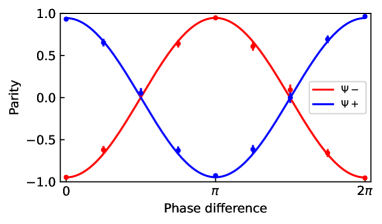
- 実験では、時間-bin光子を用いて2つの捕獲された 138Ba+ 系の間で高忠実度の遠隔もつれを実現し、ベル状態の忠実度が 97.0(4)% に達した。
- 忠実度誤差の最大要因は、量子ビット回転を駆動する 1762 nm レーザーの強度揺らぎであり、1.00% の誤差を占め、誤差予算における主要な項である。
- パス長の安定化により、光子パケットの重なり誤差を 0.4% まで低減し、時間的プロファイルを 30 ps 以内に一致させた。
- 光子検出タイミングジッター(10 ns ウィンドウ)に起因する反動誘発誤差は 0.2% であり、運動状態のもつれとレーザー周波数の揺らぎによる追加寄与も存在する。
- 検出器のダークカウントとバックグラウンド光は誤差予算に 0.2% 未満の寄与であり、ビームスプリッタの不完全性とモード不一致は 0.1% 未満である。
- 合計の忠実度誤差は 2.00% と推定され、2.1 ms の残存コherency時間により、8 μs の分析ウィンドウ内での誤差は 0.01% 未満に制限される。
この論文を読む
Nubintのビューアで原文を開き、読みながら気になる箇所をすぐに質問できます。
Nubintでこの論文を読むこのレビューはAIが論文の原文をもとに作成しました。引用する前に原文をご確認ください。