
[論文レビュー] Neural functional theory for inhomogeneous fluids: Fundamentals and applications
本稿では、深層ニューラルネットワークを用いて非一様流体における密度プロファイルに対する1体直接相関関数の関数的依存性を学習する、機械学習と古典的密度汎関数理論を融合したハイブリッドフレームワークを提案する。この手法により、自動微分および汎関数線積分を用いて自由エネルギーと対相関関数を含む熱力学的および構造的性質を高精度に予測可能であり、最先端の基本的測定理論を上回りつつ、マクロスケールでもミクロスケールの精度を維持する。
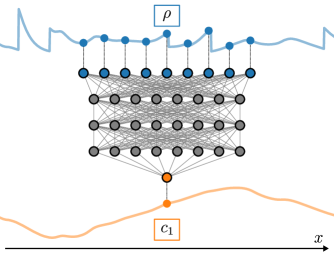
We present a hybrid scheme based on classical density functional theory and machine learning for determining the equilibrium structure and thermodynamics of inhomogeneous fluids. The exact functional map from the density profile to the one-body direct correlation function is represented locally by a deep neural network. We substantiate the general framework for the hard sphere fluid and use grand canonical Monte Carlo simulation data of systems in randomized external environments during training and as reference. Functional calculus is implemented on the basis of the neural network to access higher-order correlation functions via automatic differentiation and the free energy via functional line integration. Thermal Noether sum rules are validated explicitly. We demonstrate the use of the neural functional in the self-consistent calculation of density profiles. The results outperform those from state-of-the-art fundamental measure density functional theory. The low cost of solving an associated Euler-Lagrange equation allows to bridge the gap from the system size of the original training data to macroscopic predictions upon maintaining near-simulation microscopic precision. These results establish the machine learning of functionals as an effective tool in the multiscale description of soft matter.
研究の動機と目的
- 正確な汎関数が未知である非一様流体において、機械学習ベースの手法を用いて高精度な密度汎関数を構築すること。
- 古典的密度汎関数理論における従来の近似手法の限界を乗り越えるために、ニューラルネットワークを用いて密度プロファイルから直接相関関数への汎関数写像を学習すること。
- 訓練済みのニューラル汎関数に基づく汎関数計算を用いて、高次相関関数、自由エネルギー、状態方程式の予測を可能とすること。
- 熱的ネーターの和則則などの既知の物理法則との整合性を検証し、自己稠密な密度プロファイル計算への応用を示すこと。
- ミクロスケールの訓練データから大規模な予測に至るまで、シームレスにスケーラブルかつマルチスケールな手法を確立すること。
提案手法
- 平面幾何におけるグランドカノニカルモンテカルロシミュレーションのデータを用いて、局所的密度プロファイル ρ(r) から1体直接相関関数 c₁(r;[ρ]) への汎関数写像を表す深層ニューラルネットワークを学習する。
- 多様な非一様環境をカバーするため、シミュレーションでランダム化された外部ポテンシャルを用いて多様な訓練データを生成する。
- 自動微分を用いた汎関数計算により、訓練済みのニューラル汎関数から高次相関関数を計算する。
- 参照路に沿った汎関数線積分を用いて過剰ヘルムホルツ自由エネルギーを計算し、熱力学的整合性を確保する。
- ニューラル汎関数をDFTのオイラー=ラグランジュ方程式に適用し、自己稠密な密度プロファイル計算を実行することで、ニューラルDFTフレームワークを構築する。
- 等変性を考慮したアーキテクチャ(例:等変性ニューラルネットワーク)を活用し、データ要件を削減しながらも、異方性粒子や高次元幾何に応用可能にする。
実験結果
リサーチクエスチョン
- RQ1深層ニューラルネットワークは、非一様流体における密度プロファイルに対する1体直接相関関数の関数的依存性を高精度に学習できるか?
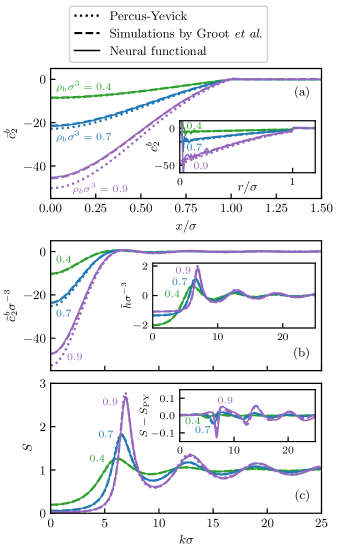
- RQ2学習されたニューラル汎関数は、対構造、自由エネルギー、状態方程式といった既知の物理的量を高い精度で再現できるか?
- RQ3自動微分による汎関数計算が、高次相関関数や熱力学的性質へのアクセスを可能にするか?
- RQ4ニューラルDFTフレームワークは、根本的測定理論のような既存の解析的近似手法を上回り、平衡状態の流体構造を予測できるか?
- RQ5本手法は、平面幾何の訓練データから出発して、マクロスケールの三次元系に一般化可能であり、ミクロスケールの精度を保持できるか?
主な発見
- ニューラル汎関数は、複雑な非一様環境において、最先端の根本的測定理論を上回る高い精度で密度プロファイルを予測する。
- 自動微分による汎関数計算により、高次相関関数が的確に計算され、既存の理論的予想と整合的であることが確認された。
- 汎関数線積分による自由エネルギーの計算結果は、既知の熱力学的関係と一致し、熱的ネーターの和則則を明示的に検証した。
- ニューラル汎関数を用いたオイラー=ラグランジュ方程式の自己稠密解は、多様な外部ポテンシャルに対して安定かつ高精度な密度プロファイルを生成した。
- 本手法は、マクロスケールの系サイズにまで外挿しても、シミュレーション水準のミクロスケールの精度を維持しており、強力なマルチスケール能力を示した。
- 本フレームワークは、切断Lennard-Jones流体など他の系にも一般化可能であり、等変性ニューラルネットワークを用いることで、異方性粒子や3次元幾何にまで拡張可能である。
この論文を読む
Nubintのビューアで原文を開き、読みながら気になる箇所をすぐに質問できます。
Nubintでこの論文を読むこのレビューはAIが論文の原文をもとに作成しました。引用する前に原文をご確認ください。