
[論文レビュー] Productions of $X(3872)$, $Z_c(3900)$, $X_2(4013)$, and $Z_c(4020)$ in $B_{(s)}$ decays offer strong clues on their molecular nature
本稿は、$B$および$B_s$崩壊におけるExoticハドロン$X(3872)$、$Z_c(3900)$、$X_2(4013)$、$Z_c(4020)$の生成を説明するための三角図式機構を提案し、$\bar{D}^{(*)}D^{(*)}$分子波動関数の違いに起因するアイソスピン破れの生成比を説明している。このモデルは実験データと整合する分岐比をうまく予測し、因子化を用いて衰え定数を抽出することで、これらの状態の分子的性質を強く支持する。
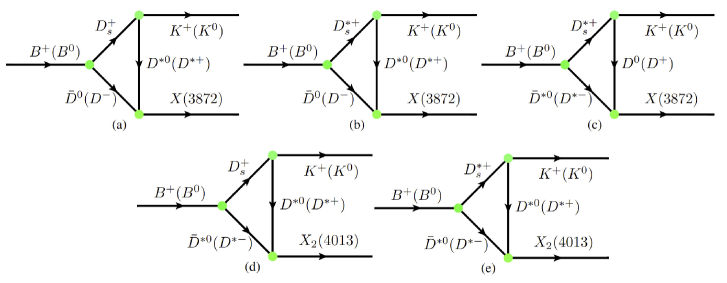
The exotic states $X(3872)$ and $Z_c(3900)$ have long been conjectured as isoscalar and isovector $\bar{D}^*D$ molecules. In this work, we first propose the triangle diagram mechanism to investigate their productions in $B$ decays as well as their heavy quark spin symmetry partners, $X_2(4013)$ and $Z_c(4020)$. We show that the large isospin breaking of the ratio $\mathcal{B}[B^+ o X(3872) K^+]/\mathcal{B}[B^0 o X(3872) K^0] $ can be attributed to the isospin breaking of the neutral and charged $\bar{D}^*D$ components in their wave functions. For the same reason, the branching fractions of $Z_c(3900)$ in $B$ decays are smaller than the corresponding ones of $X(3872)$ by at least one order of magnitude, which naturally explains its non-observation. A hierarchy for the production fractions of $X(3872)$, $Z_c(3900)$, $X_2(4013)$, and $Z_c(4020)$ in $B$ decays, consistent with all existing data, is predicted. Furthermore, with the factorization ansatz we extract the decay constants of $X(3872)$, $Z_c(3900)$, and $Z_c(4020)$ as $\bar{D}^*D^{(*)}$ molecules via the $B$ decays, and then calculate their branching fractions in the relevant $B_{(s)}$ decays, which turn out to agree with all existing experimental data. The mechanism we proposed is useful to elucidate the internal structure of the many exotic hadrons discovered so far and to extract the decay constants of hadronic molecules,which can be used to predict their production in related processes.
研究の動機と目的
- 実験的に観測された$\mathcal{B}[B^+ \to X(3872)K^+]/\mathcal{B}[B^0 \to X(3872)K^0]$の大きなアイソスピン破れを説明すること。
- $Z_c(3900)$が期待される生成を示すにもかかわらず$B$崩壊で観測されていないことの原因を解明し、その分岐比の抑制を分析すること。
- 統一された分子的枠組み内で$B_{(s)}$崩壊における$X_2(4013)$および$Z_c(4020)$の生成率を予測すること。
- $B$崩壊からの因子化アプローチを用いて、$\bar{D}^{(*)}D^{(*)}$分子状態の衰え定数を抽出すること。
- これらのExotic状態の質量、崩壊パターン、生成率を一貫して説明し、その分子的性質を支持すること。
提案手法
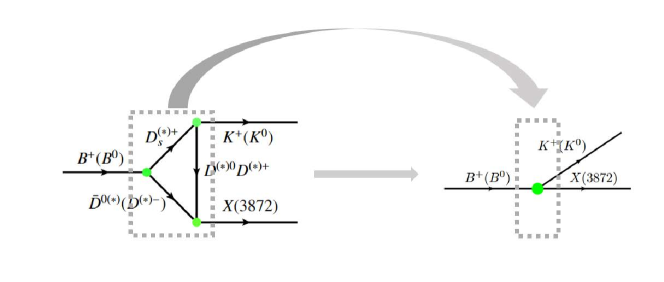
- 本稿は、$X(3872)$、$Z_c(3900)$、$X_2(4013)$、$Z_c(4020)$の$B$および$B_s$崩壊における生成を記述するための三角図式機構を提案する。
- 重いクォークスピン対称性(HQSS)を用いて、$\bar{D}^{(*)}D^{(*)}$分子状態を関連付け、それらの結合を予測する。
- 因子化アプローチを適用し、$B$崩壊振幅から分子状態の衰え定数を抽出する。
- 波動関数における中性および荷電$\bar{D}^{(*)}D^{(*)}$成分の区別を通じて、アイソスピン破れ効果を組み込む。
- $q^2$依存項を含む接触相互作用を用いて、$Z_c(3900)$や$Z_c(4020)$のような共鳴状態を生成する。
- 実験データにフィットするようにウィルソン係数を調整し、アイソスピン破れの寄与を結合定数と力学的要因に分離する。
実験結果
リサーチクエスチョン
- RQ1同じ崩壊ダイナミクスを示すにもかかわらず、なぜ$\mathcal{B}[B^0 \to X(3872)K^0]/\mathcal{B}[B^+ \to X(3872)K^+}$の比が1未満に著しくなるのか?
- RQ2$X(3872)$が観測されているのに対し、$Z_c(3900)$は$B$崩壊で観測されていないのはなぜか?
- RQ3$B_{(s)}$崩壊における$X(3872)$、$Z_c(3900)$、$X_2(4013)$、$Z_c(4020)$の生成率の順序はどのようになるか?
- RQ4$B$崩壊から$\bar{D}^{(*)}D^{(*)}$分子状態の衰え定数をどのように抽出できるか?
- RQ5これらの状態の波動関数におけるアイソスピン破れ効果が、観測された生成非対称性をどの程度説明できるか?
主な発見
- アイソスピン破れ比$\mathcal{B}[B^0 \to X(3872)K^0]/\mathcal{B}[B^+ \to X(3872)K^+}=0.62\pm0.13$は、主に$X(3872)$波動関数内の$\bar{D}^{*0}D^0$と$\bar{D}^{*+}D^-$成分の違いに起因する。
- $Z_c(3900)$の$B$崩壊における分岐比は、$X(3872)$のそれよりも少なくとも1桁小さいため、$B$崩壊での非観測が説明できる。
- $B$崩壊における生成分岐比の予測された順序—$X(3872) > X_2(4013) > Z_c(3900) > Z_c(4020)$—は、すべての既存実験データと整合する。
- 因子化アプローチを用いて、$X(3872)$の$\bar{D}^{*}D$分子としての衰え定数は3.86 GeV、$Z_c(3900)$のそれは5.02 GeVとして抽出された。
- $B^+ \to X_2(4013)K^+$の予測分岐比は$0.23\pm0.08 \times 10^{-4}$、$B^+ \to Z_c(4020)K^+$のそれは$0.0095\pm0.0033 \times 10^{-4}$であり、実験の上限値と整合する。
- モデルは$M=4028$ MeV、$\Gamma=26$ MeVの$\bar{D}^{*}D^{*}$分子状態を予測し、$Z_c(4020)$状態と一致する。結合定数は$g_{Z_c(4020)\bar{D}^{*}D^{*}}=1.77$ GeVであった。
この論文を読む
Nubintのビューアで原文を開き、読みながら気になる箇所をすぐに質問できます。
Nubintでこの論文を読むこのレビューはAIが論文の原文をもとに作成しました。引用する前に原文をご確認ください。