
[論文レビュー] Search-based Motion Planning for Quadrotors using Linear Quadratic Minimum Time Control
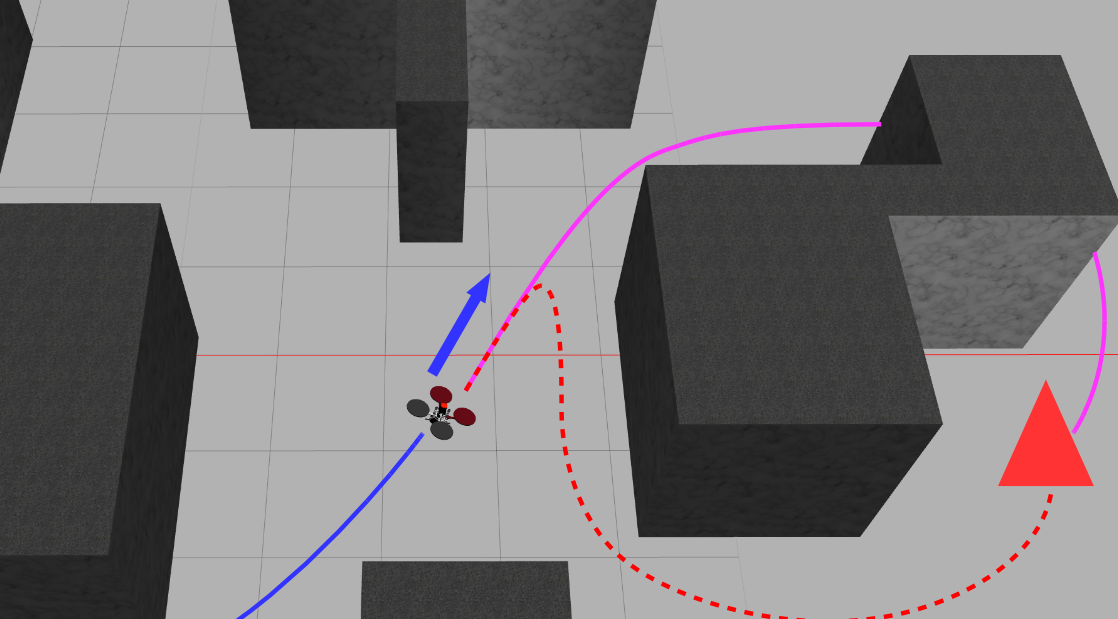
本論文は、線形二次最小時間(LQMT)制御から導出された運動プリミティブを用いて、障害物が多い環境でも動的可換で最小時間の軌道を生成する、検索ベースの運動計画フレームワークを提案する。この手法は最適制御解を用いて状態空間を離散化し、タイトなヒューリスティクスを備えた効率的なグラフ探索を可能にし、従来のパスベース手法と比較して滑らかでグローバルに最適な軌道を実時間でオンライン再計画可能である。
In this work, we propose a search-based planning method to compute dynamically feasible trajectories for a quadrotor flying in an obstacle-cluttered environment. Our approach searches for smooth, minimum-time trajectories by exploring the map using a set of short-duration motion primitives. The primitives are generated by solving an optimal control problem and induce a finite lattice discretization on the state space which can be explored using a graph-search algorithm. The proposed approach is able to generate resolution-complete (i.e., optimal in the discretized space), safe, dynamically feasibility trajectories efficiently by exploiting the explicit solution of a Linear Quadratic Minimum Time problem. It does not assume a hovering initial condition and, hence, is suitable for fast online re-planning while the robot is moving. Quadrotor navigation with online re-planning is demonstrated using the proposed approach in simulation and physical experiments and comparisons with trajectory generation based on state-of-art quadratic programming are presented.
研究の動機と目的
- パスベースの軌道生成の限界に対処する。これは、軌道がホモロジー類に制限され、動的特性を無視すると、部分的最適または実行不能なパスが生じる可能性がある。
- 事前に計算された幾何的パスに依存せずに、障害物が豊富な環境においてグローバルに最適で動的可換かつ時間最小化の軌道を実現する。
- LQMT問題の明示的解を活用することで、高速飛行中のオンライン再計画を計算的に効率的に行う手法を開発する。
- 最適制御から導出された運動プリミティブを用いて状態空間を離散化し、強力なヒューリスティクス誘導によるグラフ探索を可能にする、解像度完全な計画を実現する。
提案手法
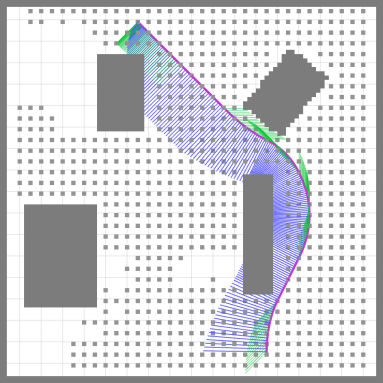
- 短時間区間における線形二次最小時間(LQMT)最適制御問題を解くことで運動プリミティブを生成し、状態間の最小時間遷移を保証する。
- LQMT解は状態遷移から制御入力を明示的かつ閉形式でマッピングするため、状態空間の有限ラティス離散化を可能にする。
- ノードが離散化された状態を表し、エッジが運動プリミティブを表すグラフを構築し、状態空間上の検索ベースの軌道計画を可能にする。
- LQMT解に基づくタイトなヒューリスティクスを用いてA*探索を誘導し、高次元状態空間における収束を著しく加速する。
- 最終的な軌道は非制約二次計画法を用いて精錬され、低次元での計画後でも多旋翼機の動的特性を正確に満たすことを保証する。
- 事前計算されたルックアップテーブルを避け、静止状態を仮定しないことで、運動中に迅速なオンライン再計画を可能にする。
実験結果
リサーチクエスチョン
- RQ1最適制御から導出された運動プリミティブを用いて状態空間を離散化することで、効率的なグラフ探索による軌道計画が可能になるか?
- RQ2LQMT問題の明示的解が、高次元状態空間におけるA*探索の収束を著しく加速するタイトで計算可能なヒューリスティクスを提供できるか?
- RQ3提案手法は、幾何的最短パスに依存するパスベース手法と比較して、滑らかでより動的可換かつ時間最適な軌道を生成できるか?
- RQ4本手法は、静止状態を仮定しない条件下でも、高速な多旋翼機の実時間オンライン再計画をサポートできるか?
主な発見
- LQMTから導出された運動プリミティブを用いた状態空間の離散化により、解像度完全で動的可換かつ最小時間の軌道が生成された。
- LQMTに基づくヒューリスティクスの使用により、A*探索の収束が著しく加速され、高次元状態空間における実時間計画が可能になった。
- 従来のパスベース手法と比較して、本手法は滑らかな軌道を生成し、障害物付近の急な旋回を回避した。特にオンライン再計画時にも同様の滑らかさを維持した。
- 物理実験とシミュレーションの両方で、障害物が豊富な環境における成功したオンライン再計画が確認され、安全で時間最適な軌道が得られた。
- 特に動的状況下では、最新の二次計画法ベースの手法と比較して、本手法は軌道の滑らかさと時間最適性の両面で優れた性能を示した。
- オープンソースの実装がGitHubで公開されており、再現性が保たれるとともに、より広範なロボットシステムへの統合が可能である。
この論文を読む
Nubintのビューアで原文を開き、読みながら気になる箇所をすぐに質問できます。
Nubintでこの論文を読むこのレビューはAIが論文の原文をもとに作成しました。引用する前に原文をご確認ください。