
[論文レビュー] Tuning the coherent interaction of an electron qubit and a nuclear magnon
本論文は、スピン軌道結合に起因する電子g因子の異方性を活用して、ガリウム砒素量子ドットにおける一貫した電子-核スピン相互作用をイン・スイットにチューニングすることに成功した。アルゴリズム的フィードバックを用いて、電子-核交換相互作用を精密に制御し、磁性励起子(マグノン)の注入レートと電子量子ビットのコherency時間の決定的チューニングを実現した。また、高精度分光法により単一核スピンのハイパーフィン定数を直接測定した。
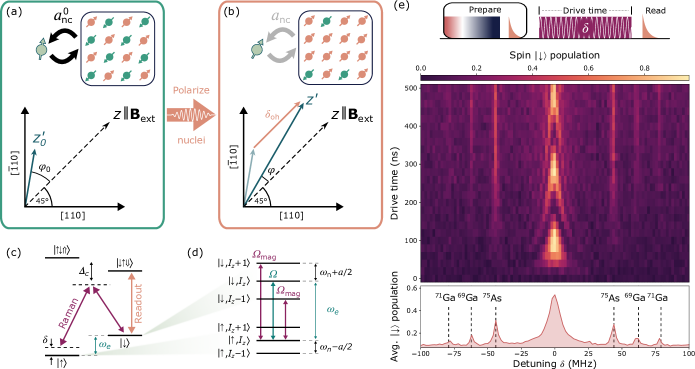
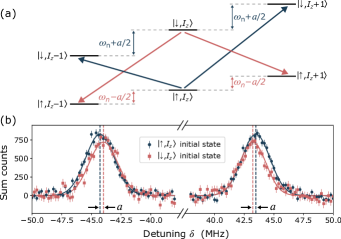
A central spin qubit interacting coherently with an ensemble of proximal spins can be used to engineer entangled collective states or a multi-qubit register. Making full use of this many-body platform requires tuning the interaction between the central spin and its spin register. GaAs quantum dots offer a model realization of the central spin system where an electron qubit interacts with multiple ensembles of $\sim 10^{4}$ nuclear spins. In this work, we demonstrate tuning of the interaction between the electron qubit and the nuclear many-body system in a GaAs quantum dot. The homogeneity of the GaAs system allows us to perform high-precision and isotopically selective nuclear sideband spectroscopy, which reveals the single-nucleus electronic Knight field. Together with time-resolved spectroscopy of the nuclear field, this fully characterizes the electron-nuclear interaction for a priori control. An algorithmic feedback sequence selects the nuclear polarization precisely, which adjusts the electron-nuclear exchange interaction in situ via the electronic g-factor anisotropy. This allows us to tune directly the activation rate of a collective nuclear excitation (magnon) and the coherence time of the electron qubit. Our method is applicable to similar central-spin systems and enables the programmable tuning of coherent interactions in the many-body regime.
研究の動機と目的
- ガリウム砒素量子ドットにおける中心電子スピン量子ビットと核スピン系の間の一貫した相互作用を、イン・スイットで動的にチューニングすることを目的とする。
- 固体状態における中心スピン系の固定された結合パラメータの制限を克服し、電子-核交換相互作用に対するリアルタイム制御を導入することを目的とする。
- フィードバック駆動による核スピン極化ロックを用いて、集団的核励起(マグノン)と電子量子ビットコherency時間のプログラマブル制御を達成することを目的とする。
- イソトープ選択的核サイドバンド分光法を用いて、単一核スピンのハイパーフィン定数(非共線項を含む)を直接測定することで、電子-核相互作用を完全に特徴づけること。
- 制御された核スピン極化によりオーバーハウザー・シフトを調整することで、マグノンラビ周波数のab initioチューニングを実証すること。
提案手法
- 高精度な核サイドバンド分光法を可能にするために、イソトープ純度の高いガリウム砒素量子ドットを用いた。
- 核スピン場の時間分解分光を実施し、共線および非共線ハイパーフィン項を含む電子-核相互作用ハミルトニアンを完全に特徴づけた。
- 核スピン極化をプログラマブルなセットポイントにロックするためのアルゴリズム的フィードバックシーケンスを実装し、電子-核交換相互作用のイン・スイットチューニングを可能にした。
- スピン軌道結合に起因する電子g因子の異方性を、平均場的核スピン極化およびオーバーハウザー・シフトをチューニングする制御ノブとして活用した。
- 電子駆動周波数と核スピン極化を変化させながらマグノンラビ周波数を測定し、理論的予測である相互作用強度の $ a_{ ext{nc}} $ に比例するスケーリングを実証した。
- パラメータ $ heta_1 $, $ heta_2 $, および $ heta_3 $ を持つ減衰する二準位系モデルを用いてラビ振動をフィッティングし、マグノン注入レート $ heta_{ ext{mag}} $ を抽出した。
実験結果
リサーチクエスチョン
- RQ1ガリウム砒素量子ドットにおける一貫した電子-核スピン相互作用は、電子g因子の異方性を用いてイン・スイットにチューニング可能か?
- RQ2フィードバック制御により核スピン極化をどれほど制御可能であり、電子-核交換相互作用およびオーバーハウザー・シフトを調整可能か?
- RQ3核スピン極化を調整することでマグノン注入レートを決定的にチューニング可能であり、理論的予測と整合的か?
- RQ4非共線ハイパーフィン相互作用は、電子-核結合を媒介する役割を果たしており、直接測定可能か?
- RQ5電子-核スピン相互作用のチューニングは、電子量子ビットのコherency時間 $ T_2 $ にどのように影響を及ぼし、デコherencyダイナミクスの制御に利用可能か?
主な発見
- フィードバック制御による核スピン極化を用いて、イン・スイットで電子-核相互作用をチューニングし、オーバーハウザー・シフト $ heta_{ ext{oh}} $ を直接操作した。
- マグノンラビ周波数 $ heta_{ ext{mag}} $ は広い範囲で実験的にチューニング可能であり、理論的予測 $ heta_{ ext{mag}} = rac{a_{ ext{nc}} heta}{2 heta_n} imes rac{5N_{ ext{As}}}{2} $ と良好に一致し、ab initio制御の有効性を確認した。
- 核スピン極化ロックにより、核系のスロー・ノイズスペクトルが百倍以上に狭くなった。これは環境のゆらぎが低減されたことを示している。
- 高精度なイソトープ選択的核サイドバンド分光法により、非共線項を含む単一核スピンのハイパーフィン定数を直接測定した。
- 電子-核交換相互作用のチューニングに応じて電子量子ビットのコherency時間 $ T_2 $ が変化し、デコherencyチャネルの制御が可能であることを示した。
- 本手法により、集団的核マグノンの活性化レートに対する決定的制御が可能となり、固体ステートプラットフォームにおけるプログラマブル量子多体系への重要な一歩を示した。
この論文を読む
Nubintのビューアで原文を開き、読みながら気になる箇所をすぐに質問できます。
Nubintでこの論文を読むこのレビューはAIが論文の原文をもとに作成しました。引用する前に原文をご確認ください。