
[논문 리뷰] A multiple-circuit approach to quantum resource reduction with application to the quantum lattice Boltzmann method
이 논문은 2차원 비압축성 라우지에르-스토크스 방정식의 해를 스트림 함수와 코리올리량에 대해 별도의 양자 회로로 분리하는 두 회로 양자 알고리즘을 제안한다. 이로써 스트림 함수와 코리올리량을 분리함으로써 단일 회로 접근 방식 대비 CNOT 게이트 수를 35% 감소시키고, 병합된 회로 깊이를 16% 감소시켰으며, 동시에 실행을 통해 추가로 자원 효율성을 높여 근접한 양자 하드웨어에서의 양자 시뮬레이션 효율성을 크게 향상시킨다.
This work proposes a multi-circuit quantum lattice Boltzmann method (QLBM) algorithm that leverages parallel quantum computing to reduce quantum resource requirements. Computational fluid dynamics (CFD) simulations often entail a large computational burden on classical computers. At present, these simulations can require up to trillions of grid points and millions of time steps. To reduce costs, novel architectures like quantum computers may be intrinsically more efficient for these computations. Current quantum algorithms for solving CFD problems are based on single quantum circuits and, in many cases, use lattice-based methods. Current quantum devices are adorned with sufficient noise to make large and deep circuits untenable. We introduce a multiple-circuit algorithm for a quantum lattice Boltzmann method (QLBM) solve of the incompressible Navier--Stokes equations. The method, called QLBM-frugal, aims to create more practical quantum circuits and strategies for differential equation-based problems. The presented method is validated and demonstrated for 2D lid-driven cavity flow. The two-circuit algorithm shows a marked reduction in CNOT gates, which consume the majority of the runtime on quantum devices. Compared to the baseline QLBM technique, a two-circuit strategy shows increasingly large improvements in gate counts as the qubit size, or problem size, increases. For 64 lattice sites, the CNOT count was reduced by 35%, and the gate depth decreased by 16%. This strategy also enables concurrent circuit execution, further halving the seen gate depth.
연구 동기 및 목표
- 기존의 단일 회로 양자 알고리즘으로 라우지에르-스토크스 방정식을 풀기 위한 양자 격자 뜨개질 방법(QLBM)에서 높은 양자 자원 소모 문제를 해결하기 위해.
- 스트림 함수와 코리올리량 성분을 분리함으로써 현재의 노이즈가 많은 중규모 양자(NISQ) 장치에서 주요 제약 요소인 CNOT 게이트 수와 회로 깊이를 줄이기 위해.
- 자원 효율성을 향상시키고 동시에 실행을 허용함으로써 유체 역학의 더 실용적인 근접한 양자 시뮬레이션을 가능하게 하기 위해.
- 기준 2D 리벳 드리븐 캐비티 유동 문제에서 고전적 LBM 결과와의 비교를 통해 정확성을 검증하고, 양자 오버헤드를 줄이기 위해.
제안 방법
- 2차원 라우지에르-스토크스 방정식을 압력 항을 제거한 스트림 함수-코리올리량 형태로 재구성하여 광범위한 운반-확산 방정식과 푸아송 방정식을 풀이하는 문제로 환원한다.
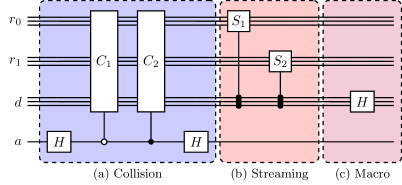
- 코리올리량 운반 방정식을 풀기 위한 하나의 회로와 스트림 함수를 복원하기 위한 푸아송 방정식을 풀기 위한 다른 회로를 별도로 구현한다.
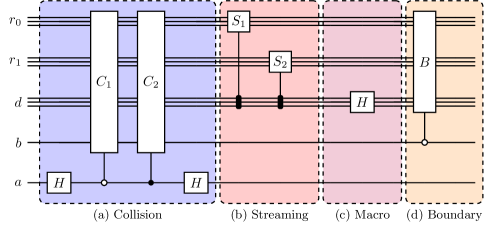
- 경계 조건을 고전적으로 사전 계산하여 회로 깊이와 CNOT 게이트 수를 줄이고 자원 효율성을 향상시킨다.
- 각 시간 단계에서 두 회로를 동시에 실행하도록 설계하여 순차적 실행 대비 관측된 게이트 깊이를 효과적으로 반으로 줄였다.
- Qiskit의 트랜스파일러를 사용하여 고수준 연산을 단일 큐비트 및 CNOT 게이트로 변환하여 하드웨어 호환성을 확보한다.
- 64×64 격자 크기의 D2Q5 격자 모델을 사용하며, 양자 상태 준비 및 측정은 정확성 검증을 위해 상태벡터 시뮬레이션을 통해 수행된다.
실험 결과
연구 질문
- RQ1스트림 함수와 코리올리량 성분을 별도의 양자 회로로 분리함으로써 64×64 격자에서 라우지에르-스토크스 방정식의 QLBM 시뮬레이션에 필요한 총 CNOT 게이트 수를 줄일 수 있는가?
- RQ2두 회로를 동시에 실행함으로써 근접한 양자 하드웨어에서 효과적인 회로 깊이를 얼마나 줄이고 런타임 효율성을 향상시킬 수 있는가?
- RQ3경계 조건을 고전적으로 사전 계산함으로써 QLBM 알고리즘의 양자 자원 비용은 전적으로 양자로 경계를 인코딩하는 것과 비교해 어떻게 영향을 받는가?
- RQ42D 리벳 드리븐 캐비티 흐름 문제에서 두 회로 QLBM의 정확도는 고전적 LBM 시뮬레이션과 비교해 어느 정도인가?
- RQ5두 회로 접근 방식은 이전의 단일 회로 QLBM 방법과 동일한 큐비트 스케일링을 유지하는가? 이는 근접한 구현 가능성을 높인다.
주요 결과
- 64×64 격자에서 두 회로 QLBM는 단일 회로 구현 대비 총 CNOT 게이트 수를 35% 감소시켰다.
- 스트림 함수와 코리올리량 회로를 동시에 실행함으로써 병합된 회로 깊이가 16% 감소했으며, 이는 관측된 깊이를 효과적으로 반으로 줄인 것이다.
- 경계 조건을 고전적으로 사전 계산함으로써 CNOT 수를 최소 35% 감소시켰으며, 특히 코리올리량 회로에서는 경계 사전 계산으로 인해 CNOT 수가 75% 감소했다.
- 양자 시뮬레이션과 고전적 LBM 시뮬레이션 간의 스트림 함수와 코리올리량 상대 오차는 무시할 만할 정도로 작으며, 리벳 드리븐 캐비티 시험 케이스에서 오차는 1% 이하였다.
- 이 방법은 M이 격자 크기일 때 O(log M)의 큐비트 스케일링을 유지하며, 선형 스케일링보다 유리하여 근접한 구현 가능성을 향상시켰다.
- 두 회로 접근 방식은 서로 다른 물리적 성분의 해를 모듈식으로 독립적으로 실행 가능한 회로로 분리함으로써 알고리즘 설계를 단순화하고 고장 내성 능력을 향상시켰다.
이 논문 읽기
누빈트 뷰어에서 원문을 열고, 읽으면서 궁금한 곳을 바로 물어보세요.
누빈트에서 이 논문 읽기이 리뷰는 AI가 논문 원문을 바탕으로 만들었습니다. 인용하기 전에 원문을 확인해 주세요.