
[논문 리뷰] Control and Readout of a 13-level Trapped Ion Qudit
이 연구는 Ba-137+에서 13레벨 트랩 아이온 큐딧의 상태 준비와 단일 샷 판독을 시연하고, 25레벨로 확장 가능한 프로토콜을 제시하며 SPAM 정확도와 오류원을 분석한다.
To implement useful quantum algorithms which demonstrate quantum advantage, we must scale currently demonstrated quantum computers up significantly. Leading platforms such as trapped ions face physical challenges in including more information carriers. A less explored avenue for scaling up the computational space involves utilizing the rich energy level structure of a trapped ion to encode multi-level qudits rather than two-level qubits. Here we show control and single-shot readout of qudits with up to 13 computational states, using protocols which can be extended directly to manipulate qudits of up to 25 levels in our chosen information host, $^{137} ext{Ba}^{+}$. This represents more than twice as many computational states per qudit compared with prior work in trapped ions. In addition to the preparation and readout protocols we demonstrate, universal quantum computation requires other quantum logic primitives such as entangling gates. These primitives have been demonstrated for lower qudit dimensions and can be directly generalized to the higher dimensions we employ. Hence, our advance opens an avenue towards using high-dimensional qudits for large-scale quantum computation. We anticipate efficiently utilizing available energy states in a trapped ion to play a significant and complementary role in tackling the challenge in scaling up the computational space of a trapped ion quantum computer. A qudit architecture also offers other practical benefits, which include affording relaxed fault tolerance thresholds for quantum error correction, providing an avenue for efficient quantum simulation of higher spin systems, and more efficient qubit gates.
연구 동기 및 목표
- 고차원 큐딧을 트랩 아이온에서 사용해 아이온당 정보 용량을 증가시켜 양자 컴퓨터의 규모 확장을 모티베이트한다.
- Ba-137+ 에너지 준위에 인코딩된 13레벨 큐딧에 대한 상태 준비 및 측정(SPAM)을 보인다.
- 고차원 큐딧 인코딩에서 SPAM 정확도가 달성 가능하다는 것을 보여주고 주요 오류원을 식별한다.
- Ba-137+에서 13레벨에서 25레벨까지 확장 인코딩의 경로를 제공한다.
제안 방법
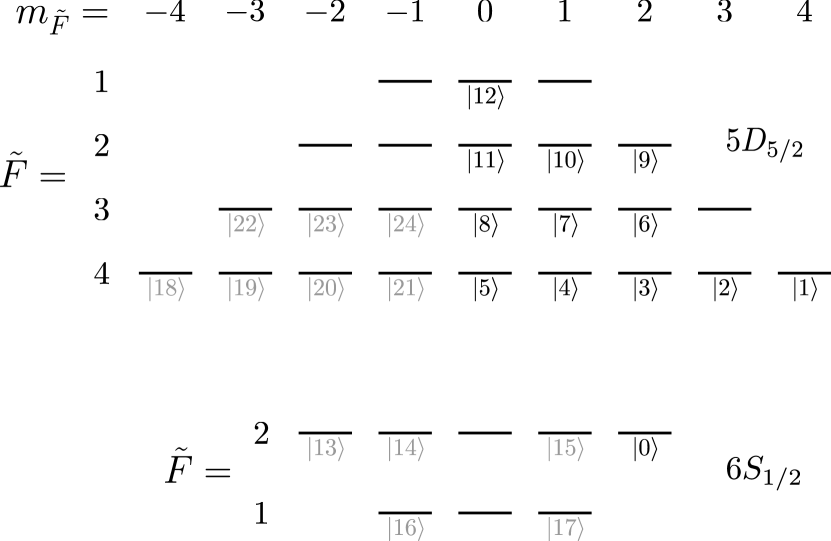
- 1762 nm 전이와 함께 6S1/2 F=2,mF=2 및 선택된 5D5/2 준상태를 사용하여 Ba-137+에서 13 큐딧 레벨을 인코딩한다.
- 목표 상태를 비대상 상태를 5D5/2로 Shelving한 다음 Deshelving과 형광 검사로 준비된 상태를 식별하는 단일 샷 SPAM을 수행한다.
- 포스트 셀렉티드 측정으로 SPAM 정확도를 특성화하고 자기장 노이즈와 π-펄스 오차를 통해 오류를 모델링한다.
- 중간 자기장으로부터 전이 주파수를 경험적으로 보정하고 전이 강도를 모델링한다.
- 필터 함수 이론을 사용해 SPAM 오차를 자기장 노이즈 및 π-펄스 지속 시간과의 관계로 추정한다.
실험 결과
연구 질문
- RQ1고 Ba-137+ 이온이 13레벨 큐딧에 대해 고신뢰도의 SPAM을 제공할 수 있는가?
- RQ2고차원 큐딧 SPAM의 주요 오류 원인은 무엇이며 큐딧 차원이 커질수록 어떻게 확장되는가?
- RQ3제시된 프로토콜을 이용해 Ba-137+에서 13레벨을 넘어선 큐딧 인코딩 확장이 가능한가?
- RQ4유한 자기장 내에서의 전이 강도와 에너지 준위 혼합이 고차원 큐딧 제어에 어떤 영향을 미치는가?
주요 결과
- 13레벨 큐딧에 대해 평균 포스트 선택 SPAM 정확도 91.7±0.3%를 달성했다.
- 13레벨 큐딧에 대해 포스트 선택 평균 SPAM 오차 8.3±0.3%를 관찰했고 원시 SPAM 오차는 13.1±0.3%였다.
- 자기장 노이즈를 SPAM 오차의 주요 원인으로 확인했으며, 이 오차는 모델에 따라 κ^2 τ_π^2로 확장된다.
- 특정 프로토콜에서 SPAM 매개변수의 보정 시간이 큐딧 차원에 따라 증가하지 않는다는 것을 시연했다.
- 제시된 제어 및 판독 체계로 자기 노이즈를 개선하면 Ba-137+에서 25레벨까지의 인코딩이 가능하다고 주장했다.
- 큐딧 차원 확장은 최적의 큐딧 상태 선택을 사용할 때 SPAM 정확도에 본질적으로 영향을 주지 않는다는 것을 보였다.
이 논문 읽기
누빈트 뷰어에서 원문을 열고, 읽으면서 궁금한 곳을 바로 물어보세요.
누빈트에서 이 논문 읽기이 리뷰는 AI가 논문 원문을 바탕으로 만들었습니다. 인용하기 전에 원문을 확인해 주세요.