
[논문 리뷰] Fault-tolerant quantum algorithm for symmetry-adapted perturbation theory
이 논문은 헤이젠베르크 제한된 추정 방법을 사용하여 일阶 대칭성 적응형 섭동 이론(SAPT) 상호작용 에너지 성분—전자기력, 교환, 전자기력-교환—을 계산하는 고장 내성 양자 알고리즘을 제시한다. 고차 텐서 분해와 블록 인코딩을 활용함으로써 알고리즘은 최적의 불확실성 스케일링을 달성하고 기준 분자 및 헴-아르테미신린 복합체에 대한 세부 자원 추정을 제공하며, 대규모 양자 화학 응용 분야에서의 주요 비용 요인을 규명한다.
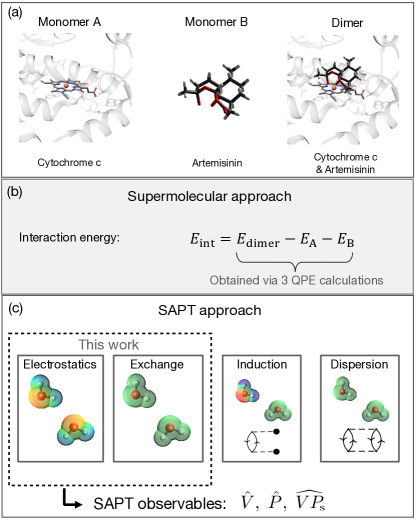
The efficient computation of observables beyond the total energy is a key challenge and opportunity for fault-tolerant quantum computing approaches in quantum chemistry. Here we consider the symmetry-adapted perturbation theory (SAPT) components of the interaction energy as a prototypical example of such an observable. We provide a guide for calculating this observable on a fault-tolerant quantum computer while optimizing the required computational resources. Specifically, we present a quantum algorithm that estimates interaction energies at the first-order SAPT level with a Heisenberg-limited scaling. To this end, we exploit a high-order tensor factorization and block encoding technique that efficiently represents each SAPT observable. To quantify the computational cost of our methodology, we provide resource estimates in terms of the required number of logical qubits and Toffoli gates to execute our algorithm for a range of benchmark molecules, also taking into account the cost of the eigenstate preparation and the cost of block encoding the SAPT observables. Finally, we perform the resource estimation for a heme and artemisinin complex as a representative large-scale system encountered in drug design, highlighting our algorithm's performance in this new benchmark study and discussing possible bottlenecks that may be improved in future work.
연구 동기 및 목표
- 총 에너지 이외의 물리적 해석이 가능한 SAPT 상호작용 에너지 성분을 계산하는 고장 내성 양자 알고리즘을 개발하기 위해.
- 고장 내성 양자 컴퓨터에서 SAPT 관측량의 기대값 추정에 대해 헤이젠베르크 제한된 스케일링을 달성하기 위해.
- 약물 설계에 관련된 대규모 시스템을 포함한 다양한 분자에 대해 논리적 큐비트와 Toffoli 게이트 수를 기준으로 한 세부 자원 추정을 제공하기 위해.
- 향후 최적화를 위해 알고리즘의 주요 성능 저하 요인, 특히 고유상태 준비와 블록 인코딩을 규명하기 위해.
제안 방법
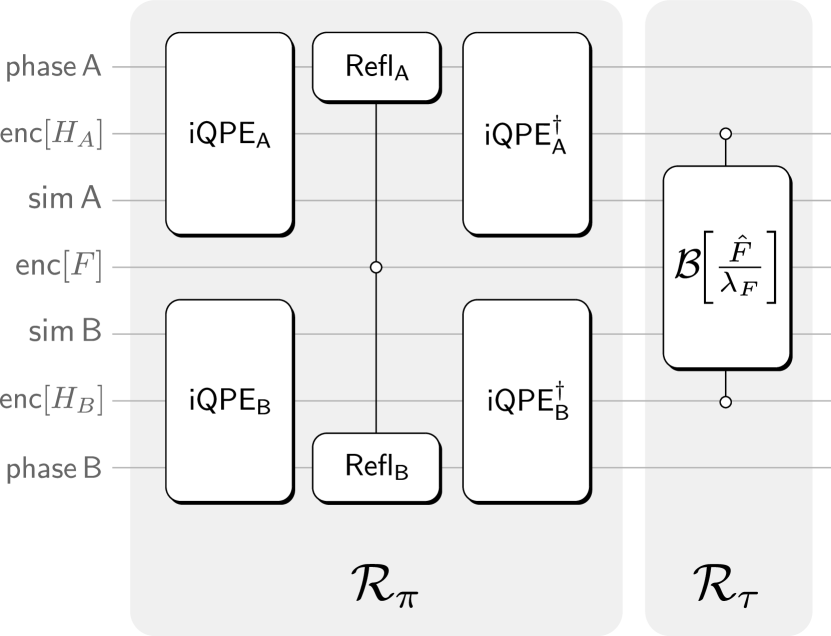
- SAPT 연산자의 헤이젠베르크 제한된 기대값 추정을 위해 QSP-EVE 방법을 사용한다.
- SAPT 해밀토니안을 효율적으로 표현하기 위해 블록 인코딩을 적용하여 관측량 평가의 낮은 깊이 구현을 가능하게 한다.
- 자원 오버헤드를 줄이기 위해 고차 텐서 분해를 사용하여 SAPT 연산자를 희박하고 저랭크 성분으로 분해한다.
- 관측량의 기대값 ⟨ΨAΨB|F̂|ΨAΨB⟩ 형태를 계산하도록 방법을 특화한다. 여기서 F̂는 일阶 SAPT 연산자이다.
- 표면 코드 기반의 고장 내성 양자 컴퓨팅 모델을 사용하여 논리적 큐비트 수와 Toffoli 게이트 수를 포함한 자원 추정을 유도한다.
- 프레임워크는 기준 분자와 헴-아르테미신린 복합체에 적용되며, cc-pVDZ 및 더 큰 기저 집합에서의 기저 집합 의존성 분석이 수행된다.
실험 결과
연구 질문
- RQ1고장 내성 양자 알고리즘이 SAPT 상호작용 에너지 성분의 추정에 대해 헤이젠베르크 제한된 스케일링을 달성할 수 있는가?
- RQ2다양한 분자 시스템에서 일阶 SAPT 관측량을 계산하기 위한 주요 자원 비용—논리적 큐비트와 Toffoli 게이트 수—는 무엇인가?
- RQ3SAPT 연산자의 고유상태 준비와 블록 인코딩이 전체 계산 비용에 어떻게 기여하는가?
- RQ4약물 유사 복합체와 같은 대규모 분자 시스템에서 알고리즘의 주요 성능 저하 요인은 무엇인가?
- RQ5기저 집합 크기와 시스템 복잡성이 고장 내성 하드웨어에서 SAPT를 위한 필요한 양자 자원에 어떻게 영향을 미치는가?
주요 결과
- 알고리즘은 기대값 추정의 불확실성에 대해 헤이젠베르크 제한된 스케일링을 달성하여 런타임에 비례한 최적의 정밀도 스케일링을 가능하게 한다.
- cc-pVDZ[46] 기저 집합을 사용한 헴-아르테미신린 복합체의 경우, 교환 항을 계산하기 위해 약 3.39×10¹¹개의 Toffoli 게이트와 1.43×10⁴개의 논리적 큐비트가 필요하다.
- 주요 자원 비용은 특히 더 큰 기저 집합에서 SAPT 연산자의 블록 인코딩에서 비롯되며, Toffoli 수는 기저 함수 수의 제곱에 비례하여 증가한다.
- 고유상태 준비가 큰 분자에서 전체 비용에 크게 기여하며, 현재 구현에서 주요 성능 저하 요소이다.
- 자원 추정 결과에 따르면 기저 집합 크기가 강한 영향을 미치며, cc-pVDZ[90] 기준으로 교환 항의 Toffoli 수는 3.44×10⁴에 도달하고 논리적 큐비트 수는 5×10⁵를 초과한다.
- 연구는 블록 인코딩과 고유상태 준비의 최적화가 전체 알고리즘 효율성 향상에 가장 큰 기여를 할 수 있음을 규명한다.
이 논문 읽기
누빈트 뷰어에서 원문을 열고, 읽으면서 궁금한 곳을 바로 물어보세요.
누빈트에서 이 논문 읽기이 리뷰는 AI가 논문 원문을 바탕으로 만들었습니다. 인용하기 전에 원문을 확인해 주세요.