
[논문 리뷰] Full Eigenstate Thermalization via Free Cumulants in Quantum Lattice Systems
요약: 이 논문은 높은 차수의 상관관계를 자유 누적량(free cumulants)으로 분해하여chaotic 많은체 시스템에서 일반 ETH를 수치적으로 테스트한다. 네 시간 상관관계는 비자명한 주파수 구조를 가진 네 번째 자유 누적량에 인코딩되어 있음을 보인다.
The Eigenstate-Thermalization-Hypothesis (ETH) has been established as the general framework to understand quantum statistical mechanics. Only recently has the attention been paid to so-called full ETH, which accounts for higher-order correlations among matrix elements, and that can be rationalized theoretically using the language of Free Probability. In this work, we perform the first numerical investigation of the full ETH in physical many-body systems with local interactions by testing the decomposition of higher-order correlators into thermal free cumulants for local operators. We perform exact diagonalization on two classes of local non-integrable (chaotic) quantum many-body systems: spin chain Hamiltonians and Floquet brickwork unitary circuits. We show that the dynamics of four-time correlation functions are encoded in fourth-order free cumulants, as predicted by ETH. Their dependence on frequency encodes the physical properties of local many-body systems and distinguishes them from structureless, rotationally invariant ensembles of random matrices.
연구 동기 및 목표
- 로컬 비적분 가능 양자 많은체 시스템에서 고차 상관관성에 대한 일반 Eigenstate Thermalization Hypothesis (ETH)를 동기부여하고 검증한다.
- Free Probability 이론이 예측하는 대로 네 점 상관관계가 자유 누적량으로 분해됨을 보여준다.
- Crossing partition이 지수적으로 억제되고 non-crossing partition이 인수분해되어 시간 및 주파수 영역에서 ETH 구조를 재현함을 보인다.
- 주파수 해상 자유 누적량을 통해 물리적 많은체 역학과 구조 없는 난수 매트릭스 구별.
- 비적분 격자 모델 및 Floquet 회로에서 일반성 가능성 및 고차 상관관계를 탐구한다.
제안 방법
- 두 개의 혼돈 양자 많은체 시스템(비정형적인 Ising 스핀 체인과 Floquet 벽돌 구간 회로)에 대해 정확 대각화 수행.
- Free Probability 프레임워크 내에서 네 점 시간 상관함수를 계산하고 이를 자유 누적량으로 표현한다.
- 시간 및 주파수 영역 모두에서 Cross partition의 지수적 억제와 non-crossing partition의 인수분해를 검증함으로써 ETH 예측을 시험한다.
- 네 번째 자유 누적량 k4와 그 푸리에 변환을 평가하여 주파수 해상 ETH 함수 tilde{k4}(ω1, ω2, ω3)을 얻는다.
- 회전 불변 난수 행렬과의 비교를 통해 자유 누적량의 비평면적(시스템 특이적) 주파수 의존성을 강조한다.
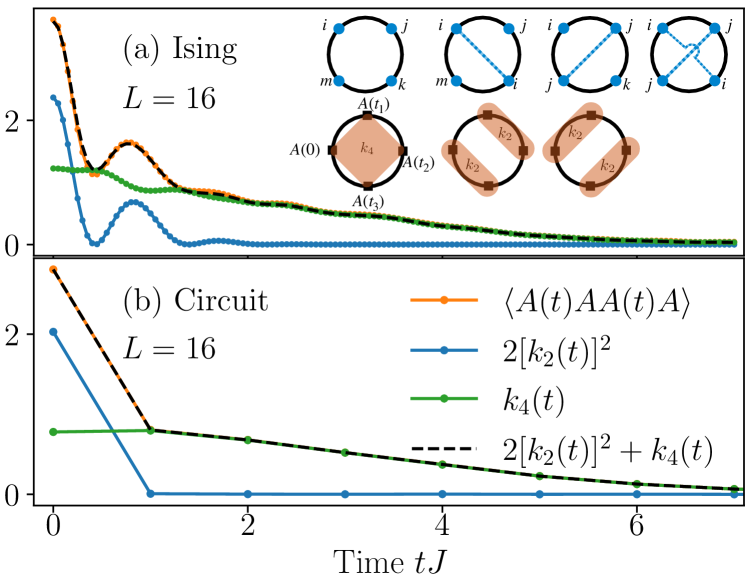
- k2와 k4 분해를 사용하여 OTOC(<A(t) A A(t) A>)와 같은 동작을 분석하여 보다 긴 시간의 역학을 정량화한다.
실험 결과
연구 질문
- RQ1일반 ETH가 자유 누적량으로 표현될 때 국소 상호작용을 갖는 유한 크기 혼돈 양자 격자 시스템에서 성립하는가?
- RQ2Crossing 다이어그램은 지수적으로 억제되고 time 및 frequency 영역에서 non-crossing 다이어그램이 ETH가 예측하는 대로 인수분해되는가?
- RQ3물리적 시스템과 무작위 매트릭스 어넴블에서 네 번째 자유 누적량 tilde{k4}(ω1, ω2, ω3)의 주파수 의존성은 어떠한가?
- RQ4네 점 상관관계(OBTOC 포함)가 k2 및 k4 항으로 정확히 설명될 수 있으며, 두 점 함수를 넘는 고차 상관관계에 어떤 시사점을 주는가?
- RQ5Floquet 회로와 해밀토니안 스핀 체인은 k4 동역학에서 유사한 ETH 특징과 잠재적 일반성을 보이는가?
주요 결과
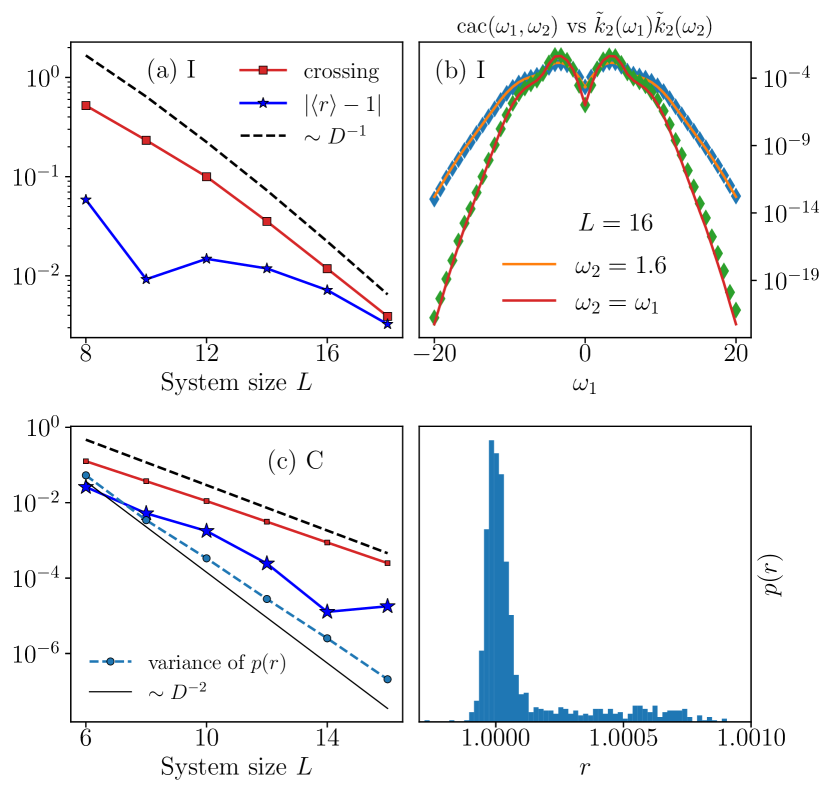
- Crossing partition 기여는 시스템 크기가 커질수록 지수적으로 억제되며 ETH 예측을 뒷받침한다.
- Non-crossing(cactus) 기여는 인수분해하며, cac(ω1, ω2)의 비는 L이 커짐에 따라 tilde{k2}(ω1) tilde{k2}(ω2)의 곱으로 수렴한다.
- 네 번째 자유 누적량 k4(t)는 두 점 상관관계가 감소한 후 남은 OTOC 다이내믹스를 포착하여 비자명한 고차 상관관계를 나타낸다.
- 주파수 해상 tilde{k4}(ω1, ω2, ω3)는 Ising 해밀토니언에서 비자명한 구조를 보이며 큰 주파수에서 감소하고 Floquet 회로에서는 2π 내에서 비자명한 동역학으로 주기적 구조를 보이며 ETH를 평탄한 난수 매트릭스와 구분한다.
- ETH 프레임워크를 자유 누적량으로 적용하면 전체 네 점 상관관계가 <A(t) A A(t) A> ≈ 2[k2(t)]^2 + k4(t)로 Ising과 회로 모델 모두에서 정확히 재현된다.
- 결과는 두 가지 모델 클래스(Hamiltonian와 Floquet)에서 지속되며, 구조가 없는, 회전 불변 난수 매트릭스와 다르다.
이 논문 읽기
누빈트 뷰어에서 원문을 열고, 읽으면서 궁금한 곳을 바로 물어보세요.
누빈트에서 이 논문 읽기이 리뷰는 AI가 논문 원문을 바탕으로 만들었습니다. 인용하기 전에 원문을 확인해 주세요.