
[논문 리뷰] Gradient-free neural topology optimization: Towards effective fracture-resistant designs
이 논문은 사전 훈련된 잠재-베르누이 autoencoder(LBAE)를 사용하여 설계를 저차원 잠재공간으로 재매개변수화함으로써 반복 횟수를 최소한으로 줄이는 그래디언트 기반 신경형 상호작용 최적화 프레임워크를 제안한다. 이 방법은 그래디언트 기반 방법이 실패하는 비미분 가능하고 균열에 강한 설계의 효과적인 최적화를 가능하게 하며, 분포 외 문제에 대해 강력한 일반화 성능과 기존의 블랙박스 최적화보다 뚜렷한 성능 향상을 보여준다.
Gradient-free optimizers allow for tackling problems regardless of the smoothness or differentiability of their objective function, but they require many more iterations to converge when compared to gradient-based algorithms. This has made them unviable for topology optimization due to the high computational cost per iteration and the high dimensionality of these problems. We propose a gradient-free neural topology optimization method using a pre-trained neural reparameterization strategy that addresses two key challenges in the literature. First, the method leads to at least one order of magnitude decrease in iteration count to reach minimum compliance when optimizing designs in latent space, as opposed to the conventional gradient-free approach without latent parameterization. This helps to bridge the large performance gap between gradient-free and gradient-based topology optimization for smooth and differentiable problems like compliance optimization, as demonstrated via extensive computational experiments in- and out-of-distribution with the training data. Second, we also show that the proposed method can optimize toughness of a structure undergoing brittle fracture more effectively than a traditional gradient-based optimizer, delivering an objective improvement in the order of 30% for all tested configurations. Although gradient-based topology optimization is more efficient for problems that are differentiable and well-behaved, such as compliance optimization, we believe that this work opens up a new path for problems where gradient-based algorithms have limitations.
연구 동기 및 목표
- 고차원 상호작용 최적화 문제에서 그래디언트 기반 최적화의 높은 계산 비용과 느린 수렴 문제를 해결한다.
- 특히 균열과 같은 비미분 가능 목표 함수에서 그래디언트 기반 방법의 차원의 저주와 낮은 확장성 문제를 극복한다.
- 균열 저항성과 같은 복잡하고 비연속적인 목표 함수의 효과적인 최적화를 가능하게 하며, 그래디언트 기반 방법이 비연속적이거나 노이즈가 많은 그래디언트로 인해 불가능한 경우에 대비한다.
- 사전 훈련된 LBAE를 사용한 잠재공간 최적화가 그래디언트 기반 및 그래디언트 기반 최적화 방법 간의 성능 격차를 크게 줄일 수 있음을 입증한다.
- 재훈련 없이도 분포 외 문제 및 새로운 물리 영역으로의 일반화 능력을 조사하여 강건성과 전이 가능성의 타당성을 검증한다.
제안 방법
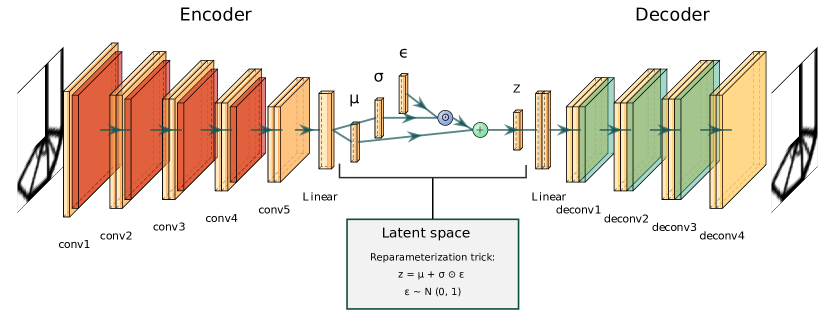
- 다양한 훈련 예제로 구성된 다양한 분포의 설계에서 상호작용 설계의 저차원, 분리된 잠재 표현을 학습하기 위해 잠재-베르누이 autoencoder(LBAE)를 사용한다.
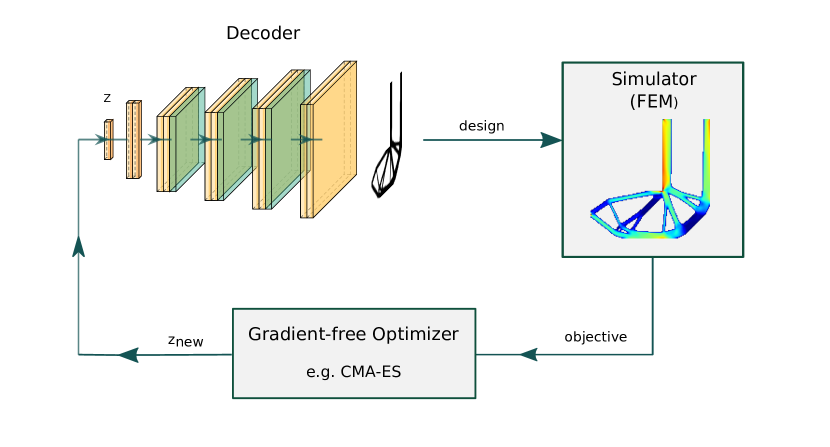
- LBAE의 잠재공간으로 상호작용 최적화 문제를 재매개변수화하여 설계 변수의 차원을 감소시키고 최적화 효율성을 향상시킨다.
- 유한요소법(FEM) 시뮬레이션을 통한 성능 평가 기반으로 CMA-ES와 같은 그래디언트 기반 최적화기를 사용하여 잠재공간에서 반복적으로 설계를 업데이트한다.
- 체적 분율과 같은 하드 제약 조건을 특정 제약 값에 해당하는 다양체에 제한함으로써 잠재공간에서 제약 조건을 강제한다.
- 다양한 체적 분율과 구조를 가진 설계의 분포를 토대로 LBAE를 훈련시켜 일반화 능력과 표현력을 향상시킨다.
- 고정된 시뮬레이션 예산(FEM 평가 수)을 기준으로 성능를 평가하며, 실제 벽시계 시간을 반영하기 위해 병렬 인구 평가를 고려한다.
실험 결과
연구 질문
- RQ1사전 훈련된 autoencoder를 통한 잠재공간 재매개변수화가 그래디언트 기반 최적화에서 수렴에 필요한 반복 횟수를 크게 줄일 수 있는가?
- RQ2잠재공간 최적화의 성능는 기존의 블랙박스 최적화와 비교해 수렴 속도와 해의 품질 측면에서 어떻게 다른가?
- RQ3일부 유형의 상호작용 문제(예: 구조적 유연성)에서 훈련된 모델이 재훈련 없이 분포 외 문제(예: 열적 유연성 최적화)로 일반화할 수 있는 정도는 어느 정도인가?
- RQ4제안된 방법이 그래디언트 기반 방법이 실패하는 비미분 가능 목표 함수, 예를 들어 균열 저항성 최적화를 효과적으로 수행할 수 있는가?
- RQ5잠재공간 표현이 다양한 길이 척도에서의 다양한 설계 특징을 지원할 수 있는가, 아니면 특정한 구조적 패턴에 편향되어 있는가?
주요 결과
- 제안된 잠재공간 재매개변수화 방법은 재매개변수화 없이 기존의 블랙박스 최적화 방식에 비해 최소한 한 계단 수준의 반복 횟수 감소를 이룬다.
- 가장 열악한 경우—랜덤 초기화에서 가장 열악한 실행 결과를 고려하더라도—LBAE 기반 방법은 베이스라인에 비해 뚜렷한 성능 우위를 보였다.
- 이 방법은 분포 외 문제, 특히 새로운 물리 문제(열적 유연성 최적화)로의 일반화에 효과적으로 대응하며, 그래디언트 기반 베이스라인 수준의 성능에 근접한다.
- 학습 데이터와 현저히 다른 특징을 가진 설계로의 일반화가 가능함을 보여주어 강건성과 전이 가능성의 잠재력을 입증한다.
- 현재 접근법은 특정한 특징 길이 척도에 편향을 보이며, 이는 더 표현력 있는 아키텍처나 잠재공간 내 제약 조건 강화 방법의 개선이 해답 다양성 향상에 기여할 수 있음을 시사한다.
- 그래디언트 정보가 없음에도 불구하고, 특히 균열에 강한 설계에서 그래디언트 기반 방법과 유사한 성능를 달성함을 입증하였다.
더 나은 연구,지금 바로 시작하세요
논문 읽기부터 검토까지, 연구 시간을 획기적으로 줄여보세요.
카드 등록 없음 · 무료 플랜 제공
이 리뷰는 AI가 만들고, 인간 에디터가 검토했습니다.