
[논문 리뷰] Incompressible Navier-Stokes solve on noisy quantum hardware via a hybrid quantum-classical scheme
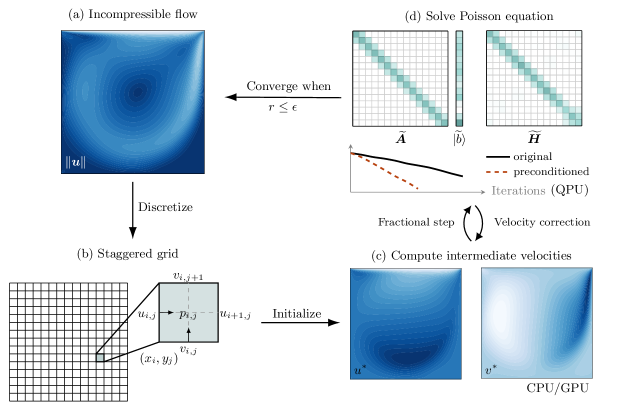
이 논문은 노이지 중간 규모 양자(NISQ) 하드웨어에서 압축성 없는 나비에-스토크스 방정식을 해결하기 위한 하이브리드 양자-고전 알고리즘을 제안한다. 고전적 압력 프로젝션 방법과 압력 푸아송 방정식을 위한 변분 양자 선형 해법(VQLS)을 조합하고, HTree 톰그래피와 다중격자 조건부 조정을 적용하여, IBM의 초전도 양자 프로세서에서 고정밀도 해를 달성하였다. 이는 하드웨어 노이즈와 자원 제약에도 불구하고 근접한 양자 유체역학 시뮬레이션의 실현 가능성을 보여준다.
Partial differential equation solvers are required to solve the Navier-Stokes equations for fluid flow. Recently, algorithms have been proposed to simulate fluid dynamics on quantum computers. Fault-tolerant quantum devices might enable exponential speedups over algorithms on classical computers. However, current and foreseeable quantum hardware introduce noise into computations, requiring algorithms that make judicious use of quantum resources: shallower circuit depths and fewer qubits. Under these restrictions, variational algorithms are more appropriate and robust. This work presents a hybrid quantum-classical algorithm for the incompressible Navier--Stokes equations. A classical device performs nonlinear computations, and a quantum one uses a variational solver for the pressure Poisson equation. A lid-driven cavity problem benchmarks the method. We verify the algorithm via noise-free simulation and test it on noisy IBM superconducting quantum hardware. Results show that high-fidelity results can be achieved via this approach, even on current quantum devices. Multigrid preconditioning of the Poisson problem helps avoid local minima and reduces resource requirements for the quantum device. A quantum state readout technique called HTree is used for the first time on a physical problem. Htree is appropriate for real-valued problems and achieves linear complexity in the qubit count, making the Navier-Stokes solve further tractable on current quantum devices. We compare the quantum resources required for near-term and fault-tolerant solvers to determine quantum hardware requirements for fluid simulations with complexity improvements.
연구 동기 및 목표
- 현재의 노이지 양자 하드웨어에서 압축성 없는 유체역학 시뮬레이션을 위한 실용적인 양자 알고리즘을 개발하기 위해.
- 효율적인 톰그래피를 통해 근접한 장치에서 고정밀도 양자 상태 독출 문제를 해결하기 위해.
- 다중격자 조건부 조정을 통한 변분 양자 알고리즘의 수렴성과 학습 가능성 향상을 위해.
- 유체역학 문제에 대한 VQLS, VQE 및 HHL 해법의 양자 자원 요구량을 비교 평가하기 위해.
- 2차원 리벳 구동 캐비티 유동에 대해 실질적인 IBM 양자 프로세서에서 방법을 실험적으로 검증하기 위해.
제안 방법
- 비선형 항과 시간 스텝을 처리하기 위해 고전적 압력 프로젝션 방법을 사용하고, 압력 푸아송 방정식은 변분 양자 선형 해법(VQLS)을 통해 해결한다.
- 선형 시스템 잔차를 기반으로 한 비용 함수를 최소화하기 위해 고전적 최적화기를 사용하여 양자 회로의 매개변수를 학습한다.
- 실수 값 상태벡터를 효율적으로 재구성하기 위해 선형 복잡도를 가지는 양자 상태 톰그래피인 HTree를 사용하여 독출 시간을 단축시킨다.
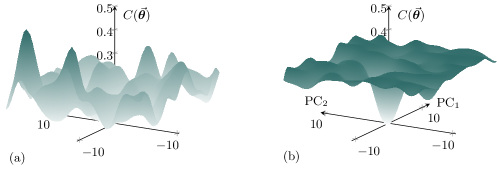
- 최적화 과정 중 국소 최솟값에 갇히는 것을 방지하고 조건 수를 개선하기 위해 선형 시스템에 다중격자 조건부 조정을 적용한다.
- Qiskit를 사용하여 고도의 최적화 수준으로 IBM의 ibm_kolkata, ibm_sherbrooke, ibm_torino 양자 프로세서에서 알고리즘을 구현하고 테스트한다.
- 자원 추정은 VQE, VQLS, HHL의 큐비트 수, 2 큐비트 게이트 수, 회로 깊이 및 127 큐비트 ibm_sherbrooke 프로세서에서의 추정 실행 시간 기준으로 비교한다.
실험 결과
연구 질문
- RQ1현재의 노이지 양자 하드웨어에서 고정밀도로 압축성 없는 나비에-스토크스 방정식을 하이브리드 양자-고전 알고리즘으로 해결할 수 있는가?
- RQ2다중격자 조건부 조정은 변분 양자 알고리즘의 학습 가능성과 수렴성을 유체역학 문제에 대해 얼마나 효과적으로 향상시키는가?
- RQ3근접한 응용에서 기존 방법에 비해 HTree 톰그래피가 양자 상태 독출 시간을 상당히 단축시킬 수 있는가?
- RQ4NISQ 장치에서 유체 흐름 문제를 해결하기 위해 VQLS, VQE, HHL의 상대적 양자 자원 요구량은 어떠한가?
- RQ5초전도 양자 프로세서에서 관찰되는 실제 노이즈 수준에서도 제안된 방법이 강건한가?
주요 결과
- 실제 IBM 양자 프로세서에서 2차원 리벳 구동 캐비티 유동에 대해 고정밀도 해를 성공적으로 계산하여, 현재 하드웨어에서의 실현 가능성과 타당성을 검증하였다.
- 다중격자 조건부 조정은 VQLS 최적화 과정에서 수렴 속도를 크게 향상시키고 국소 최솟값에 갇힐 가능성을 줄였다.
- HTree 톰그래피를 통해 실수 값 상태벡터를 선형 시간 내에 효율적으로 재구성할 수 있었으며, 기존의 양자 상태 톰그래피에 비해 측정 오버헤드를 감소시켰다.
- 자원 추정 결과, 5 큐비트 시스템에서 VQLS는 1,900개의 2 큐비트 게이트와 8,700의 회로 깊이를 요구하며, ibm_sherbrooke에서 추정 실행 시간은 1.1 ms로 나타났다. 이는 문제 행렬 A가 단순한 파울리 분해를 갖는 경우를 제외하고는 많은 NISQ 장치에 대해 여전히 비현실적이다.
- HHL은 자원 요구량이 매우 높아 NISQ 하드웨어에서 실현 가능하지 않으며, 370,000개의 2 큐비트 게이트와 170만의 회로 깊이가 필요하고 추정 실행 시간은 240 ms로 나타났다.
- 연구는 VQLS가 문제 행렬 A가 효율적인 파울리 분해를 허용할 경우에만 NISQ 장치에서 유의미하게 활용 가능하며, 이는 공학 문제에 대한 일반적 적용 가능성을 제한함을 결론지었다.
이 논문 읽기
누빈트 뷰어에서 원문을 열고, 읽으면서 궁금한 곳을 바로 물어보세요.
누빈트에서 이 논문 읽기이 리뷰는 AI가 논문 원문을 바탕으로 만들었습니다. 인용하기 전에 원문을 확인해 주세요.