
[논문 리뷰] MNISQ: A Large-Scale Quantum Circuit Dataset for Machine Learning on/for Quantum Computers in the NISQ era
MNISQ는 NISQ 시대의 기계학습을 위한 대규모 495만 개 데이터 포인트를 가진 양자 회로 데이터셋을 소개한다. 고전적 MNIST 유사 데이터를 양자 회로와 QASM 형식으로 인코딩하며, 이는 양자 커널 방법을 통한 이중 평가를 가능하게 한다. 양자 커널 방법은 97%의 정확도를 달성하고, 고전적 모델인 S4는 QASM 토큰화된 시퀀스에서 77%의 정확도를 기록하여, 양자 우월성 잠재력과 고전적 모델의 양자 데이터에 대한 능력 모두를 입증한다.
We introduce the first large-scale dataset, MNISQ, for both the Quantum and the Classical Machine Learning community during the Noisy Intermediate-Scale Quantum era. MNISQ consists of 4,950,000 data points organized in 9 subdatasets. Building our dataset from the quantum encoding of classical information (e.g., MNIST dataset), we deliver a dataset in a dual form: in quantum form, as circuits, and in classical form, as quantum circuit descriptions (quantum programming language, QASM). In fact, also the Machine Learning research related to quantum computers undertakes a dual challenge: enhancing machine learning exploiting the power of quantum computers, while also leveraging state-of-the-art classical machine learning methodologies to help the advancement of quantum computing. Therefore, we perform circuit classification on our dataset, tackling the task with both quantum and classical models. In the quantum endeavor, we test our circuit dataset with Quantum Kernel methods, and we show excellent results up to $97\%$ accuracy. In the classical world, the underlying quantum mechanical structures within the quantum circuit data are not trivial. Nevertheless, we test our dataset on three classical models: Structured State Space sequence model (S4), Transformer and LSTM. In particular, the S4 model applied on the tokenized QASM sequences reaches an impressive $77\%$ accuracy. These findings illustrate that quantum circuit-related datasets are likely to be quantum advantageous, but also that state-of-the-art machine learning methodologies can competently classify and recognize quantum circuits. We finally entrust the quantum and classical machine learning community the fundamental challenge to build more quantum-classical datasets like ours and to build future benchmarks from our experiments. The dataset is accessible on GitHub and its circuits are easily run in qulacs or qiskit.
연구 동기 및 목표
- NISQ 시대의 기계학습을 위한 대규모 이중 형식 데이터셋(양자 회로 및 QASM)을 구축하여 벤치마킹하는 것.
- 양자 및 고전적 모델이 양자 회로 분류 작업에서 비교 가능하게 평가할 수 있도록 하는 것.
- 최신 고전적 모델이 양자 회로 데이터를 효과적으로 학습할 수 있음을 입증하면서도, 잠재적 양자 우월성도 보여주는 것.
- 미래의 양자-고전 기계학습 연구를 위한 공개적이고 재현 가능한 벤치마킹을 제공하는 것.
제안 방법
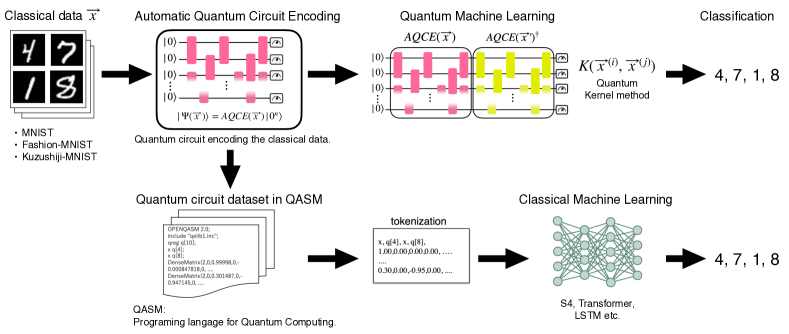
- 고전적 이미지 데이터(MNIST, Fashion-MNIST, Kuzushiji-MNIST)를 진폭 인코딩을 사용하여 양자 회로로 변환하여 데이터셋을 구성한다.
- 각 회로는 두 가지 형태로 표현된다: 양자 모델 학습을 위한 양자 회로와 고전적 모델 학습을 위한 QASM 코드.
- 모델의 노이즈에 대한 내성 평가를 위해 데이터 무결도(80%, 90%, 95%) 기반으로 9개의 서브데이터셋으로 분할한다.
- 고전적 모델(S4, Transformer, LSTM)은 수치 값을 소수 세 자리까지 절삭하고 이산 토큰으로 간주하여 토큰화된 QASM 시퀀스에서 학습한다.
- 양자 커널 방법은 양자 회로 데이터에 직접 힐베르트-슈미트 커널을 사용하여 분류에 적용한다.
- 하이퍼파rameter는 AdamW를 사용하고, 코즈인 애너일링과 가중치 감소를 적용하며, 검증은 무결도 80%인 mnist_786 서브셋에서 수행한다.
실험 결과
연구 질문
- RQ1QASM 형식으로 인코딩된 양자 회로를 분류하는 데 있어, 비틀린 양자역학적 구조를 지닌 데이터에 대해 고전적 기계학습 모델이 효과적으로 작동할 수 있는가?
- RQ2양자 회로 데이터에 대한 양자 커널 학습이 높은 정확도를 달성하여 이 작업에서 잠재적 양자 우월성을 보여주는가?
- RQ3양자 회로 데이터의 노이즈 증가(무결도 감소)에 따라 모델 성능은 어떻게 변화하는가?
- RQ4최신 순차 모델인 S4, Transformer, LSTM은 QASM로 표현된 양자 회로에 대해 일반화 가능한가?
- RQ5MNISQ 데이터셋은 미래의 양자-고전 기계학습 연구를 위한 벤치마킹으로 적합한가?
주요 결과
- 양자 커널 방법은 MNISQ 데이터셋에서 테스트 정확도 97%를 달성하여, 양자 회로 분류 작업에서 뛰어난 성능을 입증했다.
- S4 모델은 토큰화된 QASM 시퀀스에서 77%의 정확도를 기록하여, 동일한 작업에서 Transformer(58.84%)와 LSTM(55.68%)를 앞섰다.
- 고전적 모델들은 높은 무결도 데이터에서 약 55% 수준의 근사 기준 성능를 기록하여, 양자적 구조가 비트리비하지만 학습 가능한 것으로 나타났다.
- Transformer와 LSTM 모델은 무결도가 증가함에 따라 성능 향상이 거의 없어, 회로 표현에서 노이즈에 민감하지 않음을 시사했다.
- MNISQ 데이터셋은 메타데이터와 튜토리얼을 포함하여 GitHub에 공개되어 있어, 향후 연구의 재현 가능한 벤치마킹을 가능하게 한다.
- 데이터셋은 qulacs와 Qiskit에서 실행 가능하여, 양자 및 고전적 기계학습 실험에 넓은 접근성을 제공한다.
![Figure 2: Schematic diagram of how to embed classical data into the probability amplitude of a quantum state the using the AQCE [ 20 ] algorithm.](https://ar5iv.labs.arxiv.org/html/2306.16627/assets/x2.png)
더 나은 연구,지금 바로 시작하세요
논문 읽기부터 검토까지, 연구 시간을 획기적으로 줄여보세요.
카드 등록 없음 · 무료 플랜 제공
이 리뷰는 AI가 만들고, 인간 에디터가 검토했습니다.