
[논문 리뷰] Noisy Qudit vs Multiple Qubits : Conditions on Gate Efficiency for Enhancing Fidelity
이 논문은 동일한 힐베르트 공간 차원과 노이즈 환경 조건에서 단일 큐디트 시스템과 다중 큐비트 시스템의 게이트 편밀리티를 비교하며, 리드블라드 형식의 1차 평균 게이트 불편밀리티(AGI)를 사용한다. 연구는 게이트 효율성에 대한 임계 곡선 $(d^2 - 1)/(3\log_2 d)$ 를 유도하여 디코herence 시간에 비해 게이트 시간이 충분히 짧을 경우, 특정 큐디트 플랫폼이 상태 기반 큐비트 시스템의 편밀리티 스케일링을 따라하거나 이를 초월할 수 있음을 보여준다.
Today, multiple new platforms are implementing qudits, $d$-level quantum bases of information, for Quantum Information Processing (QIP). It is therefore crucial to study their efficiencies for QIP compared to more traditional qubit platforms. We present a comparative study of the infidelity scalings of a qudit and $n$-qubit systems, both with identical Hilbert space dimensions and noisy environments. The first-order response of the Average Gate Infidelity (AGI) to the noise in the Lindblad formalism, which was found to be gate-independent, was calculated analytically in the two systems being compared. This yielded a critical curve $O(d^2/\log_2(d))$ of the ratio of their respective gate times in units of decoherence time. This quantity indicates how time-efficient operations on these systems are. The curve delineates regions where each system has a higher rate of increase of the AGI than the other. This condition on gate efficiency was applied to different existing platforms. It was found that specific qudit platforms possess gate efficiencies competitive with state-of-the-art qubit platforms. Numerical simulations complemented this work and allowed for discussion of the applicability and limits of the linear response formalism.
연구 동기 및 목표
- 노이즈 조건 하에서 단일 큐디트 시스템이 동등한 다중큐비트 시스템보다 계산 편밀리티 측면에서 뛰어나게 되는지 평가하는 것.
- 큐디트 기반 플랫폼이 오차 채널 수가 많음에도 불구하고 다중큐비트 시스템의 평균 게이트 불편밀리티(AGI) 성능을 유지하거나 초월할 수 있는 조건을 규명하는 것.
- 게이트 효율성과 디코herence 시간스케일의 상대적 관계를 정량적으로 기준화하여 큐디트 플랫폼의 타당성을 확립하는 것.
- 약한 노이즈 조건 하에서 AGI의 선형 반응 근사가 타당한지 검증하고, 수치 시뮬레이션을 통해 그 한계를 평가하는 것.
제안 방법
- 동일한 힐베르트 공간 차원을 가진 단일 큐디트 및 n-큐비트 시스템에 대해 리드블라드 형식에서 노이즈에 의한 평균 게이트 불편밀리티(AGI)의 1차 반응을 해석적으로 계산한다.
- 모든 유니터리 게이트에 대해 하르 측도를 사용하여 평균화함으로써 상태 독립적인 편밀리티 지표를 확보한다.
- 디코herence 노이즈 조건 하에서 단일 큐디트의 AGI 스케일링을 추론하며, 차원 $d$ 와 노이즈 비율 $\gamma$ 를 포함한 추적 기반 표현식을 사용한다.
- 동일한 형식을 사용하여 순수 디코herence 조건 하에서 $n$ 큐비트의 AGI 스케일링을 유도하고 큐디트 경우와 비교한다.
- 게이트 시간과 디코herence 시간의 비율을 성능 지표로 정의하고, 두 시스템 간의 우월한 성능 영역을 분리하는 임계 곡선 $ (d^2 - 1)/(3\log_2 d) $ 를 유도한다.
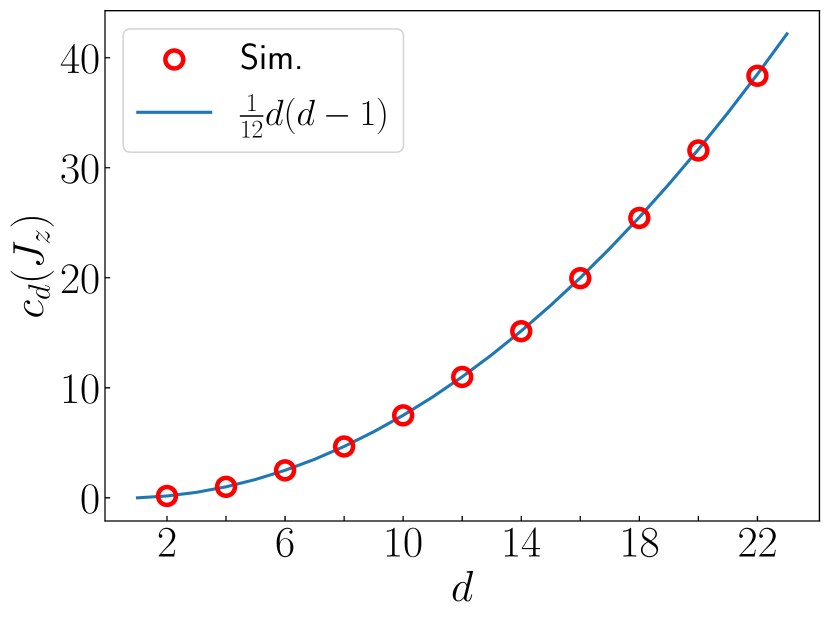
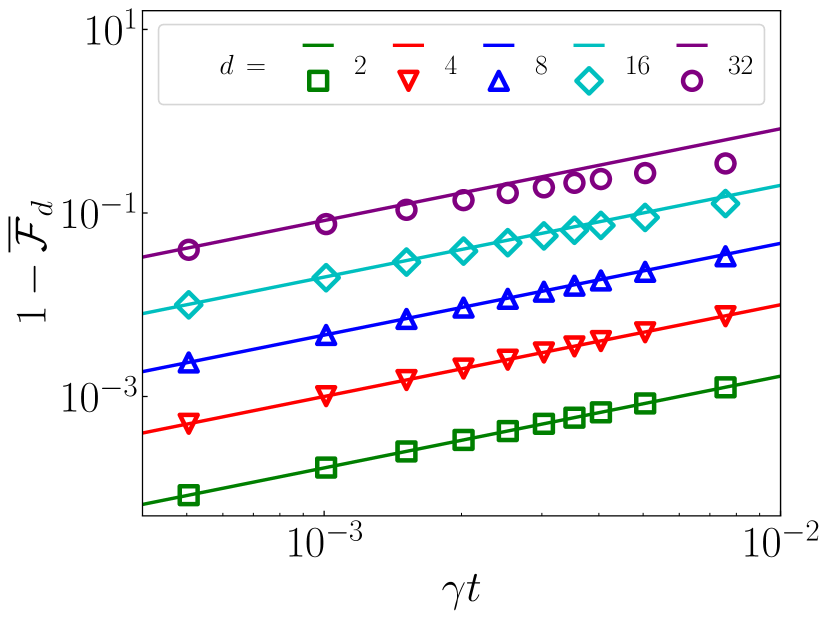
- 수치 시뮬레이션을 통해 $d=4$ 와 $d=8$ 인 경우 $N_g = 4400$ 개의 게이트에 대해 선형 AGI 스케일링의 이탈과 고노이즈 수준에서의 게이트 의존성의 정도를 평가한다.
실험 결과
연구 질문
- RQ1단일 큐디트 시스템이 동등한 다중큐비트 시스템보다 낮은 평균 게이트 불편밀리티를 유지하기 위해 필요한 게이트 효율 조건는 무엇인가?
- RQ2동일한 힐베르트 공간 차원 조건에서 큐디트 시스템의 오차 채널 수가 다중큐비트 시스템 대비 편밀리티 스케일링에 미치는 영향은 어떠한가?
- RQ3약한 노이즈 조건 하에서 큐디트 및 다중큐비트 시스템에 대해 AGI의 선형 반응 근사가 어느 정도 타당한가?
- RQ4큐디트 또는 다중큐비트 시스템이 뛰어난 편밀리티 스케일링을 보이기 위한 게이트 시간 대 디코herence 시간의 비율 임계값은 무엇인가?
- RQ5수치 시뮬레이션은 선형 반응 이론이 증가하는 노이즈 조건 하에서 AGI 성장 예측의 한계를 어떻게 드러내는가?
주요 결과
- 임계 곡선 $ (d^2 - 1)/(3\log_2 d) $ 는 게이트 효율 비율(게이트 시간 / 디코herence 시간)에 대한 임계값을 정의하며, 이 비율에서 큐디트와 다중큐비트 시스템의 AGI 스케일링이 유사해진다.
- $d=4$ 인 경우, 임계 비율은 약 $ (16 - 1)/(3 \cdot 2) = 2.5 $ 로 계산되며, 이는 게이트 시간이 디코herence 시간의 2.5배 이내일 경우 큐디트 시스템이 다중큐비트 시스템을 능가할 수 있음을 시사한다.
- 수치 시뮬레이션 결과, AGI가 고 $\gamma t$ 에서 선형성을 벗어나며, $d$ 가 클수록 더 작은 $\gamma t$ 에서도 뚜렷한 비선형성이 나타난다.
- 단일 큐디트의 AGI는 $ \overline{\mathcal{F}}(\mathcal{E}_z) = \frac{d + d^2 - \frac{\gamma t}{12}d^2(d^2 - 1)}{d(d+1)} + o(\gamma t) $ 로 스케일링되며, 이는 주로 $d$ 의 제곱에 비례하는 주요 노이즈 항을 확인한다.
- $n$ 큐비트의 경우, AGI는 $ \overline{\mathcal{F}}(\mathcal{E}_z) = \frac{2^n + 2^{2n} - \frac{\gamma t}{4}n2^{2n}}{2^n(2^n + 1)} + o(\gamma t) $ 로 스케일링되며, 노이즈 계수에 대해 $n$ 에 대한 선형 의존성이 나타난다.
- 본 연구는 게이트 시간이 디코herence 시간에 비해 충분히 짧을 경우 특정 큐디트 플랫폼이 최신 기술 수준의 큐비트 플랫폼과 경쟁 가능한 게이트 효율성을 달성할 수 있음을 확인한다.
이 논문 읽기
누빈트 뷰어에서 원문을 열고, 읽으면서 궁금한 곳을 바로 물어보세요.
누빈트에서 이 논문 읽기이 리뷰는 AI가 논문 원문을 바탕으로 만들었습니다. 인용하기 전에 원문을 확인해 주세요.